
37 Malcolm RD, Braeside, VIC
Why Professional Landscapers Upgrade Their Trailers
4 April 2026 | roshartrailers
By Roshar Trailers Editorial Team
Updated: 18 August 2026
Professional landscapers often start with a trailer that suits the equipment and workload they have at the time. As the business changes, however, the trailer may need to carry more machinery, accommodate different tools, handle changing loads or support a crew moving between multiple job sites.
That is usually why landscapers upgrade trailers: not simply because a newer trailer is available, but because the existing configuration no longer supports the work efficiently.
An upgrade can involve more usable space, different ramp access, better-positioned storage, a cage, a different axle configuration or a custom layout designed around specific equipment.
Quick answer: Professional landscapers often upgrade trailers when their equipment, load or workflow outgrows the existing setup. Common signals include difficult mower access, insufficient storage, frequent equipment rearrangement, changing load requirements and the need for a configuration better matched to larger machinery or a growing landscaping operation.
Why Landscapers Outgrow Basic Trailers
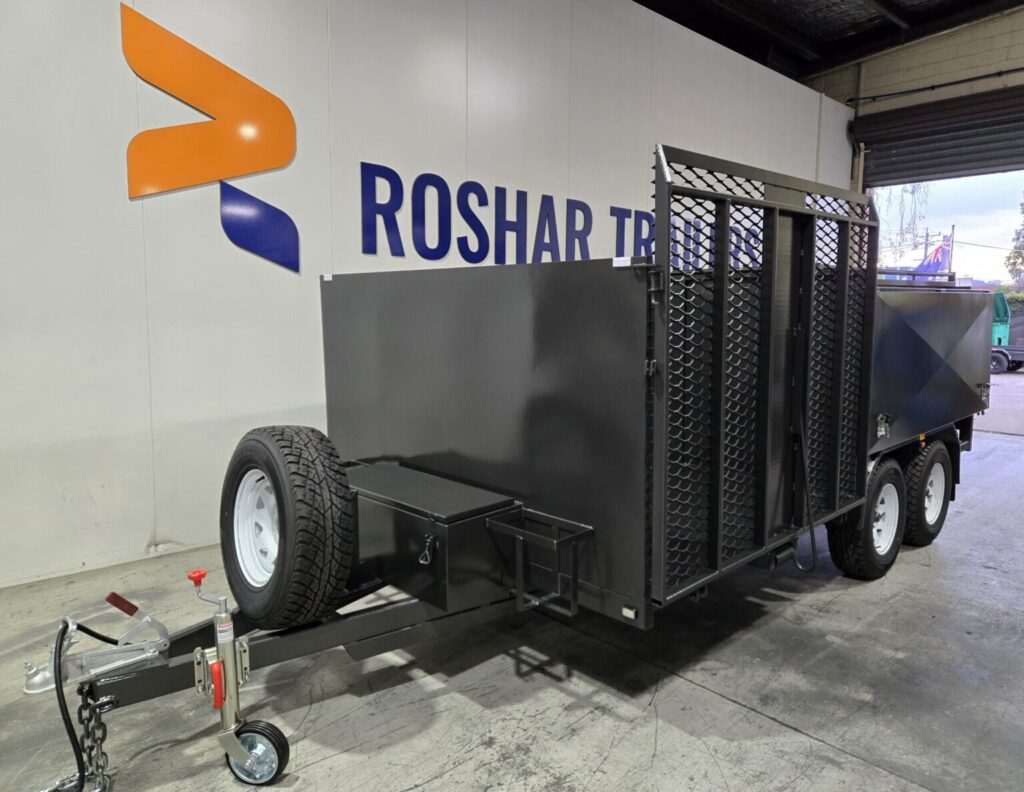
A trailer that worked well when a business started may become less practical as the operation develops.
The change is often gradual.
A landscaper might begin with one mower, a trimmer, a blower and several hand tools. Later, the business may add another mower, hedge-trimming equipment, more battery-powered tools, additional PPE, work supplies or equipment for broader property-maintenance services.
Eventually, the original trailer can become crowded.
Common signs include:
- equipment regularly being moved to reach other tools
- mower access becoming difficult
- tools occupying the loading path
- insufficient dedicated storage
- green waste competing with equipment for space
- larger machinery no longer fitting the layout comfortably
- the crew spending unnecessary time reorganising equipment
- existing ramp or cage arrangements no longer matching the work
These problems do not automatically mean a different trailer is required.
First determine whether the existing layout can be reorganised safely and practically. If the same problems continue, it may be time to compare a configuration better suited to the current workload.
For businesses focused heavily on mowing, our lawn mowing trailers page covers dedicated mower trailer configurations.
More Equipment Means More Storage Needs
Business growth often changes what needs to travel to each job.
A landscaping crew may carry:
- mowers
- line trimmers
- brushcutters
- blowers
- hedge trimmers
- rakes and shovels
- pruning equipment
- batteries and chargers where appropriate
- PPE
- spare parts
- consumables
- other work supplies
Simply placing additional equipment wherever space remains can make a trailer increasingly difficult to use.
Storage Should Solve Access Problems
Useful storage does more than make a trailer look organised. It gives frequently used equipment a predictable location and helps preserve space for larger machinery.
Depending on the workload, storage could include:
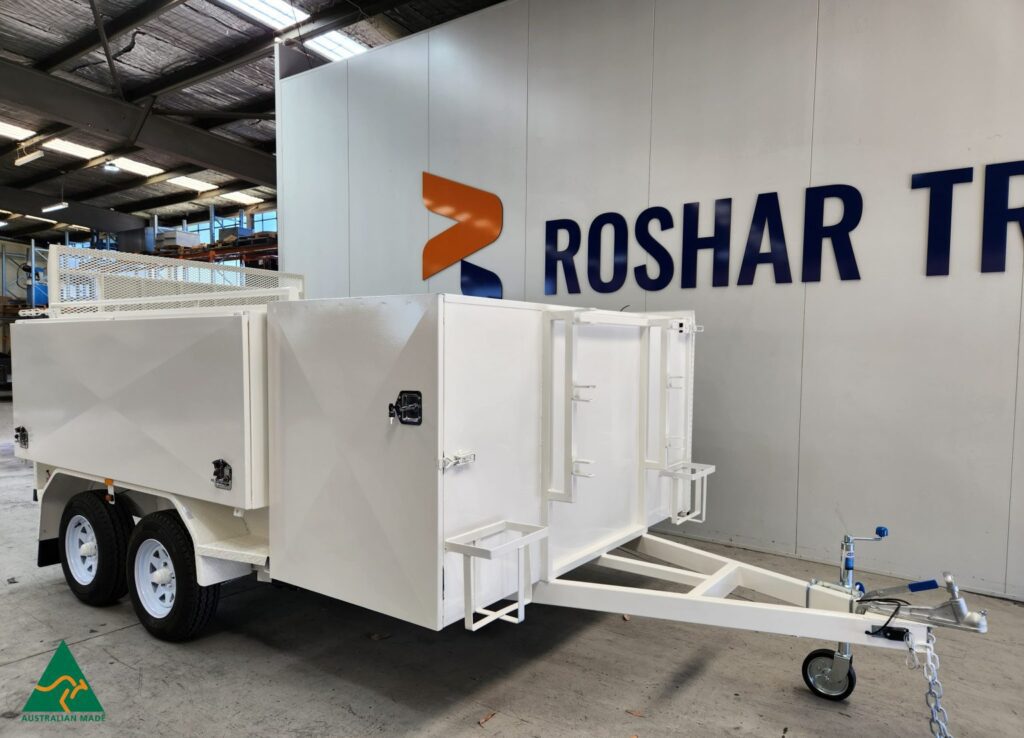
Toolboxes for smaller tools, PPE, straps and work supplies.
Equipment racks for appropriate trimmers or long-handled tools.
Cages for suitable bulky equipment, materials or green waste.
Dedicated machinery positions for equipment that needs to remain accessible throughout the day.
The objective is not to add as many storage accessories as possible.
Storage should solve a defined problem without unnecessarily reducing floor space or blocking the equipment loading route.
Consider How Often Equipment Is Used
Daily-use tools should generally be easier to access than equipment needed only occasionally.
If workers have to unload several items to reach a tool used at every property, the storage arrangement may no longer match the workflow.
That repeated handling can be an upgrade signal.
Ramp Access And Faster Loading
Landscaping businesses may load and unload mowing equipment several times during a working day.
As equipment changes, the existing ramp and loading arrangement may become less practical.
A larger mower, for example, can change the required ramp width, loading clearance, usable floor space and surrounding storage positions.
The important question is not simply whether the trailer has a ramp.
Ask:
Can the equipment move between the ground and its normal transport position without unrelated tools or storage getting in the way?
If workers routinely need to move equipment before the mower can be unloaded, the layout may need attention.
Look At The Complete Loading Route
Ramp access, mower position, storage and restraint points need to work together.
Before upgrading, identify the mower’s full transport dimensions, its normal position on the trailer and anything that repeatedly obstructs the loading route.
This helps determine whether the actual problem is the ramp, the trailer dimensions or the surrounding layout.
For a detailed pre-purchase explanation of ramps, dimensions and loading considerations, see what to look for in a lawn mowing trailer.
Tool Security And Trailer Organisation
Professional landscaping teams benefit from knowing where equipment belongs.
This becomes increasingly important when multiple workers use the same trailer.
A consistent layout can make it easier to notice whether equipment has been returned before leaving a property and can reduce unnecessary searching between tasks.
A practical organisation system might separate:
- large mowing equipment
- daily-use powered tools
- long-handled tools
- PPE
- smaller hand tools
- spare parts
- work supplies
- landscaping materials
- green waste where applicable
The arrangement should reflect the actual sequence of work.
If a trimmer and blower are used at almost every property, for example, they should not routinely be buried behind occasional equipment.
Security And Storage Are Related But Different
Organisation gives equipment a designated place. Security involves considering how tools and machinery are protected and restrained according to the trailer configuration and working environment.
An upgrade may therefore involve lockable or enclosed storage for appropriate equipment, but the exact solution depends on what is carried and how the trailer is used.
Adding more storage does not automatically solve every security or organisation problem.
For detailed storage, equipment-positioning and workflow ideas, see our lawn mowing trailer setup guide.
Better Load Control And Daily Safety
An upgrade should also consider how the complete load is carried.
As a landscaping business adds equipment, the total load can change. So can the way weight is distributed across the trailer.
A trailer that once carried a mower and a few tools may later carry additional machinery, storage systems, materials and other equipment.
Review:
- trailer ratings
- equipment weights
- available payload
- load distribution
- restraint points
- restraint equipment
- ramp and gate security
- towing-vehicle limits
- braking configuration where applicable
Equipment should be appropriately positioned and restrained during transport.
Transport Victoria advises that loads carried on vehicles and trailers need to be properly secured, with restraints suitable for the load and loads positioned so they remain stable. Refer to Transport Victoria’s current guidance on securing loads on vehicles and trailers when reviewing load restraint.
Daily Workflow Can Reveal Problems
Some upgrade signals appear during normal work rather than during a formal trailer inspection.
Examples include:
- straps becoming difficult to connect because equipment blocks restraint points
- workers repeatedly rearranging the load between jobs
- tools being left loose because storage is full
- green waste interfering with machinery
- ramps or gates becoming awkward to access
- the trailer frequently becoming overcrowded
These are operational signals worth investigating.
The solution may be better organisation, different storage or a trailer configuration more appropriate for the workload.
When A Tandem Trailer Makes Sense
As equipment and load requirements change, professional landscapers may consider whether a tandem configuration is appropriate.
A tandem trailer uses two axles rather than one and may be worth comparing for larger or heavier trailer configurations.
However, tandem should not be treated as an automatic upgrade from single axle.
Consider:
- equipment weight
- expected total load
- trailer dimensions
- applicable trailer ratings
- towing-vehicle limits
- braking requirements
- manoeuvrability
- the type of work performed
A compact landscaping operation may not benefit from moving to a larger configuration simply because the business has grown.
Likewise, a crew carrying larger machinery and a broader equipment load may find that its requirements have moved beyond the specifications of the existing setup.
For heavier landscaping applications, compare our tandem trailers.
When A Custom Lawn Mowing Trailer Is Worth Considering
Sometimes the problem is not trailer size.
It is layout.
A standard trailer may have adequate carrying space while still failing to match the equipment or working routine.
A custom configuration may be worth considering when:
- a mower needs a specific loading arrangement
- several machines need dedicated positions
- standard ramps do not suit the equipment
- storage needs to fit around machinery
- long-handled tools require dedicated racks
- cage dimensions need to match a particular workload
- restraint points need to work with specific equipment positions
- tools and green waste need better separation
- the crew repeatedly rearranges a standard layout
The purpose of a custom build should be to solve specific operational requirements.
Before discussing one, document what is wrong with the current trailer.
For example:
“The mower fits, but the toolbox blocks the loading route.”
is more useful than:
“We need a bigger trailer.”
The first statement identifies a layout problem. The second assumes size is the solution.
For specialised layouts, cages, storage and ramp requirements, view our custom trailer options.
Upgrade The Existing Trailer Or Change The Configuration?
Not every business needs to replace its trailer when a problem appears.
Sometimes the existing configuration can continue to work with better organisation or appropriate modifications.
| Problem | Question To Ask |
|---|---|
| Tools are difficult to find | Can storage be reorganised? |
| Mower loading is awkward | Is the ramp or loading route the problem? |
| Equipment blocks restraint points | Can positions be changed? |
| Green waste consumes working space | Would a different containment layout help? |
| Trailer is regularly overloaded | Does the business need a different rated configuration? |
| Larger mower no longer fits properly | Are different dimensions required? |
| Standard layout never matches equipment | Would a custom configuration solve the issue? |
The answer helps distinguish a storage problem from a capacity, loading or trailer-configuration problem.
That distinction can prevent unnecessary changes while making genuine upgrade requirements clearer.
Questions To Ask Before Upgrading
Before changing trailers, document the current workload.
1. What Equipment Do We Carry Regularly?
List everything normally transported, including machinery, tools, PPE and supplies.
Record dimensions and weights where relevant.
2. What Has Changed Since We Chose The Current Trailer?
Perhaps the business has added a larger mower, expanded into landscaping, increased the number of workers or started carrying different materials.
Identify the change that created the problem.
3. Where Do We Lose Time?
Look for repeated handling.
Do workers move tools to reach the mower? Is equipment difficult to locate? Does green waste need to be rearranged between sites?
4. What Does Not Fit Properly?
Identify equipment that lacks adequate space or interferes with another part of the load.
5. Is The Problem Capacity Or Layout?
A bigger trailer is not necessarily the answer to poor organisation.
Likewise, reorganising a trailer will not solve a genuine load-capacity issue.
6. Does The Towing Vehicle Suit The Proposed Change?
A trailer upgrade affects the towing combination.
Check the vehicle manufacturer’s towing limits, towbar specifications and the requirements of the individual trailer.
7. Will The Business’s Equipment Change Again?
Avoid designing around vague future expansion, but account for equipment changes that are genuinely planned.
A mower already scheduled for replacement, for example, is relevant to the decision.
A Practical Upgrade Review
Before speaking with a trailer manufacturer, create a simple record of the current setup.
Include:
- mower make and model
- mower dimensions
- equipment weights where available
- trailer details
- current storage arrangement
- tools carried daily
- materials or waste regularly transported
- towing vehicle
- specific loading problems
- specific storage problems
- likely equipment changes
Photos of the current loaded trailer can also help illustrate where space and access problems occur.
This turns the upgrade conversation from a general request into a clearer set of operational requirements.
A manufacturer can then discuss whether those requirements point toward a different standard configuration, tandem setup or custom layout.
Frequently Asked Questions
Why do professional landscapers upgrade their trailers?
Professional landscapers may upgrade when their existing trailer no longer suits the equipment, load or workflow. Common reasons include additional machinery, insufficient storage, difficult mower access, changing load requirements and the need for a more specialised layout.
How do I know if my landscaping trailer is too small?
Signs can include equipment regularly blocking access, insufficient room for necessary tools, difficulty maintaining practical loading routes or the intended load no longer fitting within the trailer’s applicable specifications. Check both usable space and load ratings.
Can better storage avoid the need for a larger trailer?
Sometimes. Toolboxes, racks and better equipment positioning can improve usable space when organisation is the main problem. If the issue is actual load capacity or machinery dimensions, storage changes alone may not solve it.
Why does ramp access matter for professional landscapers?
Landscapers may load and unload mowing equipment several times a day. A ramp and loading route that suit the equipment can reduce unnecessary rearrangement and make repeated site access more practical.
When should a landscaper consider a tandem trailer?
A tandem configuration may be worth comparing when larger equipment, a heavier overall load or different trailer dimensions change the business’s requirements. Suitability should be based on the individual trailer, load and towing combination rather than axle count alone.
Is a custom trailer worth considering for a landscaping business?
A custom trailer may be useful when standard ramps, storage, cages or equipment positions repeatedly fail to match the business’s machinery and workflow. Customisation is most valuable when it addresses clearly identified operational requirements.
Should I upgrade my trailer when buying a larger mower?
Not automatically. Compare the new mower’s full transport dimensions and weight with the existing trailer’s usable space, ratings, ramp access and restraint arrangement. An upgrade is relevant if the current trailer no longer suits those requirements.
What information should I give a trailer manufacturer before upgrading?
Provide details about the mower and other machinery, dimensions, equipment weights where available, the tools and materials normally carried, towing vehicle information and the specific problems with the current setup.
Upgrade Around The Work, Not The Trend
Understanding why landscapers upgrade trailers comes down to one principle: the trailer should continue to support the equipment and workflow of the business.
More equipment can create storage pressure. A larger mower can change ramp requirements. Mixed landscaping work can create new containment needs. A growing crew can make consistent organisation more important.
None of these automatically means the business needs the biggest or most complex trailer available.
Start by identifying the specific problem. Determine whether it relates to storage, loading access, load capacity, equipment dimensions or workflow. Then compare the configuration that addresses that requirement.
For dedicated mower trailer options, visit our lawn mowing trailers page.
For heavier landscaping work, compare our tandem trailers. For specialised storage, ramp, cage or equipment requirements, view our custom trailer options.