
37 Malcolm RD, Braeside, VIC
Lawn Mowing Trailer Setup: Essential Gear and Tips
14 July 2025 | roshartrailers
By Roshar Trailers Editorial Team
Updated: 18 August 2026
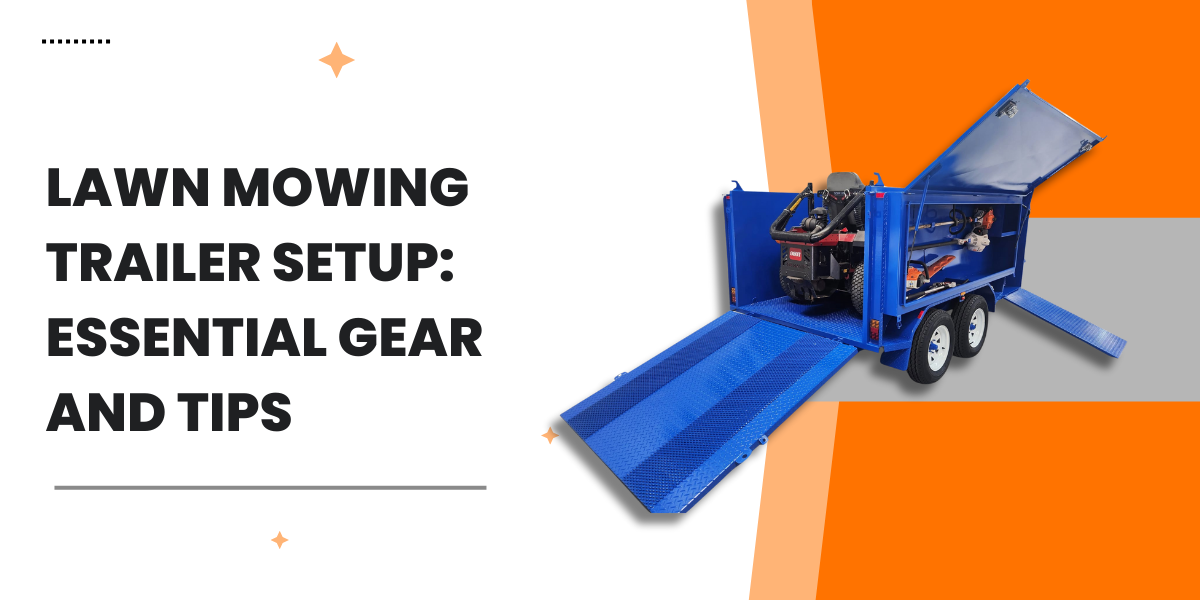
A practical lawn mowing trailer setup should make it easier to carry, access, secure and organise the equipment used throughout a working day. The mower normally takes up the most floor space, but a complete setup may also need room for trimmers, blowers, hand tools, PPE, work supplies, fuel and garden waste.
The goal is not to fit as much equipment as possible onto the trailer. A useful setup gives commonly used equipment a logical place, keeps the mower loading path clear and allows machinery and tools to be appropriately restrained during transport.
Quick answer: Start a lawn mowing trailer setup with the mower and loading route. Then plan storage for trimmers, blowers, hand tools, PPE and supplies. Add suitable tie-down points, organise tools by how often they are used, account for fuel and green waste, and keep frequently used equipment accessible between jobs.
Planning Your Lawn Mowing Trailer Setup
The best place to start is with an inventory of the equipment you actually use.
Avoid designing the trailer around storage accessories first and then trying to fit the equipment around them.
List everything normally transported during a working day, including:
- lawn mower or ride-on mower
- line trimmers and brushcutters
- leaf blowers
- hedge-trimming equipment
- rakes and shovels
- smaller hand tools
- personal protective equipment (PPE)
- batteries or other power supplies
- compliant fuel containers where applicable
- spare parts and consumables
- load-restraint equipment
- first-aid or other workplace safety equipment
- green waste where applicable
Then separate those items into three groups:
Large equipment that requires floor space.
Frequently used equipment that should remain easy to access.
Smaller or occasional items that may be suitable for dedicated storage.
This process helps establish the trailer layout before racks, cages or toolboxes are positioned.
Start With The Largest Equipment
The mower will often determine the basic layout.
Measure its full transport dimensions rather than looking only at cutting-deck width. Handles, discharge components and other parts may affect the space required.
If more than one mower is transported, position both on paper before deciding where smaller equipment will go.
Also consider how the equipment enters and leaves the trailer.
The floor space may technically be large enough for the mower while still creating an inconvenient loading route once toolboxes, cages or other equipment are added.
For trailer configurations designed around lawn care equipment, visit our lawn mowing trailers page.
Mower Storage And Ramp Access
Mower position and ramp access should be planned together.
A practical setup should provide a clear path between the ramp and the mower’s normal transport position.
If a trimmer rack, toolbox or loose equipment regularly blocks that path, the trailer may need to be rearranged every time the mower is loaded.
That can make an otherwise organised setup inefficient.
Check Ramp Width And Loading Clearance
Consider:
- mower width
- usable ramp width
- ramp length
- loading angle
- mower ground clearance
- position of gates or cages
- equipment beside the loading route
- how the ramp is secured for travel
The ramp needs to suit the actual machine being loaded.
A mower with low ground clearance may respond differently to a steep loading angle than equipment with greater clearance.
Instead of asking only whether the trailer has a ramp, ask:
Can the mower move from the ground to its transport position without other equipment getting in the way?
That question is much more useful when planning a repeat-use trailer.
Give The Mower A Consistent Position
Where practical, keep the mower in the same transport position from job to job.
A consistent position can make it easier to establish restraint points and avoid repeatedly rearranging the trailer.
It also helps preserve designated spaces for smaller tools.
The appropriate position depends on the complete trailer and load. Do not position heavy equipment solely according to convenience without considering the trailer manufacturer’s load specifications and load-distribution requirements.
Toolboxes And Secure Storage
Once the mower position is established, plan storage for smaller equipment.
Toolboxes, cages, racks and dedicated holders can help prevent frequently used tools from becoming mixed together on the trailer floor.
Storage can be divided according to equipment type.
Toolboxes
A toolbox can provide a designated location for smaller tools, spare parts, straps, PPE or work supplies.
Tool Racks
Suitable racks can provide dedicated positions for appropriate long-handled equipment such as rakes and selected garden tools.
Dedicated Trimmer Storage
Dedicated storage can keep line trimmers or similar equipment separate from the mower loading area.
Cage Sections
Cage sections can provide containment for appropriate equipment or materials depending on the trailer configuration.
The purpose of storage is not simply to create more compartments.
A useful storage feature should make equipment easier to locate without interfering with access to larger machinery.
Keep Frequently Used Gear Accessible
Think about the order in which tools are normally used.
If the trimmer comes off the trailer at nearly every property, placing it behind equipment used only occasionally creates unnecessary handling.
A simple priority system can help:
- Daily-use equipment – easiest access.
- Regular but secondary tools – dedicated nearby storage.
- Spare parts and occasional equipment – less prominent storage.
- Waste and dirty materials – separate where practical.
The arrangement can then reflect the actual sequence of a lawn care job.
Tie-Down Points And Load Control
An organised trailer still needs an appropriate restraint system.
Mowers, powered equipment and other loads should not be allowed to move freely during transport.
Tie-down points should therefore be considered when the layout is being designed rather than added as an afterthought.
Ask:
- Where will the mower sit?
- Where can suitable restraints connect?
- Will toolboxes block access to restraint points?
- Can straps or other restraints be used without awkward routing?
- How will smaller equipment be prevented from moving?
- Are racks and storage systems suitable for the loads they carry?
Having several anchor points does not automatically mean a load is correctly restrained.
The restraint equipment, anchor points, load position and restraint method need to work together.
Transport Victoria advises road users to select restraints appropriate for the load and to make sure loads are secure and stable before travelling.
For current requirements and practical information, refer to Transport Victoria’s guidance on securing loads on vehicles and trailers.
Avoid Loose Equipment On The Floor
Small loose items can undermine an otherwise organised setup.
Straps, spare line, hand tools, bottles and parts should have designated locations rather than being left around the mower.
This improves organisation and reduces the number of items that need to be moved before loading or unloading machinery.
Fuel, Safety And Daily Use Considerations
Lawn care work may involve fuel, batteries, chemicals, sharp tools and powered equipment.
These should be treated as separate setup considerations rather than simply placed wherever space remains.
Plan Fuel Storage Carefully
If petrol or other dangerous goods are transported for work, use appropriate compliant containers and follow applicable requirements.
Fuel should not be treated like ordinary tool storage.
WorkSafe Victoria provides guidance covering dangerous goods transported as tools of trade, including requirements relating to packaging, marking, securing loads and separation from ignition sources or incompatible dangerous goods.
For current Victorian information, see WorkSafe Victoria’s guidance on transporting dangerous goods as tools of trade.
For a lawn mowing trailer setup, practical considerations include:
- use appropriate compliant containers
- follow container and equipment instructions
- prevent containers from moving during transport
- keep them away from inappropriate ignition or heat sources
- check current dangerous-goods requirements applicable to the materials and quantities carried
Do not rely on a homemade holder or generic storage suggestion without considering the actual container and applicable requirements.
Include Safety Equipment Based On The Work
Safety equipment should be selected according to the hazards involved in the work rather than assuming every lawn care trailer requires an identical checklist.
Depending on the tasks performed, a lawn care team may need items such as:
- hearing protection
- eye protection
- gloves
- protective footwear
- sun protection
- first-aid supplies
- other task-specific PPE or controls
PPE should form part of a broader approach to controlling workplace risks rather than being treated as the only safety measure.
Keep frequently required safety equipment somewhere workers can reach without unloading machinery.
Organising Tools For Faster Jobs
A good lawn mowing trailer setup follows the workflow of the operator.
Consider a typical job:
Arrive → unload mower → trim or edge → mow → blow down → pack equipment → secure load → leave.
The trailer can be organised around that sequence.
Equipment used at almost every property should generally be accessible without removing unrelated tools.
This might mean:
- mower near the main loading route
- trimmer in a dedicated rack
- blower in a consistent accessible location
- hand tools grouped together
- PPE near the access point
- spare parts and consumables inside storage
- green waste area separated from clean equipment where appropriate
This is more useful than arranging equipment purely according to appearance.
Use Consistent Tool Locations
Consistency can be particularly valuable when several workers use the same trailer.
If the blower, straps, PPE and hand tools always return to the same locations, each team member knows where to find them.
It also makes end-of-job checks easier.
A tool missing from its normal position can be noticed before the team leaves the property.
Keep The Floor As Clear As Practical
The trailer floor normally needs to accommodate the largest equipment.
Where suitable, racks, cages and toolboxes can move smaller items away from the mower’s loading area.
However, avoid adding storage simply because unused wall or cage space exists.
Storage should be positioned so it does not create new loading problems or interfere with restraints.
Setup Ideas For Lawn Care Businesses
There is no single lawn mowing trailer setup that suits every operator.
The appropriate arrangement depends on the equipment and services involved.
Compact Lawn Care Setup
A smaller operator using one mower may prioritise:
- clear mower floor space
- one trimmer storage position
- blower storage
- toolbox for smaller items
- PPE area
- practical restraint points
The benefit of this arrangement is simplicity.
There is little reason to fill the trailer with storage features that are not required.
Multi-Equipment Setup
A business carrying several powered tools may need more defined storage.
A practical arrangement could include:
- dedicated mower area
- separate trimmer or brushcutter rack
- blower position
- toolbox storage
- long-handled tool rack
- PPE area
- work-supply storage
- clearly accessible restraint points
The main challenge is preventing smaller equipment from gradually taking over the mower loading path.
Lawn And Garden Maintenance Setup
Businesses that also perform garden clean-ups may need to account for green waste.
In this case, consider whether equipment and waste need distinct areas.
Loose garden material should not be allowed to interfere with mower access, equipment restraint or other loads.
The amount and type of waste should also be considered when evaluating the complete load and available trailer capacity.
Daily Trailer Setup Checklist
A well-planned setup still needs to be maintained during normal use.
Before leaving for the first job, check that:
- the mower and other equipment are appropriately positioned
- loads are restrained for transport
- ramps and gates are secured
- loose tools have been returned to storage
- fuel or other regulated materials are appropriately stored
- required PPE and work supplies are present
- tyres and other relevant trailer components show no obvious problems
- lights and required connections are functioning
- the load remains within applicable trailer and towing limits
After each job, return equipment to its normal location rather than allowing the trailer to become progressively more disorganised.
A short reset between properties can help preserve the layout throughout the day.
Review The Setup As Equipment Changes
A trailer layout should not be treated as permanent if the business changes.
Review it when:
- a larger mower is introduced
- additional tools are purchased
- more workers begin using the trailer
- green-waste requirements change
- existing storage becomes difficult to access
- restraint points no longer suit the load
- equipment regularly needs to be rearranged
A setup that worked well for one mower and a few tools may no longer suit a broader lawn care operation.
Common Lawn Mowing Trailer Setup Mistakes
Some layout problems can be avoided during the planning stage.
Designing Around Accessories Instead Of Equipment
Buying racks and boxes before measuring equipment can leave too little usable space for the mower.
Plan the machinery first.
Blocking The Loading Route
A useful toolbox becomes a problem if it prevents the mower from reaching the ramp.
Check access with the full working load in mind.
Leaving Tools Loose
Unsecured tools and supplies can move around and make the trailer difficult to organise.
Give frequently transported items appropriate storage or restraint.
Using Every Available Space
Not every gap needs to contain equipment.
Leaving clear working and loading space can be more valuable than adding another storage compartment.
Ignoring Future Changes Completely
You do not need to overbuild a setup for hypothetical equipment, but consider changes that are genuinely likely.
A planned mower upgrade may affect ramp width, floor space and storage positions.
When A Custom Trailer Setup Makes Sense
A standard setup may work well when the equipment fits comfortably and the available ramp, storage and restraint arrangement supports the working routine.
A custom configuration becomes relevant when recurring layout problems cannot be solved easily.
Examples include:
- a specific mower requires different ramp access
- multiple machines need dedicated positions
- toolboxes need to fit around particular equipment
- cage dimensions need to suit the work
- specialised racks are required
- standard restraint locations do not suit the planned layout
- garden waste and equipment require separate areas
The purpose of customisation should be to solve a defined operational problem.
Start with the equipment list, mower dimensions, loading sequence and storage requirements. Those details provide a better foundation for a custom trailer than simply asking for more compartments.
For custom storage, cages and ramp layouts, view our custom trailer options.
Frequently Asked Questions
What should a lawn mowing trailer setup include?
A practical setup may include mower space, ramp access, storage for powered and hand tools, suitable load-restraint points, PPE storage, work supplies and space for other equipment or green waste where required. The exact arrangement depends on the work being performed.
Where should the mower go on a lawn mowing trailer?
The mower should have a consistent position that provides practical ramp access and allows it to be appropriately restrained. Its position should also suit the trailer’s load requirements and leave enough space for other necessary equipment.
How should I organise tools on a mower trailer?
Organise tools according to how frequently they are used. Keep daily-use equipment readily accessible, give smaller tools dedicated storage and avoid placing equipment where it blocks the mower loading path.
Are toolboxes useful on a lawn mowing trailer?
Toolboxes can be useful for smaller tools, PPE, straps, spare parts and work supplies. They are most effective when positioned where they do not unnecessarily reduce mower access or interfere with restraint points.
What is the best way to store trimmers on a mower trailer?
Use storage or racks designed to suit the equipment being transported and position commonly used trimmers where they can be reached without unloading unrelated equipment. The equipment should also be appropriately secured for transport.
Why are tie-down points important in a lawn mowing trailer setup?
Suitable tie-down points form part of the system used to restrain equipment during transport. Their position should suit the equipment and the restraints being used rather than simply being placed wherever space is available.
How should fuel be stored on a lawn mowing trailer?
Fuel should be transported in compliant containers and in accordance with relevant dangerous-goods requirements, manufacturer instructions and workplace procedures. Containers should be appropriately secured and kept away from unsuitable heat or ignition sources.
Should garden waste have a separate trailer area?
A separate or clearly defined area can be useful when green waste is regularly transported. The arrangement should prevent waste from interfering with equipment access, load restraint and the trailer’s allowable carrying capacity.
How can I make my lawn mowing trailer more organised?
Begin by removing equipment that is not regularly needed. Assign fixed locations to frequently used tools, keep the mower loading route clear, use suitable storage for smaller items and return equipment to its normal position after each job.
When should I consider a custom lawn mowing trailer setup?
A custom setup may make sense when standard ramp, cage, toolbox, storage or equipment positions do not match the machinery and workflow of the business. Customisation should address a specific loading, storage or operational requirement.
Build The Setup Around The Work
A good lawn mowing trailer setup starts with the equipment and workflow rather than the accessories.
Give the mower a practical loading route and consistent transport position. Organise frequently used tools where they can be accessed easily. Use storage for smaller equipment, plan suitable restraint points, account for fuel and safety equipment, and keep the floor as clear as the work allows.
Then review the setup as equipment and services change.
The result should be a trailer that supports the way the business actually works from one property to the next.
For trailer options designed for lawn care work, visit our lawn mowing trailers page.
For custom storage, cages and ramp layouts, view our custom trailer options.