
37 Malcolm RD, Braeside, VIC
Complete Guide to Flat Top Trailers
21 March 2026 | roshartrailers
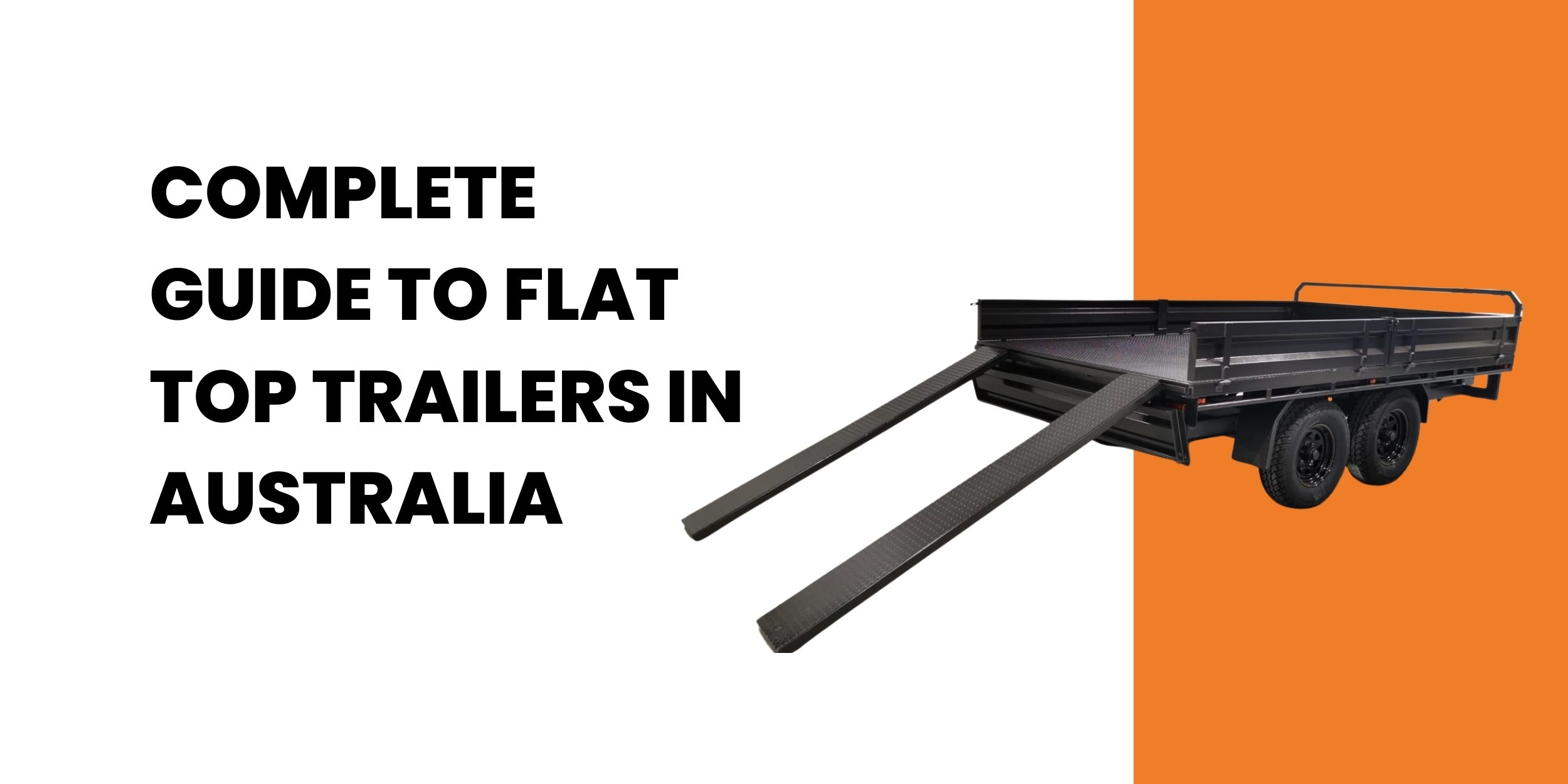
Flat top trailers are open-deck trailers used for carrying machinery, pallets, construction materials, landscaping supplies, farm equipment and oversized loads. Their flat loading surface makes them practical for Australian tradies, builders, landscapers, contractors and businesses that need easy access from the sides, rear or above.
Unlike enclosed trailers, a flat top trailer gives you a clear deck for loads that are bulky, irregular, palletised or difficult to fit inside a standard trailer. This guide explains the main flat top trailer sizes, common uses, load capacity terms, axle setups, safety considerations and custom options to compare before choosing one.
For available models, sizes and build options, explore Roshar flat top trailer
Reviewed by: Roshar Trailers Team
Roshar Trailers manufactures Australian-made trailers in Melbourne for trade, machinery, landscaping, construction and commercial transport applications.
Last updated: June 2026
What Is A Flat Top Trailer?
A flat top trailer is a trailer with an open, flat deck designed to carry large, heavy, long or irregular loads. It is commonly used when the load needs more access than a box trailer, cage trailer or enclosed trailer can provide.
Flat top trailers are useful because they allow loading by:
- Hand, for trade tools and smaller materials
- Forklift, for pallets and packaged goods
- Ramps, for machinery and equipment
- Crane or lifting equipment, for oversized or awkward loads
In Australia, low ATM trailers are expected to comply with applicable Australian Design Rules, and Vehicle Standards Bulletin 1 helps manufacturers understand the ADR requirements for common trailer types up to 4.5 tonnes ATM.
Quick facts about flat top trailers
| Feature | Details |
| Best for | Machinery, pallets, construction materials, landscaping supplies |
| Common sizes | 8×5, 10×6, 12×6, 14×6 and larger custom sizes |
| Axle setup | Single axle, tandem axle or heavier custom configurations |
| Loading access | Side, rear and overhead access |
| Typical users | Tradies, builders, landscapers, farmers, contractors and transport businesses |
| Key considerations | Deck size, ATM, GTM, payload, brakes, tie-down points and towing vehicle capacity |
Flat top trailers are popular because they solve a practical transport problem: they make it easier to move items that are too bulky, wide or awkward for standard enclosed trailer layouts.
For more context on worksite use, learn more about why flat top trailers are ideal for heavy-duty transport across Victoria.
Flat Top Trailer Vs Flatbed Trailer
The terms flat top trailer and flatbed trailer are often used in similar ways. Both usually refer to an open-deck trailer with a flat loading surface. The difference is mostly in wording, regional use and trailer design details.
In Australia, flat top trailer is commonly used for trade, construction and general-purpose transport trailers. Flatbed trailer may be used more broadly for open-deck transport trailers, including larger commercial or vehicle transport layouts.
| Feature | Flat top trailer | Flatbed trailer |
| Deck style | Open, flat deck | Open, flat deck |
| Common Australian use | Trade, machinery, pallets, materials | General open-deck transport |
| Loading access | Side, rear and overhead | Side, rear and overhead |
| Typical users | Tradies, builders, landscapers, contractors | Trades, transport operators, equipment movers |
| Best for | Flexible worksite loads | Bulky, palletised or machinery loads |
Flat top trailer vs cage trailer
A cage trailer has sides that help contain loose or lightweight materials. A flat top trailer is better when the load is large, long, palletised, machinery-based or needs side loading.
| Situation | Better trailer type | Why |
| Loose green waste or light rubbish | Cage trailer | Sides help contain loose materials |
| Pallets or packaged materials | Flat top trailer | Easier forklift access |
| Machinery and equipment | Flat top trailer | Easier ramp loading and tie-down access |
| Oversized trade materials | Flat top trailer | Fewer side restrictions |
| Small loose domestic loads | Cage or box trailer | Better containment |
Common Flat Top Trailer Sizes
Flat top trailer size should be chosen around the loads you carry most often. A trailer that is too small can make loading unsafe or inefficient, while a trailer that is too large may be harder to tow, park and manoeuvre.
Common Australian flat top trailer sizes include 8×5, 10×6, 12×6, 14×6 and larger custom builds. The right size depends on load length, deck width, tie-down access, axle setup and towing vehicle capacity.
| Size | Best suited to | Common load examples |
| 8×5 | Light trade and general use | Tools, small equipment, landscaping supplies |
| 10×6 | Medium trade use | Pallets, materials, compact machinery |
| 12×6 | Heavy trade and worksite use | Machinery, timber, steel, bulk materials |
| 14×6 | Larger commercial or construction loads | Long materials, larger equipment, mixed loads |
| Custom size | Repeated or specialised transport | Machinery-specific layouts, pallet loading, trade builds |
When comparing sizes, check the usable deck space, not just the advertised trailer size. Drawbars, headboards, ramps, toolboxes, wheel guards and tie-down positions can all affect how the trailer works in daily use.
For a deeper size breakdown, see Roshar’s guide to understand flat top trailer dimensions before you buy.
What Can You Carry On A Flat Top Trailer?
A flat top trailer can carry many types of bulky, heavy or irregular loads, provided the trailer rating, deck size, restraint points and towing setup are suitable.
| Load type | Examples | Why a flat top trailer helps |
| Machinery | Mini loaders, compact equipment, compressors, generators | Easier ramp loading and tie-down access |
| Construction materials | Timber, steel, mesh, frames, pipes | Open deck suits long or awkward materials |
| Pallets | Bricks, pavers, tiles, packaged goods | Side access can support forklift loading |
| Landscaping supplies | Turf, plants, sleepers, bagged soil, mowers | Mixed materials can be arranged across the deck |
| Trade equipment | Ladders, site boxes, toolboxes, work platforms | Flexible layout for changing jobsite needs |
| Agricultural supplies | Fencing, tanks, feed, small machinery | Open-deck design suits rural and worksite use |
| Vehicle-related transport | Cars or equipment on specialised trailers | Requires the correct trailer type, ramps and ratings |
A flat top trailer is not always the correct choice for every load. Loose soil, mulch, gravel or green waste may be easier to handle in a box, cage or tipper trailer.
For vehicle transport, you can also explore Roshar’s flatbed car trailer options for vehicle transport.
Load Capacity, ATM, GTM And GVM Explained
Load capacity is one of the most important parts of choosing and using a flat top trailer. A trailer may physically fit a load, but that does not automatically mean it is rated to carry it.
Australian trailer weight terms can be confusing, so it helps to separate them clearly.
| Term | Meaning | Why it matters |
| Tare mass | The trailer’s weight when empty | Used to calculate payload |
| Payload | The load the trailer can carry | Helps prevent overloading |
| ATM | Aggregate Trailer Mass: total trailer mass when carrying the maximum recommended load | Includes the mass on the tyres and tow coupling |
| GTM | Gross Trailer Mass: loaded trailer mass carried through the trailer tyres when coupled | Important for braking and axle loading |
| GVM | Gross Vehicle Mass: maximum loaded mass of the towing vehicle | Helps confirm the towing vehicle is not overloaded |
| Towing capacity | Maximum trailer weight the vehicle is rated to tow | Must suit the loaded trailer |
VSB1 explains that GTM is the mass transmitted to the ground by the trailer tyres when coupled to the towing vehicle, while ATM is the total trailer mass when carrying the maximum load recommended by the manufacturer. It also explains that ATM minus tare mass equals the maximum load the trailer can carry.
Why ATM and GTM matter
ATM and GTM are manufacturer-specified ratings. They are based on factors such as chassis strength, axle ratings, tyre ratings and towing stability, not just deck size.
Before carrying heavy loads, check:
- Trailer tare mass
- Trailer ATM
- Trailer GTM
- Payload allowance
- Axle and tyre ratings
- Tow vehicle braked towing capacity
- Towbar rating
- Tow ball download
- Brake requirements
If you are planning to carry heavy equipment, you should also check Roshar’s flat top trailer buying guide for heavy loads and ADR compliance.
Braking rules to understand
Braking requirements are specified in terms of GTM, not ATM. VSB1 states that brakes are not required on trailers that do not exceed 750kg GTM. Trailers exceeding 750kg GTM must have an efficient service braking system, over-run brakes may be used up to 2,000kg GTM, and trailers over 2,000kg GTM must have brakes operating on all wheels plus an emergency breakaway braking system. (Infrastructure Department
That means the safest approach is to confirm the trailer’s ratings, braking setup and towing vehicle limits before carrying heavy machinery, pallets or commercial loads.
Single Axle Vs Tandem Flat Top Trailers
Flat top trailers can be built with different axle setups. The right choice depends on load weight, towing frequency, worksite conditions and stability needs.
| Feature | Single axle flat top trailer | Tandem flat top trailer |
| Best for | Lighter loads and occasional use | Heavier loads and regular trade use |
| Manoeuvrability | Easier to move and turn | More stable but heavier |
| Load support | Lower load distribution | Better weight distribution |
| Towing feel | Simpler for light work | More stable for heavier loads |
| Maintenance | Fewer tyres and components | More tyres, brakes and components |
| Typical use | Small tools, light materials, general loads | Machinery, pallets, construction materials |
A single axle flat top trailer may be enough for lighter work, smaller tools or occasional transport. A tandem axle trailer is often better when carrying heavier materials, machinery or commercial loads more frequently.
For heavy-duty use across Melbourne and Victoria, many tradies and contractors prefer tandem axle setups because the load is spread across more wheels and the trailer generally feels more stable when loaded correctly.
Safety And Load Restraint Tips
Because a flat top trailer has an open deck, load restraint is critical. Every load must be positioned, balanced and secured before towing.
Transport Victoria recommends choosing suitable restraint equipment such as webbing straps, chains, ropes, cargo nets or tarpaulins. It also advises using rated equipment where possible, notes that chains are best suited to heavy loads, and states that tarpaulins, cargo nets and ropes are only suited to light loads.
Flat top trailer safety checklist
Before towing, check that:
- The load does not exceed the trailer’s rated capacity
- The towing vehicle can safely tow the loaded trailer
- Heavy items are placed low and evenly
- Weight is balanced from side to side
- Rated tie-downs are used where possible
- Machinery is restrained at multiple points
- Pallets cannot slide on the deck
- Long materials are bundled where practical
- Straps and chains are not worn, cut or damaged
- Nothing can bounce, shift, fall or protrude dangerously
- Lights, tyres, brakes and coupling are checked before travel
- The trailer plate, ATM, GTM and tyre ratings are understood
Common load restraint mistakes
| Mistake | Why it is a problem |
| Using unrated straps for heavy loads | Restraints may not be strong enough |
| Securing only one side of the load | Load can shift during braking or cornering |
| Ignoring tow ball weight | Can affect towing stability |
| Carrying loose items on an open deck | Items may fall from the trailer |
| Using damaged straps or chains | Restraint strength may be reduced |
| Loading too much weight at the rear | Can increase sway and instability |
A flat top trailer gives flexibility, but that flexibility only works when the load is matched to the trailer rating and restrained correctly.
Custom Options To Consider
A standard flat top trailer may suit general work, but custom options can make the trailer safer, easier to use and better matched to regular loads.
| Custom option | Best suited to |
| Removable ramps | Machinery, mowers, compact equipment |
| Slide-under ramps | Saving deck space when ramps are not in use |
| Headboard | Timber, steel, pipe and forward load protection |
| Drop sides | Loads that sometimes need containment |
| Toolboxes | Straps, chains, tools and trade equipment |
| Spare wheel bracket | Longer trips and worksite reliability |
| Winch points | Machinery or equipment loading assistance |
| Extra tie-down points | Repeated machinery, pallets or commercial loads |
| Checker plate or heavy-duty floor | Grip and worksite durability |
| Custom deck size | Repeated or specialised load dimensions |
Custom options should be chosen around the work the trailer does most often. For example, a landscaper may need ramps, toolboxes and a flexible deck layout. A builder may need extra length for timber or steel. A machinery operator may need specific tie-down locations, stronger ramps and a suitable braking setup.
Before choosing a builder or supplier, it is worth checking experience, build quality, warranty support, trailer compliance and whether the trailer can be configured around your actual load requirements. Roshar also has a separate guide on how to choose the right flat top trailer dealer near you.
Final Thoughts
A flat top trailer is one of the most flexible trailer types for Australian worksites because it provides an open deck for machinery, pallets, construction materials, landscaping supplies and bulky trade loads.
The best trailer is not simply the biggest one. It is the one that matches your regular load, towing vehicle, loading method, restraint requirements and worksite conditions.
After comparing sizes, load ratings, axle setups, braking rules, safety needs and custom options, you can review Roshar’s flat top trailer options to compare available configurations.
FAQs
What is a flat top trailer used for?
A flat top trailer is used for carrying machinery, pallets, building materials, landscaping supplies, trade equipment, farming supplies and oversized loads that need open-deck access.
What size flat top trailer is best for heavy loads?
For heavier trade, machinery or construction loads, many users compare 10×6, 12×6, 14×6 or custom sizes. The right size depends on the load dimensions, trailer rating, axle setup, brakes and towing vehicle capacity.
Is a flat top trailer the same as a flatbed trailer?
The terms are often used in similar ways. In Australia, flat top trailer is commonly used for open-deck trade and worksite trailers, while flatbed trailer can be a broader term for open-deck transport trailers.
Do flat top trailers need brakes?
Brakes are not required on trailers that do not exceed 750kg GTM. Trailers over 750kg GTM require an efficient service braking system, and trailers over 2,000kg GTM require brakes on all wheels plus a breakaway braking system.
What is the difference between ATM and GTM?
ATM is the total loaded trailer mass, including weight imposed on the tow vehicle. GTM is the loaded trailer mass carried through the trailer tyres when the trailer is coupled to the tow vehicle.
Can a flat top trailer carry machinery?
Yes, a flat top trailer can carry machinery when the deck size, ATM, GTM, payload, ramps, tyres, brakes and tie-down points are suitable for the machine being transported.
Is a single axle or tandem axle flat top trailer better?
A single axle trailer may suit lighter loads and easier manoeuvring. A tandem axle trailer is usually better for heavier, regular or commercial loads because the weight is spread across more wheels.
What should I check before towing a loaded flat top trailer?
Check the trailer rating, payload, tyre condition, brake setup, coupling, lights, tow vehicle capacity, towbar rating, load balance and restraint equipment before towing.
Are flat top trailers suitable for tradies?
Yes. Flat top trailers are commonly used by tradies because they can carry changing loads such as tools, ladders, timber, steel, machinery, pallets and site equipment.
When should I consider a custom flat top trailer?
Consider a custom flat top trailer when your load is repeated, heavy, awkward, difficult to secure or requires specific ramps, deck dimensions, tie-down points, headboards, storage or braking requirements.