
37 Malcolm RD, Braeside, VIC
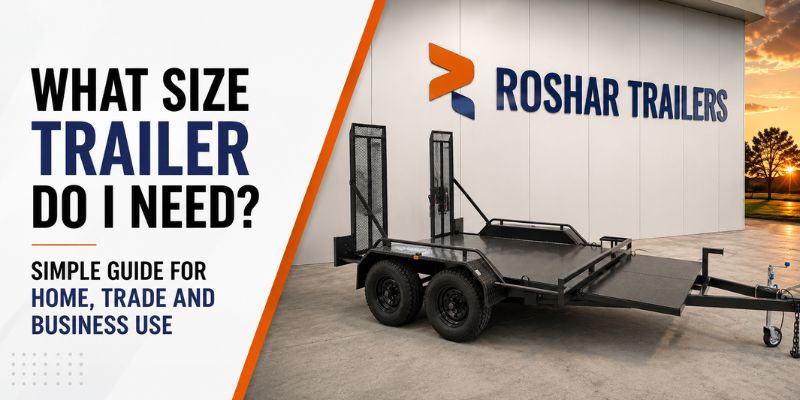
What Size Trailer Do I Need? Simple Guide for Home, Trade and Business Use
11 August 2026 | roshartrailers
By Roshar Trailers Team, Trailer Manufacturing
Published: 11 August 2026
If you are asking what size trailer do I need, start with the load first: length, width, weight, loading method and towing vehicle limit. For most buyers, the right trailer is the smallest size that safely carries the real loaded job.
A trailer that is too small creates double trips, poor load restraint and frustrating overhang. A trailer that is too large can be harder to reverse, store, tow and justify financially. The right size is the middle ground between capacity, control and everyday practicality.
For tradies, landscapers, farmers, contractors, vehicle owners, homeowners and small businesses, size should never be chosen by tray dimensions alone. A 7×5 trailer, 8×5 trailer or 10×6 trailer can mean very different things once payload, axle setup, brakes, cage height, ramps and tow vehicle capacity are included.
For trailer buyers across Victoria, the right choice also depends on local use. Melbourne tradies, landscapers and contractors may need trailers that suit tight job sites, daily road use, mixed loads and safe storage at home or in the workshop.
How do I choose the right trailer size for my load?
Choose trailer size by measuring the longest, widest, tallest and heaviest load you expect to carry, then match that to tray space, payload, axle setup, brakes and towing capacity. Dimensions matter, but safe loaded weight matters more.
Start with your real load, not the advertised trailer size. A 6×4 trailer may sound enough for household rubbish, but a cage, spare wheel, toolbox or heavier floor can reduce usable payload. An 8×5 trailer may fit more volume, but it still needs the right axle, tyres and brakes for the weight.
According to Transport for NSW, trailers must be a suitable size and type for their intended tasks, and the loaded trailer mass must not exceed the lowest relevant rating across the towbar, coupling, towing vehicle, trailer carrying capacity and tyres.
A simple way to think about size is “fit plus margin.” Your load should fit inside the trailer with space for safe restraint, balanced placement and legal visibility. If the load needs to hang out every trip, the trailer is probably too short.
Trailer sizing decision table
| Main use | Common starting size | Better when | Watch out for |
| Household clean-ups | 6×4 or 7×4 box trailer | Light waste, furniture, garden tools and short trips | Easy to overload with soil, bricks or wet green waste |
| Home renovation | 7×5 or 8×5 box trailer | Bulky but moderate loads, timber, plasterboard offcuts and fixtures | Check overhang, cage height and load restraint |
| Landscaping | 8×5, 10×6 or tipper/cage setup | Green waste, mulch, soil, tools and mowers | Wet material becomes heavy quickly |
| Trades and contractors | 7×5 or 8×5 tradesman trailer | Tools, compressor boxes, shelving and daily site access | Payload reduces as storage and toolboxes are added |
| Machinery and plant | 10×6, 12×7 or larger plant/flat top trailer | Mini loaders, excavators, rollers and compact equipment | Ramps, tie-downs, brakes and machine weight matter most |
| Vehicle transport | 14ft to 16ft+ car carrier | Cars, project vehicles and workshop transport | Measure wheelbase, track width, ramps and rated capacity |
| Farm and rural use | Tandem, flat top or custom trailer | Mixed loads, fencing gear, tanks, machinery and property work | Rough access and weight distribution need planning |
Need help choosing the right trailer size? Speak with Roshar Trailers for practical advice based on your load, towing vehicle and work needs across Melbourne and Victoria.
What trailer size guide should Australian buyers use?
Use a trailer size guide that starts with a use case, then checks tray size, payload, axle configuration, brakes, tyres, loading access and storage space. A useful guide compares what the trailer carries, how often it works and where it is towed.
Many buyer guides talk about small, medium and large trailers. That helps as a starting point, but Australian buyers also need to think about load ratings and road use. A “bigger trailer” is not automatically better if the tow vehicle, storage space or payload setup does not suit it.
Roshar’s box trailer page notes that its box trailers cover compact 6×4 options through to larger tandem and heavy-duty configurations for home, trade, landscaping, business and commercial transport use. It also states that custom options may include custom sizing, cages, ramps, toolbox options, floor upgrades, suspension upgrades and brake upgrades.
That is the practical difference between choosing size and choosing a working trailer. Size answers “will it fit?” Configuration answers “will it work safely and conveniently?”
Simple trailer size guide
| Trailer size category | Typical buyer | Best suited to |
| Compact trailer | Homeowners, DIY buyers, light garden users | Small clean-ups, light furniture, camping gear and local errands |
| Medium box trailer | Renovators, small businesses, property owners | General materials, bulkier household jobs and moderate work loads |
| Large box or cage trailer | Landscapers, contractors, maintenance teams | Green waste, tools, mowers, bulky light loads and repeated jobs |
| Tandem trailer | Builders, farmers, contractors, heavier users | Regular heavier loads, longer trips and stronger load support |
| Tradesman trailer | Electricians, plumbers, carpenters, mobile services | Organised tools, secure storage and daily trade workflow |
| Flat top trailer | Construction, agriculture, machinery and pallet transport | Side loading, oversized materials, machinery, pallets and long cargo |
| Custom trailer | Business owners and specialised users | When standard size, access, ramps or storage layout does not solve the job |
What size trailer do I need for home use?
For home use, most buyers start with a compact or medium box trailer, usually around 6×4, 7×4, 7×5 or 8×5 depending on access and load size. Choose larger only if your loads are bulky, repeated or difficult to restrain.
A 6×4 or 7×4 trailer can be easier to reverse, park, store and move around a driveway. That matters if you have narrow access, a tight garage or family members who may borrow the trailer. Smaller trailers can also encourage safer loading because you are less tempted to fill a large tray with heavy material.
A 7×5 or 8×5 trailer may suit homeowners renovating, moving furniture, carrying garden equipment or doing bigger property jobs. The size jump gives more usable floor area, but it also increases the need to think about weight, tyre condition, braking requirements and load balance.
For general home buyers, box trailers are usually the most practical starting point because they suit rubbish runs, garden loads, furniture, small business errands and everyday transport.
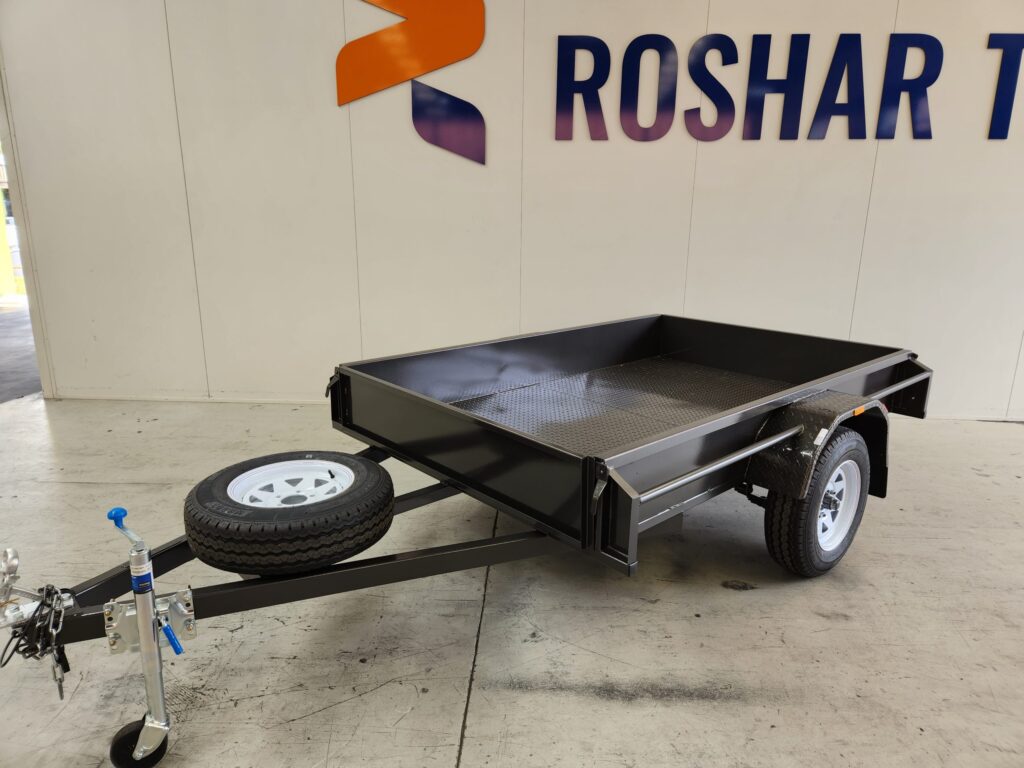
For home, trade and business towing needs in Melbourne, a box trailer is often the simplest starting point because it can handle many everyday jobs without becoming too large for driveways, storage and local road use.
Home-use examples
- Small garden clean-up: a compact box trailer may be enough if the load is mostly branches, leaves and light waste.
- Moving furniture: choose enough internal length and width for the largest item, plus space for straps and padding.
- DIY renovation: consider an 8×5 trailer if you carry bulky fixtures, timber, tiles or repeated hardware runs.
- Occasional tip runs: avoid oversizing if storage, reversing and limited towing experience are bigger concerns.
- Shared family use: choose a trailer that is easy to control, not just the largest trailer one vehicle can tow.
What size trailer do tradies and contractors need?
Tradies and contractors usually need a trailer sized around daily workflow, not just cargo volume. Tool storage, shelving, side access, compressor boxes, ladder racks, payload and job-site manoeuvrability can matter more than choosing the longest tray available.
A plumber, electrician, builder, carpenter or maintenance contractor does not simply carry “stuff.” They carry tools that need to stay organised, secure, reachable and protected from weather. That is why an open box trailer may be too basic for daily trade work, even if the dimensions seem correct.
Roshar’s tradesman trailer page lists examples including 6×4, 7×4, 7×5 and 8×5 tradesman-style setups, and describes customisable features such as compressor boxes, ladder racks, internal shelving, toolboxes, lockable storage, cages, reinforced side panels, LED lighting, tie-down points and upgraded flooring or axles.
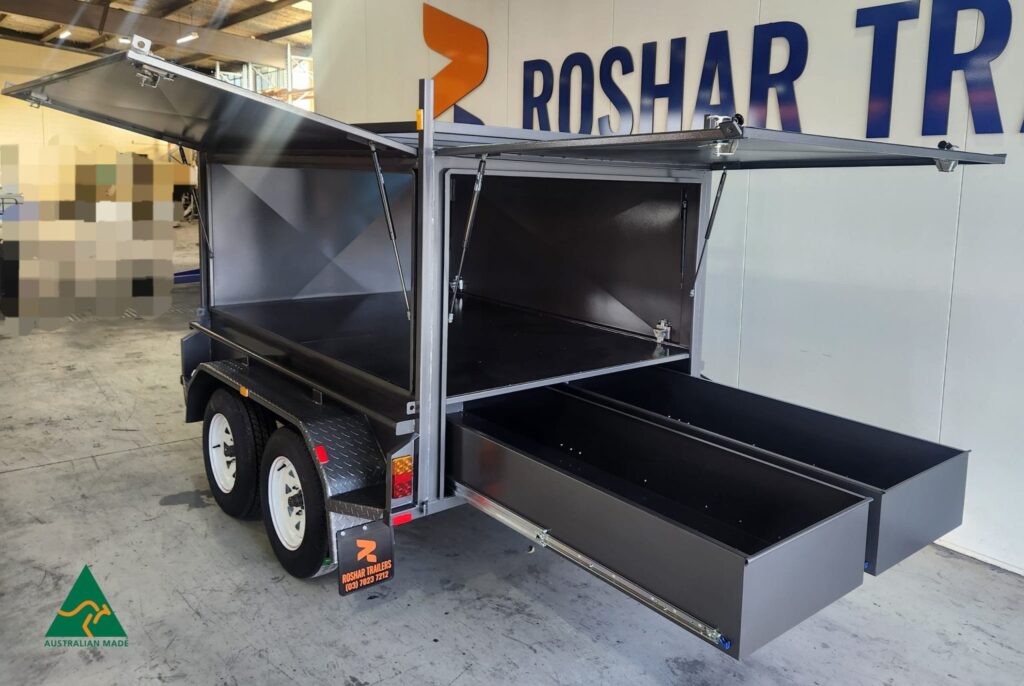
For trade use, tradesman trailers for sale should be compared by layout as well as size. A well-planned 7×5 can sometimes work better than a larger trailer with poor access.
Trade trailer size framework
| Trade need | Trailer size direction | Reason |
| Mobile tools and light equipment | 6×4, 7×4 or 7×5 tradesman trailer | Easier access, parking and site movement |
| Compressor, ladders and organised tools | 7×5 or 8×5 tradesman trailer | More room for storage and balanced load placement |
| Builder materials and mixed gear | 8×5 tandem or flat top option | Better for bulky materials and heavier repeated loads |
| Multi-team or business use | Tandem, custom or enclosed setup | Reduces downtime and improves tool organisation |
| Long materials | Trailer with racks or flat top | Better access and safer restraint than forcing length into a box trailer |
When should I choose a tandem trailer instead of a single axle?
Choose a tandem trailer when your loads are heavier, bulkier, more frequent or better supported across two axles. A single axle trailer suits lighter and occasional use, but tandem trailers usually suit business, landscaping, construction and larger trailer builds.
Single axle trailers are easier to move by hand, easier to park and often better for light home use. They can be a sensible choice if your loads are predictable and comfortably within rating. The mistake is assuming that a physically larger single axle trailer automatically carries more useful payload.
Roshar’s tandem trailer page explains that tandem axle configurations are commonly selected when buyers need more carrying capability or a larger trailer configuration for regular use. It also notes that choosing between single axle and tandem depends on what you carry, required GVM, towing vehicle capacity and job-suited configuration.
If you regularly carry soil, heavy tools, machinery, construction materials, commercial waste or rural supplies, tandem trailers deserve serious consideration. The extra trailer size should be matched with the right brakes, tyres, suspension and tow vehicle.
Single axle vs tandem size comparison
| Question | Single axle may suit | Tandem trailer may suit |
| How often will you tow? | Occasional home or light trade use | Weekly or daily work use |
| How heavy is the load? | Light to moderate loads within rating | Heavier or more varied loads |
| How bulky is the load? | Small items, tools, light waste | Green waste, materials, machinery or larger equipment |
| Do you need stability? | Short local trips and lighter loads | Longer trips, loaded work trailers and bigger builds |
| Is access tight? | Easier to manoeuvre and store | Needs more space but can offer stronger support |
| Is business downtime costly? | Less critical for occasional use | More important for contractors and operators |
What trailer size works for landscaping, farming and machinery?
Landscaping, farming and machinery use often needs a larger, stronger or more specialised trailer than household use. Start with the heaviest load, loading method and unloading method, then choose between cage, tipper, tandem, plant or flat top configurations.
Landscapers often run into the same size problem: green waste looks light, soil looks manageable, and mulch fills volume quickly. Wet material can change the trailer’s real working weight fast. A larger cage may help with volume, but payload and restraint still decide whether the trailer is suitable.
Farmers and rural property owners may carry fencing gear, water tanks, feed, tools, pumps, small machinery or mixed loads across uneven access. A standard home-use trailer may not give enough strength, deck space or loading flexibility.
Roshar’s flat top trailer page describes flat top trailers as open-deck trailers for machinery, pallets, building materials, equipment and oversized loads, with loading access from the sides, rear and top. It also lists flat top options across different sizes, GVM options, floor types and configurations.
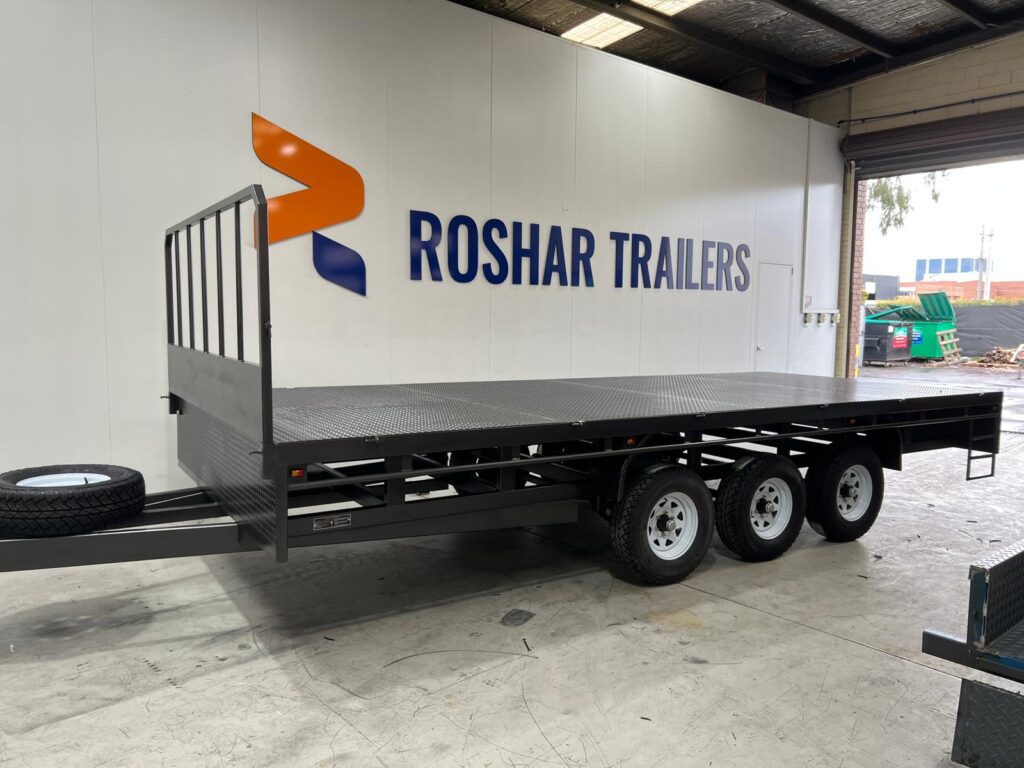
For machinery, pallets, farm supplies and long materials, flat top trailers can be more practical than a high-sided box. For compact equipment, the right trailer is usually chosen around machine width, ramp angle, tie-down points, deck strength and braking.
Work-use trailer matching table
| Use case | Size direction | Trailer type to compare |
| Lawn mowing business | Medium trailer with mower access | Lawn mowing trailer, cage trailer or custom trailer |
| Landscaping waste | 8×5, 10×6 or larger depending on volume | Cage trailer or hydraulic tipper |
| Soil, gravel or wet material | Payload-first sizing | Tipper trailer or heavy-duty tandem |
| Fencing and rural gear | Larger deck with strong tie-downs | Tandem trailer, flat top trailer or custom trailer |
| Small excavator or loader | Machine-specific sizing | Plant trailer or machinery trailer |
| Pallets and building materials | Side-loading access | Flat top trailer |
| Oversized or irregular cargo | Custom size and restraint points | Flat top or custom trailer |
How do payload, ATM and towing capacity affect trailer size?
Payload, ATM and towing capacity decide whether a trailer size is actually usable. A bigger tray can still be wrong if the trailer, tyres, coupling, brakes or tow vehicle cannot legally and safely carry the loaded weight.
This is the hidden part of trailer sizing. Tare is the empty trailer weight. Payload is how much load the trailer can carry. ATM is the total maximum loaded trailer mass set by the manufacturer. GTM is the load on the trailer wheels when coupled and loaded.
According to VSB 1 Revision 6 from the Department of Infrastructure, low-ATM trailers are trailers with an aggregate trailer mass of 4.5 tonnes or less, and the bulletin explains trailer terms such as tare mass and gross trailer mass for manufacturers and compliance purposes.
According to Transport for NSW, trailers from 0–750 kg GTM do not require brakes, 751–2000 kg GTM require an efficient braking system on at least one axle, and 2001–4500 kg GTM require an efficient braking system on all wheels.
Payload sizing example
| Trailer detail | Example |
| Trailer ATM | 1400 kg |
| Trailer tare | 400 kg |
| Approximate payload | 1000 kg |
| Load added | Mower, ramps, fuel, tools, spare parts and green waste |
| Sizing lesson | The usable payload is not the same as the trailer’s total size or external dimensions |
If you are choosing between two similar trailers, ask for tare, ATM, GTM, payload, brake setup and tyre rating in writing. A physically larger trailer with heavy accessories may carry less useful payload than expected.
What should I measure before ordering a trailer?
Before ordering, measure the load length, width, height, weight, loading angle, storage space, access width, towing vehicle limit and tie-down requirements. The right trailer size must fit the cargo, the road, the job site and the place you store it.
A trailer that looks ideal in a showroom can become frustrating at home or on site. Measure your driveway, garage, side access, worksite entry, shed door, gate opening and turning space. Also measure the largest item you expect to carry, not the average item.
According to the National Transport Commission, loads carried by a vehicle or trailer must be loaded safely, must not overhang dangerously, must not exceed mass limits and must not cover lights, indicators, reflectors or the number plate.
According to Transport Victoria, loads should be positioned so they are stable and evenly distributed across the width and length of the vehicle or trailer, and heavy loads need suitable headboards, racks and restraints.
Measurement checklist before buying
- Measure the longest item: allow extra room for tie-down angles, padding, doors, tailgates and safe positioning.
- Measure the widest item: include wheels, guards, mower decks, pallets, machinery tracks and side attachments.
- Estimate loaded weight: include fuel, water, attachments, toolboxes, spare wheels, ramps and cages.
- Check loading method: rear ramps, side loading, forklift loading and hand loading all need different trailer layouts.
- Measure storage access: driveway width, garage length, gate clearance and turning space can limit trailer size.
- Check towing vehicle rating: vehicle capacity may decide the final trailer size before the tray dimensions do.
- Plan load restraint: tie-down points, cages, racks, headboards and tarps should suit the load.
- Leave growth room carefully: choose some practical margin, but do not oversize beyond your towing and storage comfort.
Common Trailer Size Mistakes to Avoid
The most common trailer sizing mistakes come from choosing by tray size only, ignoring payload, forgetting accessory weight, buying too large for storage space and underestimating wet or heavy materials. The right trailer must work when fully loaded.
Buying by tray size only
An 8×5 trailer may sound like the answer, but tray size does not tell you payload, axle rating, brake setup, tare weight or tow vehicle suitability. Always compare the full specification, not just the floor dimensions.
Ignoring payload
Payload is the usable carrying capacity after the trailer’s own weight is counted. If the trailer has a cage, toolbox, ramps, spare wheel or heavy floor, the real payload may be lower than expected.
Forgetting cage, toolbox and ramp weight
Accessories are useful, but they add weight. A tradesman trailer with shelving, compressor box, ladder racks and storage may need a stronger axle or tandem setup to stay practical for daily use.
Choosing too large for storage space
A larger trailer can be useful on site but frustrating at home. Before buying, check driveway length, garage space, side access, turning room and where the trailer will sit when it is not being used.
Not checking tow vehicle capacity
Your ute or SUV sets a hard limit. The trailer, towbar, coupling and vehicle rating must all suit the loaded trailer weight. If one rating is lower, that lower number becomes the practical limit.
Underestimating wet soil, gravel or machinery weight
Wet soil, gravel, pavers, machinery and building materials become heavy quickly. Melbourne tradies, landscapers and contractors should treat these loads carefully because volume can look manageable while weight exceeds the trailer’s safe working range.
Conclusion
The best answer to what size trailer do I need is to start with the real load, then match tray size, payload, towing capacity, axle setup, brakes, loading access and storage space. Bigger is not always better; suitable is better.
For home, trade, landscaping, farming, machinery or business use, Roshar Trailers can help compare trailers in Melbourne and across Victoria, including box trailers, tandem trailers, tradesman trailers, flat top trailers and custom builds around your actual work, towing vehicle and long-term use.
FAQ’S
Can a smaller trailer carry more than a larger trailer?
Yes, in some cases. A smaller trailer with a higher payload rating may legally carry more than a larger trailer with heavier accessories or a lower axle rating. Always compare tare, ATM, GTM and payload, not only tray length and width.
Should I choose trailer size in feet or metres?
Either is fine, as long as you compare the same measurements. Australian trailer buyers often use feet for common tray sizes such as 6×4, 7×5 and 8×5, while some larger or custom trailers may also list metric deck dimensions.
Is it better to leave extra space in the trailer?
Yes, but only a practical amount. Extra space helps with tie-down angles, tool access and uneven loads, but too much unused tray space can make the trailer harder to store, reverse and justify. Match extra room to real future use.
Can my tow vehicle limit reduce the trailer size I should buy?
Yes, the tow vehicle limit can decide the trailer size before the tray dimensions do. Check the vehicle manual, towbar rating, coupling rating and loaded trailer weight. Do not buy a larger trailer if your vehicle cannot tow it safely.
Should I include trailer accessories when calculating size and payload?
Yes, accessories count. Cages, ramps, toolboxes, spare wheels, ladder racks, hydraulic systems and shelving add weight and can reduce usable payload. They can also change load balance, storage clearance and how easily the trailer fits your daily work.
Is custom sizing worth it for business use?
Yes, when standard sizes create wasted time, awkward loading or poor tool access. Custom sizing can suit machinery, racks, toolboxes, cages, ramps and repeated work routes. The value comes from safer loading and better workflow, not size alone.
What is the biggest trailer sizing mistake?
The biggest mistake is buying by tray size only. Many buyers ask whether an 8×5 or 10×6 trailer is “big enough” before checking weight, brakes, payload, loading method, tow vehicle capacity and storage access. The correct size is the one that works loaded.