
37 Malcolm RD, Braeside, VIC
8 Causes of Trailer Sway and How to Reduce Them
8 September 2026 | roshartrailers
By Roshar Trailers Team, Trailer Manufacturing and Sales Specialists
Published: 08/09/2026
Last updated: 08/09/2026
Table of Contents
Trailer sway is the side-to-side movement of a trailer behind the towing vehicle. A small movement can settle naturally, but an unstable trailer can continue oscillating and become increasingly difficult to control.
For Australian tradies, contractors, landscapers, farmers, vehicle owners and small businesses, understanding trailer sway causes is particularly important because work trailers are often loaded differently from one trip to the next.
A trailer carrying a toolbox and light materials can behave very differently from the same trailer loaded with machinery, green waste, building products or other dense equipment.
This guide explains what causes trailer sway, how to recognise the common triggers and practical ways to reduce the risk.
What causes trailer sway?
Trailer sway is usually caused by an unstable combination of load distribution, speed, road or wind forces, tyre condition, suspension behaviour and towing setup. The risk increases when several factors occur together, such as a rear-heavy load being towed quickly in strong crosswinds.
Trailer sway can also develop after something changes during a journey. A load may move, a tyre may lose pressure or road conditions may suddenly change. That is why trailer stability should be treated as a combination of setup + load + speed + road conditions, rather than a problem caused by one component alone.
The National Road Safety Partnership Program identifies improper loading as a major cause of trailer sway and recommends keeping heavy items low, centred and near the trailer axle while properly restraining cargo.
A practical way to think about sway
Imagine a landscaper towing a trailer loaded with green waste. If the heavy material is piled high and concentrated towards the rear gate, the trailer can become less stable than when the same load is distributed properly.
Now add a gust of wind or a passing truck at highway speed. The external force can disturb the trailer, while the poor loading makes it harder for the combination to settle.
That is why trailer sway prevention begins before the vehicle leaves the driveway.
What are the 8 main trailer sway causes?
The eight common trailer sway causes are:
| # | Cause | What can happen |
| 1 | Poor weight distribution | Trailer becomes unstable or rear-heavy |
| 2 | Excessive speed | Small movements become harder to control |
| 3 | Incorrect tyre pressure | Tracking and stability can be affected |
| 4 | Crosswinds | Side forces push the trailer laterally |
| 5 | Passing heavy vehicles | Air pressure can disturb the trailer |
| 6 | Uneven or damaged roads | Bumps can initiate sideways movement |
| 7 | Unsuitable or worn suspension | Trailer may not settle correctly |
| 8 | Incorrect towing setup or load restraint | Poor coupling, height, balance or shifting loads can affect stability |
These causes are not always isolated. A trailer with an uneven load may remain manageable at lower speeds but become unstable when exposed to wind or passing traffic.
1. Poor weight distribution
Poor weight distribution is one of the most important causes of trailer sway.
A trailer should not be loaded with most of its weight hanging behind the axle group. A rear-heavy trailer can create a pendulum effect, allowing the trailer to move from side to side more readily.
Heavy items should generally be:
- Kept low
- Positioned centrally
- Properly restrained
- Distributed appropriately around the axle group
- Loaded according to the trailer and vehicle manufacturer’s requirements
Transport Victoria specifically advises that loads should be stable and evenly distributed across the length and width of the vehicle or trailer, with heavy items underneath lighter items.
Illustrative example: A contractor loads a generator, compressor and several toolboxes at the very back of a trailer because that makes the front section easier to access. The trailer may feel noticeably less settled on the highway than if those heavy items were positioned appropriately.
For more detail on loading, Roshar’s trailer load capacity guide explains how tare, ATM, GTM, payload and load position interact.
2. Excessive speed
Speed does not necessarily create instability by itself, but it can make an existing stability problem much more difficult to control.
At higher speeds, a trailer has less time to settle after:
- A steering input
- Road bump
- Wind gust
- Passing vehicle
- Sudden lane movement
This is particularly relevant to trailer sway at highway speeds.
NSW Government towing guidance recommends driving to the limits set by the manufacturer as well as road, traffic and weather conditions. It also recommends allowing additional stopping distance when towing.
If your trailer begins moving from side to side, increasing speed to try to pull it straight is not a sensible response. Gradual deceleration and controlled steering are more appropriate.
3. Incorrect tyre pressure
Tyre pressure and trailer sway are closely related because tyres are part of the trailer’s contact with the road.
Underinflated, overinflated, damaged or incorrectly rated tyres can affect the way the trailer tracks and responds to road forces.
Before towing, check:
- Tyre pressure
- Tyre load rating
- Sidewall condition
- Uneven wear
- Cracks or damage
- Wheel condition
The correct pressure should come from the tyre, trailer or vehicle manufacturer’s specifications rather than a generic number.
NSW Government guidance specifically recommends checking that all tyres are properly inflated before each towing trip and checking them again during longer journeys.
Illustrative example: A work trailer sits outside for several weeks. One tyre gradually loses pressure. The owner loads it heavily and heads onto the freeway. The trailer may feel different even though nothing else has changed.
That is why tyre checks belong on every pre-trip inspection.
4. Crosswinds
Crosswinds can push a trailer sideways, particularly when the trailer has a large side profile.
This can affect:
- Tall enclosed trailers
- Caravans
- High-sided trailers
- Trailers carrying tall loads
- Lightweight trailers exposed to strong wind
A stable trailer can still experience movement when exposed to a strong gust. The problem becomes greater when the load is poorly distributed or the vehicle is travelling too quickly for the conditions.
In practice, the wind itself is not always the underlying setup problem. A properly loaded trailer may tolerate a gust better than a rear-heavy trailer with incorrect tyre pressure.
5. Passing heavy vehicles
A semi-trailer or bus passing in the opposite direction or overtaking can create a sudden change in air pressure around a trailer.
The effect can feel like:
- A sideways push
- A brief pull
- A sudden steering correction
- Trailer movement behind the tow vehicle
REDARC identifies side winds and the slipstream of other vehicles, particularly semi-trailers, as factors that can contribute to trailer sway.
The practical response is to maintain a controlled position, avoid abrupt steering and allow enough space from other vehicles where conditions permit.
6. Uneven or damaged roads
Potholes, corrugations, road repairs, uneven surfaces and sudden changes in road level can disturb a trailer’s tracking.
Rough roads can be particularly relevant to:
- Construction contractors
- Farmers
- Landscapers
- Regional businesses
- Equipment operators
A trailer entering a pothole while loaded unevenly can experience a sideways movement that would not occur on a smooth road.
RAC WA also identifies bumps, road undulations and sudden steering actions as possible disturbances that can initiate sway.
If a particular trailer repeatedly becomes unstable on the same type of road surface, inspect the load, tyres, suspension and running gear rather than assuming the road is the only problem.
7. Unsuitable or worn suspension
Suspension affects how the trailer responds to bumps, load changes and road forces.
Problems can include:
- Worn suspension components
- Damaged springs
- Incorrect suspension for the application
- Uneven suspension behaviour
- Excessive movement under load
Suspension should match the trailer’s intended load and operating conditions.
For example, a trailer regularly carrying construction equipment needs a setup appropriate for that application. A light-duty trailer that is repeatedly loaded beyond its intended use is not transformed into a heavy-duty trailer simply because the load fits physically.
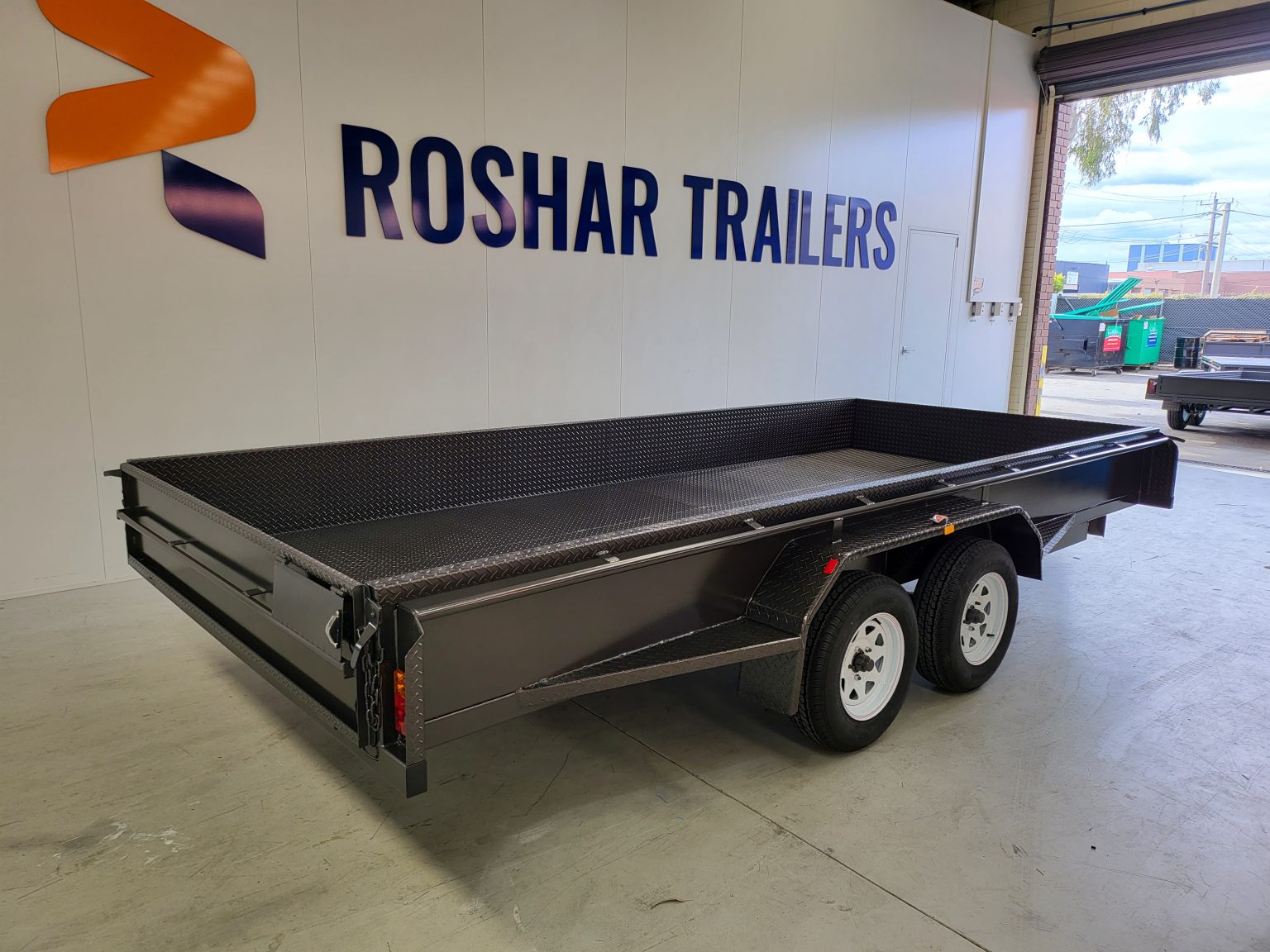
For buyers comparing tandem trailers, axle configuration, suspension, brakes, tyres and payload should be considered as one system rather than separate features.
8. Incorrect towing setup or shifting loads
Sway can also result from an unsuitable overall towing setup.
Potential issues include:
- Incorrect coupling setup
- Unsuitable tow-ball loading
- Trailer not sitting correctly
- Inadequate load restraint
- Load shifting during travel
- Trailer exceeding a relevant rating
- Tow vehicle and trailer combination not being suitable
Transport Victoria states that the load must not affect vehicle stability and that equipment used for restraint should be suitable for the load.
This is particularly important for open work trailers. A contractor might begin with a properly balanced load but then have loose equipment move towards the rear during travel. The trailer’s behaviour can change even though the original loading appeared acceptable.
How does incorrect weight distribution cause trailer sway?
Weight distribution and trailer sway are directly connected because where the load sits affects trailer balance and tow-ball loading. A rear-heavy trailer is more susceptible to instability, while heavy items positioned low and appropriately around the axle group help create a more controlled towing combination.
There is no single loading pattern that replaces the trailer and vehicle manufacturer’s specifications. Instead, start with the ratings and loading instructions for your particular combination.
Use this loading framework
| Loading question | Better approach |
| Where should heavy items go? | Low and appropriately positioned around the axle group |
| Should weight sit at the rear gate? | Avoid creating a rear-heavy configuration |
| Should loads move during travel? | No, secure them with suitable restraints |
| Should left/right weight be considered? | Yes, aim for stable, even distribution |
| What about payload? | Stay within the applicable trailer and vehicle ratings |
| What if the load is unusual? | Reassess the complete combination before towing |
A useful rule for tradies is to load the trailer around the job, rather than around convenience.
For example, if a builder places the heaviest equipment at the rear simply because it is easiest to unload first, the trailer may behave differently. Moving the equipment to an appropriate position and securing it can make the combination more predictable.
Why does trailer sway become worse at highway speeds?
Trailer sway at highway speeds becomes more difficult to manage because higher speed increases the effect of aerodynamic forces, road disturbances and steering inputs. A small movement that settles quickly at lower speed can become more pronounced when speed, wind or poor loading combine.
This is why highway towing requires more than simply staying under the posted speed limit.
Consider these conditions:
| Highway condition | Potential effect |
| Strong crosswind | Pushes the trailer sideways |
| Passing semi-trailer | Creates aerodynamic disturbance |
| Rear-heavy load | Makes the trailer easier to destabilise |
| Incorrect tyre pressure | Can affect tracking |
| Sudden steering | Can initiate lateral movement |
| Road undulations | Can disturb trailer balance |
| Heavy rain | Changes road and tyre conditions |
The safest speed is not necessarily the maximum legal speed. It should also reflect the trailer’s condition, load, weather, road surface and manufacturer’s limits.
If sway becomes noticeable, avoid trying to “drive through” it at the same speed.
How do tyre pressure and trailer sway relate?
Tyre pressure and trailer sway are linked because incorrect pressure can affect tyre stiffness, contact with the road and trailer tracking. Check all trailer tyres before towing and use the pressure specified for the actual trailer and load rather than relying on a generic pressure figure.
Tyres should be checked when they are cold, where appropriate, and inspected for visible damage.
Check these five things
- Pressure – Is each tyre at the recommended pressure?
- Load rating – Is the tyre suitable for the trailer’s application?
- Wear – Is tread wear even?
- Sidewalls – Are there cracks, cuts, bulges or other damage?
- Heat – Does one tyre appear unusually hot after towing?
NSW Government guidance recommends checking tyre inflation before each towing trip and checking tyres during the journey.
If a trailer repeatedly feels unstable despite correct loading and tyre pressure, have the suspension, wheels, bearings and alignment-related components inspected.
How can you reduce trailer sway while towing?
To reduce trailer sway, ease off the accelerator smoothly, keep steering inputs controlled, avoid sudden braking or acceleration and bring the combination to a safe stop when conditions allow. Once stopped, inspect the load, tyres, coupling and trailer before continuing.
The exact response depends on the towing system and manufacturer’s instructions. NSW Government guidance says that if trailer brakes can be operated independently, they should be applied gently; otherwise, a steady speed or slight acceleration should be held if possible until sway stops.
If sway starts
1. Stay calm.
Avoid sudden steering reactions.
2. Keep the combination controlled.
Do not make aggressive counter-steering movements.
3. Reduce acceleration smoothly.
Allow the combination to slow rather than adding speed.
4. Use the trailer braking system correctly if fitted.
Follow the brake controller and trailer manufacturer’s instructions.
5. Find a safe place to stop.
Do not immediately continue at highway speed after a significant sway event.
6. Identify the trigger.
Check load position, restraints, tyre pressure, coupling, suspension and road conditions.
The objective is not simply to stop the movement for a few seconds. The objective is to find out why the trailer became unstable.
What trailer setup helps prevent sway?
The best trailer sway prevention strategy is to match the trailer to the tow vehicle and load, maintain the running gear, load weight correctly, use suitable restraints and adjust driving speed to road and weather conditions.
This is where trailer selection matters.
A trailer used by a landscaper every day may need different characteristics from a small household trailer. A machinery operator needs a trailer that suits the machine’s weight and loading method. A tradie carrying tools needs secure storage without creating a badly balanced load.
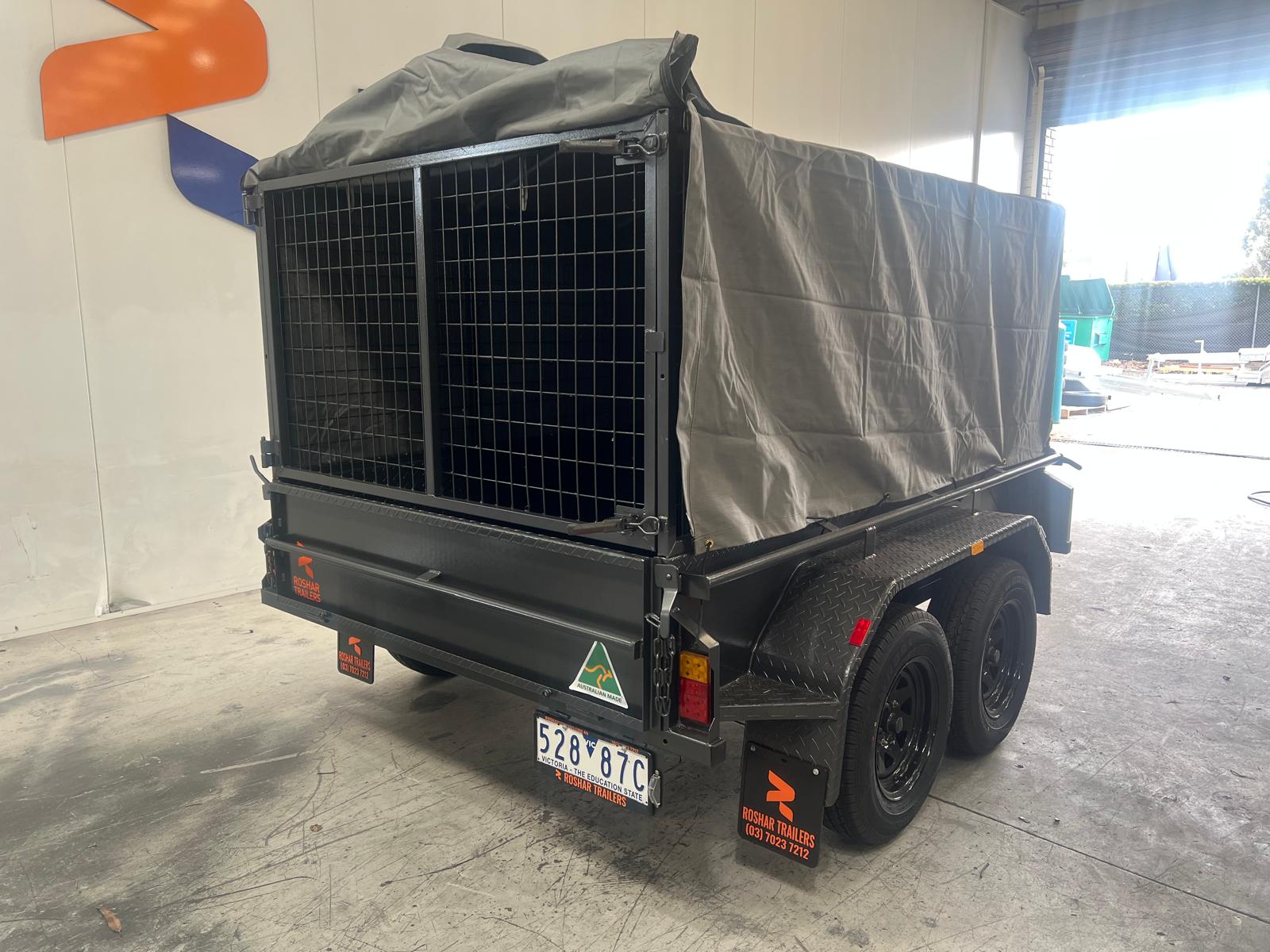
Roshar’s trailers for sale Melbourne range includes box, cage, car carrier, flat top, machinery, plant, tandem, tradesman and other trailer configurations.
Trailer stability framework
Use this five-point check before buying or loading:
| Step | Question |
| 1. Load | What is the heaviest realistic load? |
| 2. Balance | Where will that weight sit relative to the axle group? |
| 3. Vehicle | Can the towing vehicle legally and safely handle the combination? |
| 4. Running gear | Are tyres, suspension, brakes, bearings and coupling suitable? |
| 5. Conditions | Are speed, wind, road surface and traffic appropriate for the setup? |
This framework is especially useful for businesses that change their load every day.
Match the trailer to the job
A landscaper may need a cage or hydraulic tipper trailer. A contractor moving equipment may need a plant or machinery trailer. A tradie carrying valuable tools may benefit from a tradesman trailer. A business moving mixed heavy loads may consider a tandem configuration.
The important point is that more trailer is not automatically better. The trailer needs to be correctly matched to the vehicle, load and intended use.
When should you stop towing after experiencing sway?
Stop towing and inspect the combination when sway is severe, repeats after slowing down, occurs without an obvious external trigger or is accompanied by tyre, brake, suspension, coupling or load problems. Do not continue a potentially unstable setup simply because the trailer temporarily feels normal again.
Stop and investigate if you notice:
- Repeated side-to-side movement
- A trailer that pulls unexpectedly
- A tyre losing pressure
- Excessive bouncing
- A hot hub or tyre
- Loose load restraints
- Coupling movement
- Suspension damage
- Brake problems
- Unusual clunking or grinding
Roshar’s trailer towing safety guidance also identifies sway, pulling, excessive bouncing, coupling noise, hot tyres or hubs and load movement as warning signs requiring attention.
When professional inspection makes sense
A professional inspection is particularly appropriate when:
- Sway occurs repeatedly with different loads
- The trailer has recently been modified
- Suspension components are worn
- Tyres show uneven wear
- A wheel or bearing has overheated
- The trailer has been involved in an impact
- You cannot identify why the sway occurred
For owners who need trailer servicing or trailer repairs Melbourne, a proper inspection can assess the trailer as a complete system rather than treating sway as a tyre or load problem alone.
A practical trailer sway prevention checklist
Before leaving for a job, run through this quick checklist:
| Check | What to confirm |
| Load | Heavy items positioned appropriately |
| Restraints | Load is secure and cannot shift |
| Tyres | Correct pressure and no visible damage |
| Wheels | No obvious damage or loose components |
| Suspension | No visible damage or abnormal sag |
| Brakes | Working correctly where fitted |
| Coupling | Fully engaged and secured |
| Safety chains | Correctly connected |
| Lights | Brake lights and indicators operating |
| Ratings | Load remains within applicable limits |
| Weather | Wind and road conditions considered |
| Speed | Suitable for the combination and conditions |
NSW Government recommends checking roadworthiness, tyres, wheel bearings, suspension, brakes, lights and safety chains before each towing trip.
Conclusion
The most common trailer sway causes are not mysterious. Poor loading, excessive speed, incorrect tyre pressure, wind, passing traffic, uneven roads, suspension problems and an unsuitable towing setup can all contribute to instability.
The best approach is prevention.
Load the trailer correctly, secure everything, maintain the tyres and running gear, match the trailer to the tow vehicle, and adjust your driving to the conditions. If sway occurs, slow down smoothly, keep your steering controlled and inspect the combination before continuing.
For Melbourne tradies, contractors, landscapers, farmers and businesses, choosing the right trailer can also reduce the likelihood of creating an unstable setup in the first place.
Roshar Trailers supplies a range of Australian-made trailer solutions for different working requirements, with locations in Braeside, Bayswater North and Dandenong.
Need help choosing a trailer for your work or load? Contact Roshar Trailers and discuss your requirements with the team.
Braeside | Bayswater North | Dandenong
Contact Roshar Trailers for a quote
roshartrailers.com.au
FAQ’S
Can trailer sway happen even when the trailer is not overloaded?
Yes, a trailer can sway even when it is within its rated capacity. Stability also depends on load position, tow-ball loading, tyre pressure, speed, wind, road conditions, suspension and the towing combination. Being under the maximum rating does not automatically mean the trailer is correctly balanced.
Can a trailer sway after changing the load?
Yes, changing the load can alter the trailer’s balance and tow-ball loading. Moving heavy equipment, removing material from one section or allowing loose items to shift can change how the trailer tracks. Recheck the complete load position and restraints whenever the load changes significantly.
Can an empty trailer sway?
Yes, an empty trailer can still experience instability depending on its design, speed, wind, road surface, tyres, suspension and towing setup. A trailer does not automatically become stable simply because it has little or no cargo. Drive according to the trailer manufacturer’s limits and the road conditions.
Can a damaged wheel bearing cause trailer sway?
Yes, a damaged or overheating wheel bearing can affect trailer running behaviour and should not be ignored. Bearing problems can also create heat, noise or wheel movement. If a hub becomes unusually hot or you notice grinding, looseness or other warning signs, stop safely and have the trailer inspected.
Does a larger trailer always have more sway?
No, trailer size alone does not determine stability. A larger trailer may have a different centre of gravity, load distribution, suspension and aerodynamic profile, while a smaller trailer can also become unstable if it is poorly loaded or maintained. The complete towing combination matters more than dimensions alone.
Does trailer suspension affect sway?
Yes, suspension affects how the trailer responds to road bumps, load changes and lateral forces. Worn, damaged or unsuitable suspension can contribute to poor tracking or excessive movement. If sway continues after checking the load and tyres, suspension and other running-gear components should be inspected.
Can trailer sway damage the trailer?
Yes, severe or repeated sway can place abnormal forces through tyres, suspension, wheels, coupling and other components. Even if no visible damage appears immediately, a significant sway event is a reason to inspect the trailer and load before returning to normal highway towing.