
37 Malcolm RD, Braeside, VIC
How Much Weight Can a Trailer Carry? Load Capacity Explained
17 August 2026 | roshartrailers
By Roshar Trailers Team, Trailer Manufacturing
Published: 17 August 2026
Trailer load capacity is the usable weight your trailer can safely and legally carry after its own weight is counted. To calculate it, subtract tare weight from ATM, then check tow vehicle, towbar, tyre, brake and coupling limits.
For tradies, landscapers, farmers, contractors and vehicle owners, load capacity is not just a number on a plate. It decides whether a trailer can safely carry tools, soil, gravel, machinery, green waste, building materials, cars or rural equipment without overloading the trailer or tow vehicle.
The most common mistake is asking only, “how much weight can a trailer carry?” A better question is, “how much can this trailer carry when matched with my tow vehicle, load type, tyres, brakes, coupling and actual job routine?”
What does trailer load capacity mean?
Trailer load capacity means the usable weight a trailer can carry without exceeding its rated limits. It is not the same as tray size, empty trailer weight or towing capacity, because payload depends on the trailer’s ATM, tare and fitted equipment.
A trailer can look large and still have limited payload. Extra cages, ramps, toolboxes, hydraulic tipping gear, spare wheels and heavier floors can all add useful features, but they also increase tare weight. The more the trailer itself weighs, the less payload may remain inside the legal rating.
RACQ explains that payload is the trailer’s carrying capacity and is calculated as the difference between tare weight and ATM. RACQ also notes that modifications and additions can quickly reduce carrying capacity and lead to an overloaded trailer.
For Roshar customers, this matters most when the trailer is used for work. A landscaper may carry wet green waste one day and soil the next. A builder may carry timber, tools and demolition waste. A machinery operator may load a compact machine plus attachments. Each load changes the real capacity picture.
How much weight can a trailer carry in Australia?
How much weight can a trailer carry depends on its ATM, tare, GTM, payload, tyre rating, brake setup, coupling, towbar and tow vehicle limit. In Australia, the safe answer is always the lowest rated part of the towing combination.
A common example is a trailer with a 2,000 kg ATM and 600 kg tare. In simple terms, its payload is 1,400 kg before accessories, load placement and tow vehicle limits are considered. If the tow vehicle, towbar or tyres are rated lower, the usable limit drops.
NSW Government guidance says the loaded mass of a trailer must not exceed the lesser of the towbar and coupling capacity, the vehicle’s maximum towing capacity, the trailer’s maximum carrying capacity or the tyres’ maximum rated carrying capacity.
That is why “rated to 2 tonne” is not enough information by itself. You need to know whether the rating refers to ATM, GTM, GVM-style product wording, payload, axle group rating or a marketing description. Always ask for the compliance plate and written specifications.
Quick capacity guide
| Trailer rating example | Tare example | Approximate payload | What it may suit |
| 750 kg ATM | 250 kg | 500 kg | Light home use, garden waste, small furniture |
| 1,400 kg ATM | 400 kg | 1,000 kg | Small trade loads, mowers, lighter equipment |
| 2,000 kg ATM | 600 kg | 1,400 kg | Tandem work trailers, tools, materials, landscaping loads |
| 3,500 kg ATM | 900 kg | 2,600 kg | Heavier plant, cars, commercial equipment |
| 4,500 kg ATM | 1,200 kg | 3,300 kg | Heavy-duty commercial and machinery configurations |
These figures are illustrative only. The actual payload depends on the specific trailer plate, build, accessories, brakes, tyres, tow vehicle and load distribution.
What is the difference between ATM, GTM, tare and payload?
ATM is the fully loaded trailer weight when uncoupled, GTM is the loaded weight carried by the trailer axles when coupled, tare is the empty trailer weight, and payload is the amount of cargo the trailer can legally carry.
These terms often confuse buyers because they sound similar. The easiest way to remember them is this: tare is the trailer empty, ATM is the trailer fully loaded, payload is what you can add, and GTM is the weight carried through the trailer wheels when connected to the tow vehicle.
RACQ defines ATM as the trailer plus full load when not coupled to a tow vehicle, GTM as the loaded trailer weight imposed on the trailer axle when coupled, and says GTM is always less than ATM because some weight transfers to the tow vehicle.
SA Government guidance defines ATM as the trailer’s total mass when carrying the manufacturer’s recommended maximum load, including the mass imposed on the towing vehicle. It defines GTM as the maximum loaded mass transmitted to the ground by the trailer axle or axles when coupled.
Trailer weight terms explained
| Term | Meaning | Why it matters |
| Tare weight | Empty trailer weight | Needed to calculate payload |
| ATM | Trailer plus maximum load when not coupled | Common overall trailer rating |
| GTM | Weight carried by trailer axles when coupled | Important for brakes, tyres and axle load |
| Payload | ATM minus tare | The actual cargo-carrying allowance |
| Towball load | Weight imposed vertically on the towbar | Affects tow vehicle rear axle, steering and stability |
| GCM | Maximum loaded tow vehicle and trailer combination | Can limit the real-world towing setup |
How do you calculate trailer payload correctly?
Calculate payload by subtracting tare weight from ATM, then checking that the loaded trailer also stays within GTM, tyre, towbar, coupling, ball load and tow vehicle limits. The formula is simple; the real-world check is wider.
The basic formula is:
Payload = ATM − Tare Weight
Example:
- ATM: 2,000 kg
- Tare: 620 kg
- Payload: 1,380 kg
That means the trailer can carry up to 1,380 kg only if every other rating also supports the load. Add a cage, spare wheel, ramps or toolbox, and tare may increase. Load the trailer incorrectly, and axle or ball load may become a problem even if the total weight looks legal.
RACQ says the tow vehicle must have enough capacity to tow the fully laden trailer, and vehicle handbooks generally list maximum unbraked trailer weight, maximum braked trailer weight, maximum towball load and any towing conditions or required equipment.
Payload calculation table
| Step | What to check | Example |
| 1 | Find ATM on trailer plate | 2,000 kg |
| 2 | Find tare weight | 620 kg |
| 3 | Subtract tare from ATM | 2,000 − 620 = 1,380 kg |
| 4 | Add up real cargo | Tools, soil, ramps, mower, machine, attachments |
| 5 | Check tow vehicle rating | Must suit the loaded trailer |
| 6 | Check tyre, coupling and towbar ratings | Lowest rating controls the safe limit |
| 7 | Weigh if unsure | Use a weighbridge before regular highway or work use |
What reduces the real carrying capacity of a trailer?
Real carrying capacity is reduced by trailer tare, added accessories, cages, ramps, toolboxes, hydraulic equipment, heavier floors, spare wheels and poor load placement. Your tow vehicle’s capacity, towbar rating, tyres and ball load can also lower the usable limit.
A bare trailer and a work-ready trailer are not the same. A cage makes a trailer more useful for green waste. Ramps make loading machinery easier. A hydraulic tipper reduces manual unloading. Toolboxes improve storage. But all of these features add weight to the trailer before you load cargo.
For example, a landscaper may choose higher sides and a cage for bulky garden waste. That helps containment, but if the same trailer is then filled with wet soil or gravel, weight can climb quickly. Volume does not equal payload.
Roshar’s tandem trailer page notes that GVM is the maximum permitted combined mass of the trailer and its load, and that usable payload depends on tare weight, fitted accessories and selected configuration. Roshar also lists tandem GVM options from 2,000 kg to 4,500 kg depending on the selected build.
Capacity reducers buyers often forget
- Cages and racks: useful for bulky loads, but they add tare weight.
- Toolboxes and storage lids: valuable for tradies, but they reduce remaining payload.
- Hydraulic tipping gear: improves unloading efficiency, but adds components and weight.
- Ramps and tailgates: essential for machinery, but must be counted in trailer tare.
- Spare wheels and brackets: practical for business use, but still part of the loaded setup.
- Wet loads: soil, mulch and green waste can weigh far more after rain.
- Poor weight placement: a legal total load can still create unsafe ball load or axle loading.
How do brakes, tyres and tow vehicles affect load limits?
Brakes, tyres and tow vehicles affect load limits because each has a separate rating. A trailer may have enough ATM, but if the tyres, towbar, coupling, brakes or vehicle capacity are lower, that lower rating becomes the practical limit.
This is especially important for business buyers who tow different loads through the week. A 4WD, ute or van may be powerful enough to move the trailer, but towing capacity is not only engine power. It includes braking, cooling, chassis strength, towbar rating, towball load and GCM.
NSW Government guidance lists braking requirements by GTM: no brakes are required from 0–750 kg GTM, an efficient braking system is required on both wheels on at least one axle from 751–2,000 kg GTM, and 2,001–4,500 kg GTM requires efficient braking on all wheels plus breakaway requirements over 2 tonnes.
SA Government guidance similarly says trailers must have brakes if GTM exceeds 750 kg, and a trailer with GTM above 2 tonnes must have a breakaway system that applies the brakes if the trailer disconnects from the towing vehicle.
Component limit table
| Component | What to check | Why it matters |
| Trailer ATM | Maximum loaded trailer mass | Sets the trailer’s overall rated limit |
| Trailer GTM | Load through the axle group | Affects brake and axle requirements |
| Tyres | Load index and pressure | Overloaded tyres can overheat or fail |
| Towbar | Marked rated capacity | Towbar rating can be lower than vehicle towing capacity |
| Coupling | Rated capacity and condition | Must safely connect the loaded trailer |
| Brakes | Brake type and GTM range | Needed for control and legal road use |
| Tow vehicle | Braked towing limit, ball load, GCM and rear axle load | Can reduce usable trailer capacity |
Which trailer type suits heavier loads?
Heavier loads usually need a trailer built around the actual cargo: tandem trailers for repeated work loads, plant trailers for equipment, machinery trailers for machines, and hydraulic tipper trailers for soil, rubble, mulch, green waste and bulk material unloading.
The right trailer is not only about kilograms. It is about load shape, loading method, centre of gravity, tie-down points, braking, ramp angle, site access and how often the trailer is used. A palletised load, mini excavator and loose gravel all need different trailer thinking.
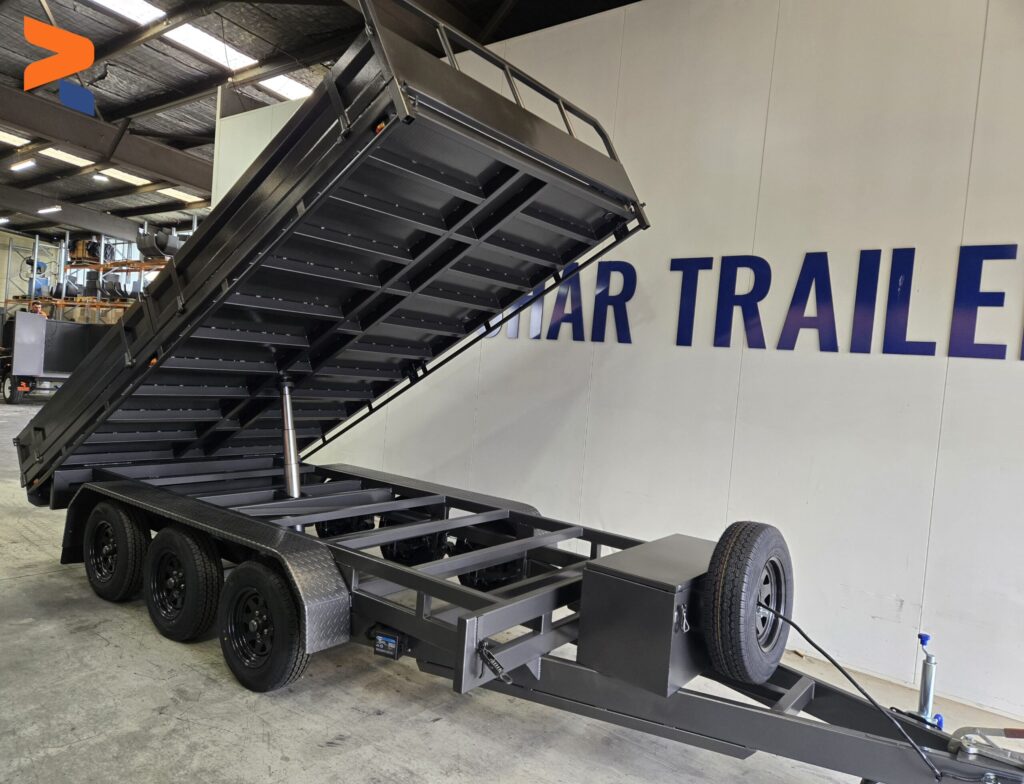
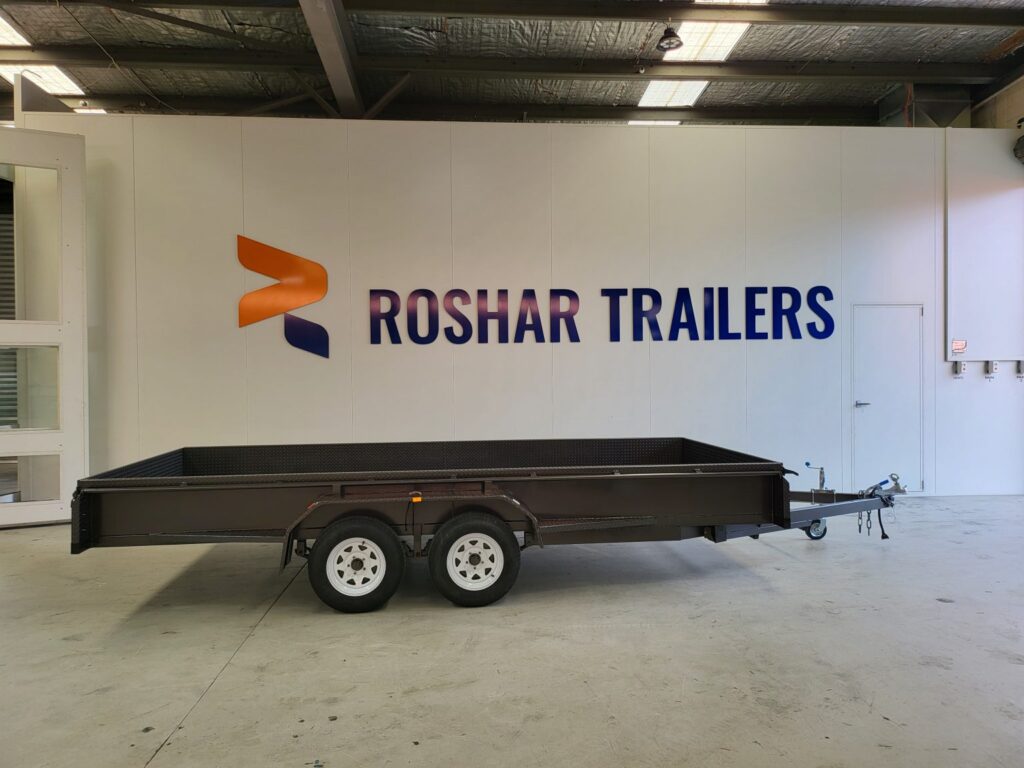
Roshar Trailers manufactures tandem trailers for trade, landscaping, property maintenance and commercial transport, with tandem configurations commonly chosen for larger builds, regular towing and applications that need more capability than many lighter single axle trailers.
Roshar’s plant trailer page says plant trailers can be customised based on the equipment being carried, towing vehicle, site conditions and preferred features, including size, GVM, floor type, brake system, suspension, ramps and other practical additions.
Roshar’s machinery trailer page says its machinery trailers are built for tough Australian conditions and can be designed for both light and heavy-duty machinery, with customisation options for specific job requirements.
Roshar’s hydraulic tipper trailer page says hydraulic tipper trailers are suited to construction, landscaping, agriculture, earthmoving, soil, gravel, rubble, green waste and bulk material removal.
Trailer type comparison
| Trailer type | Best suited to | Capacity consideration |
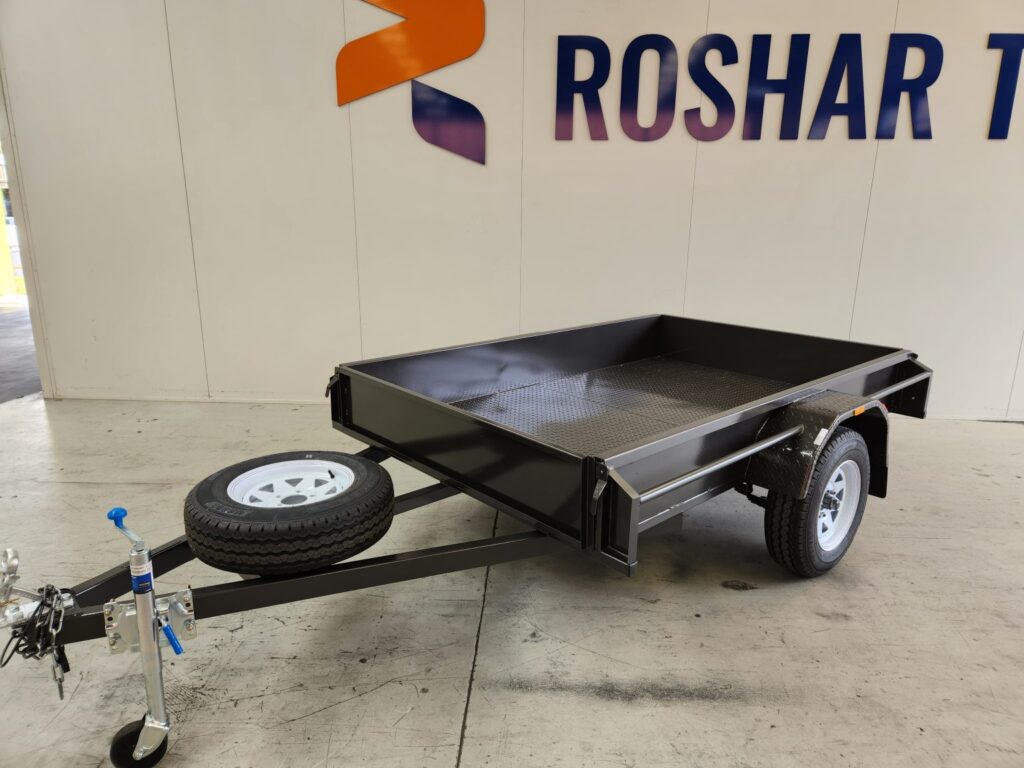
| Box trailer | Household loads, small trade loads, garden waste | Check tare, sides, axle rating and load containment |
| Tandem trailers | Repeated work loads, bulky materials, commercial use | Better for larger configurations when rated correctly |
| Plant trailer | Excavators, loaders, rollers and equipment | Check machine weight, ramps, tie-downs and brakes |
| Machinery trailers | Heavy machinery and business transport | Match trailer to machine, attachments and tow vehicle |
| Hydraulic tipper trailers | Soil, gravel, rubble, mulch and green waste | Watch bulk material weight, not just tray volume |
| Car carrier trailer | Vehicles and automotive transport | Check deck size, ramps, tyre tie-downs and vehicle weight |
| Custom trailer | Special tools, equipment or workflows | Build around real payload and access requirements |
How should you load a trailer safely?
Load a trailer by weight first, not volume. Keep heavy items low, centred and slightly forward, secure everything with suitable restraints, check tyre pressure and do not exceed ATM, GTM, towbar, coupling, tyre or tow vehicle limits.
A trailer that is within total weight can still be unsafe if it is loaded badly. Too much weight at the rear can create sway. Too much weight on the drawbar can overload the tow vehicle’s rear axle or reduce steering control. Tall, loose or shifting loads can become dangerous during braking or cornering.
NSW Government guidance says heavy loads should be concentrated towards the centre of the trailer, kept low and close to the axle or axles, with about 60 per cent of the total weight forward of the axle centre and about 5–10 per cent supported by the vehicle through the coupling as a general rule.
The National Transport Commission says vehicle or trailer loads must be loaded safely, properly restrained, not overhang dangerously, not exceed mass limits and not cover lights, indicators, reflectors or the number plate.
Safe loading process
- Start with the heaviest item: place it low and close to the axle group so the trailer remains stable.
- Keep the load slightly forward: avoid rear-heavy loading that can create trailer sway.
- Count every accessory: ramps, cages, tools, fuel, water and spare wheels all affect weight.
- Use rated restraints: machinery, cars, pallets and bulk items need suitable straps, chains or containment.
- Cover loose material: soil, mulch, rubble and green waste must not spill or blow out.
- Check lights and number plate: the load must not block the trailer’s visibility or legal markings.
- Recheck after the first short drive: straps, loads and tyre heat can change once the trailer is moving.
- Weigh the trailer if unsure: assumptions are risky when carrying soil, machinery, tools or mixed trade loads.
Conclusion
Trailer load capacity is not one simple number. It is the combined result of ATM, tare, payload, GTM, tow vehicle rating, braking, tyres, coupling, towbar, ball load and how the trailer is actually loaded.
For Victorian buyers, Roshar Trailers can help match the right trailer to the real job, whether you need tandem trailers, a plant trailer, machinery trailers or hydraulic tipper trailers for trade, landscaping, farming, construction, equipment transport or everyday work use.
FAQ’S
Can I upgrade a trailer’s load rating later?
Sometimes, but only if the trailer, axles, brakes, tyres, coupling and structure can legally support the new rating. Do not assume a rating can be changed by fitting heavier springs. Speak with the manufacturer or an approved professional before relying on any upgraded capacity.
Does a cage reduce how much weight a trailer can carry?
Yes, if the cage adds tare weight. A cage can make the trailer more useful for bulky green waste or furniture, but its own weight reduces remaining payload. The same applies to racks, toolboxes, ramps, hydraulic kits, spare wheels and other fitted accessories.
Should I load a trailer by volume or weight?
Load by weight first. A trailer may physically fit a full load of soil, gravel, mulch or rubble, but that does not mean the weight is legal or safe. Bulk materials can overload a trailer long before the tray looks full.
Do I need to weigh my trailer if I know the rating?
Yes, if the loaded weight is uncertain. Ratings tell you the limit, but only weighing tells you the actual loaded mass. This is especially important for machinery, landscaping supplies, wet green waste, soil, gravel, demolition waste and mixed work loads.
Can a 4WD tow any trailer rated to 3.5 tonnes?
No, not automatically. The tow vehicle must be rated for the loaded trailer, and you still need to check towbar capacity, towball load, GCM, rear axle load, tyres, brakes and the trailer’s actual loaded weight. Engine power alone is not enough.
What happens if a trailer is slightly overloaded?
Overloading can affect braking, tyre heat, suspension, bearings, handling, sway control and legal compliance. Even a small overload can become more serious at highway speed, in rain or on uneven worksites. Reduce the load or use a trailer with a suitable rating.
Is a tandem trailer always better for carrying more weight?
No, tandem trailers can support larger and heavier-duty configurations when correctly rated, but the rating still depends on the exact build. A tandem setup does not automatically make overloading safe. Check ATM, tare, payload, brakes, tyres and tow vehicle compatibility.