
37 Malcolm RD, Braeside, VIC
7 Types of Trailer Couplings and Their Common Uses
25 September 2026 | roshartrailers
By Writer :- Ron
By Roshar Trailers Team, Trailer Manufacturing and Sales Specialists
Published: 25/09/2026
Last updated: 25/09/2026
Choosing the right coupling is one of the most important decisions when building, buying or modifying a trailer. The coupling is the connection between the trailer and tow vehicle, so its rating, fitment and condition need to match the trailer and towing setup.
For Australian trailer owners, trailer coupling types Australia buyers see range from straightforward 50 mm ball couplings for everyday road trailers to articulated off-road couplings designed for greater movement between the tow vehicle and trailer.
The important point is that a coupling should never be selected by appearance alone. The trailer’s rating, tow-ball or hitch compatibility, braking arrangement, mounting method and intended use all matter.
Australian coupling suppliers currently list standard 50 mm couplings, override couplings, polyblock couplings and off-road options including DO35 and DO45 systems.
What is a trailer coupling and why does it matter?
A trailer coupling is the component mounted at the front of a trailer’s drawbar or A-frame that connects the trailer to the towing vehicle. It transfers towing and braking forces while allowing the trailer to articulate relative to the vehicle.
ARK describes the coupling as the essential link between a trailer and tow vehicle, fitted to the leading edge of the trailer A-frame.
That makes the coupling more than a simple connection point. It needs to work correctly during:
- Acceleration
- Braking
- Cornering
- Reversing
- Uneven-road travel
- Loading and unloading
- Repeated coupling and uncoupling
A coupling that is incorrectly rated, incorrectly mounted or worn can compromise the connection between the trailer and tow vehicle.
The three things to establish first
Before comparing types of trailer couplings, identify:
- Trailer rating – What is the trailer’s relevant mass rating?
- Towing equipment – What tow ball, pin or compatible hitch does the vehicle use?
- Application – Is the trailer mainly used on sealed roads, worksites, farms or off-road terrain?
These three answers narrow the appropriate coupling category considerably.
What are the main trailer coupling types Australia owners should know?
The main trailer coupling types Australia owners encounter can be grouped by connection method, braking arrangement, rating and articulation.
| Coupling type | Typical application | Main characteristic |
| Fixed 50 mm ball | General road trailers | Simple ball-and-coupling connection |
| 50 mm override | Braked road trailers | Coupling incorporates an override braking mechanism |
| 70 mm heavy-duty | Higher-rated applications | Larger coupling/ball interface where specified |
| Polyblock | Heavy/off-road applications | Articulated connection with substantial movement |
| Articulated off-road ball | Off-road trailers | Increased articulation compared with conventional road coupling |
| DO35 | Off-road caravans/trailers | High-articulation coupling system |
| DO45 | Heavier off-road applications | Larger articulated coupling option |
The exact rating and suitability depend on the specific coupling model. For example, current Australian coupling listings include 50 mm products with different ratings, while other products are listed at 3.5 tonnes or 4.5 tonnes.
Do not assume that two couplings with the same connection diameter have the same capacity or application.
1. Fixed 50 mm Ball Couplings
Fixed 50 mm ball couplings are a common choice for conventional road trailers where the trailer and tow vehicle use a compatible 50 mm tow-ball connection.
The coupling attaches to the trailer drawbar and locks onto the tow ball. Some designs are bolted to the trailer, while others use different mounting arrangements according to the trailer design.
ARK describes its fixed 50 mm coupling as a basic coupling that connects to a standard 50 mm tow ball and notes that fixed couplings provide limited articulation compared with specialised off-road systems.
Common uses
Fixed 50 mm couplings can suit:
- Box trailers
- General utility trailers
- Light commercial trailers
- Some tradesman trailers
- Road-going equipment trailers
When this coupling makes sense
A fixed coupling is practical when the trailer spends most of its time on normal roads and does not require extreme articulation.
For example, a tradie towing a work trailer between Melbourne job sites generally has different coupling requirements from someone taking an off-road trailer over steep, uneven terrain.
2. 50 mm Override Couplings
A 50 mm override coupling combines a 50 mm ball connection with an override braking mechanism on applicable braked trailers. When the trailer pushes against the tow vehicle during deceleration, the mechanism can operate the trailer’s braking system.
Override couplings are widely available in Australia, including 50 mm versions designed for different trailer ratings and braking arrangements.
Common uses
They can be found on:
- Braked box trailers
- Tandem trailers
- Plant trailers
- Machinery trailers
- Other road-going trailers with compatible braking systems
What to check
When replacing an override coupling, do not simply match the physical shape. Confirm:
- Coupling rating
- Tow-ball size
- Brake system compatibility
- Drawbar dimensions
- Mounting holes
- Handbrake arrangement
- Manufacturer specifications
A coupling can physically fit while still being the wrong rated or configured component for the trailer.
3. 70 mm Heavy-Duty Couplings
70 mm couplings are used for higher-rated trailer applications where the trailer and towing equipment are designed around that connection size.
Australian suppliers list 70 mm electric trailer couplings with ratings such as 4,500 kg, demonstrating that larger coupling systems are available for heavier trailer applications.
Common uses
Depending on the specific product, these couplings may be used on:
- Heavy-duty work trailers
- Machinery trailers
- Higher-rated commercial trailers
- Specialised equipment trailers
The important point is that a larger coupling is not automatically better. The coupling, tow equipment, drawbar, brakes, axles and trailer rating all need to work together.
Practical example
A contractor moving heavier machinery may require a coupling with a rating appropriate to the trailer’s approved configuration. Installing a higher-rated coupling alone does not increase the trailer’s legal carrying capacity.
4. Polyblock Couplings
Polyblock couplings use a block-style connection rather than relying on a conventional ball-and-socket arrangement. They are commonly associated with applications where additional articulation and robust off-road performance are important.
Australian trailer-parts suppliers currently list polyblock couplings alongside standard 50 mm and off-road coupling options.
Common uses
Polyblock systems may suit:
- Off-road trailers
- Heavy-duty equipment trailers
- Specialised towing applications
- Applications requiring greater articulation
Their main advantage is the ability to accommodate more movement between the towing vehicle and trailer than a basic fixed ball coupling.
What makes them different?
The connection system allows movement through the coupling itself rather than relying only on the movement available from a conventional ball connection.
That can be valuable where the trailer travels over uneven terrain and the tow vehicle and trailer need to move through different angles.
5. Articulated Off-Road Ball Couplings
Articulated off-road ball couplings are designed for towing situations where greater articulation is required than a conventional fixed road coupling provides.
Australian coupling suppliers describe off-road couplings as options for applications requiring additional articulation, with products available for different braking systems and ratings.
Common uses
These couplings can be appropriate for:
- Off-road trailers
- 4WD touring applications
- Rural trailers
- Uneven worksites
- Trailers that regularly encounter significant changes in terrain
Why articulation matters
Imagine a trailer crossing a deep diagonal rut. The tow vehicle may remain relatively level while the trailer tilts substantially to one side.
A conventional road coupling may not provide the same range of articulation as a coupling specifically designed for that environment.
This is why choosing a trailer coupling should always consider where the trailer actually travels, not simply the load it carries.
6. DO35 Couplings
DO35 is a recognised articulated coupling system used extensively in Australian off-road towing applications.
The design provides substantially more articulation than a conventional ball coupling, making it suitable for trailers and caravans that encounter uneven terrain.
Cruisemaster’s coupling range includes DO35 systems, while Australian trailer-parts suppliers currently list DO35 products for off-road towing.
Common uses
DO35 couplings are commonly associated with:
- Off-road caravans
- Off-road trailers
- Touring trailers
- Applications requiring high articulation
Important consideration
DO35 is not simply a larger version of a standard 50 mm coupling. It is a different coupling system with its own compatible hitch components.
If a trailer is equipped with a DO35 coupling, the tow vehicle needs the correct compatible hitch arrangement.
7. DO45 Couplings
DO45 is another articulated coupling system designed for demanding towing applications, particularly where increased articulation and a robust connection are required.
Australian suppliers list DO45 products alongside DO35 systems, while Cruisemaster provides DO35/DO45 coupling options for off-road applications.
Common uses
DO45 systems may be considered for:
- Heavier off-road trailers
- Off-road caravans
- Commercial off-road applications
- Equipment trailers requiring high articulation
The specific coupling model and rating should always be checked before purchase.
DO35 vs DO45
The names should not be treated as interchangeable.
| Consideration | DO35 | DO45 |
| Connection type | Articulated | Articulated |
| Typical environment | Off-road | Off-road/heavier applications |
| Compatibility | Requires compatible hitch | Requires compatible hitch |
| Selection factor | Trailer specification and application | Trailer specification and application |
| Interchangeable by default? | No | No |
Always follow the coupling and hitch manufacturer’s compatibility requirements.
How do you choose the right trailer coupling?
Choosing a trailer coupling starts with the trailer’s approved rating and intended use, then works through tow-ball or hitch compatibility, braking arrangement, mounting requirements and articulation needs.
A practical selection framework is:
1. Start with the trailer rating
Check the trailer’s compliance plate and manufacturer documentation.
Do not choose a coupling solely because its advertised rating looks high enough.
The coupling is only one part of the complete towing system.
2. Match the towing connection
A 50 mm ball coupling needs a compatible 50 mm tow ball. An articulated coupling needs its compatible hitch or pin arrangement.
Modern Trailers notes that coupler selection should consider both tow-ball size and the trailer’s gross weight rating.
3. Check the braking arrangement
Determine whether the trailer uses:
- Override brakes
- Electric brakes
- Hydraulic brakes
- Another approved braking arrangement
The coupling must be compatible with the braking system where applicable.
4. Consider the terrain
Ask where the trailer actually travels.
Mostly sealed roads: A conventional road coupling may be appropriate.
Worksites and uneven access: Consider whether additional articulation is useful.
Regular off-road towing: An articulated coupling may be more appropriate.
5. Confirm mounting requirements
Check:
- Drawbar dimensions
- Bolt-hole pattern
- Coupling plate
- Fasteners
- Welding requirements
- Manufacturer installation instructions
A coupling should not be modified or fitted using improvised mounting arrangements.
Coupling selection framework
| Question | If the answer is… | Focus on |
| Mostly road towing? | Yes | Conventional road coupling |
| Trailer has override brakes? | Yes | Compatible override coupling |
| Higher-rated trailer? | Yes | Correct heavy-duty rated coupling |
| Frequent uneven/off-road travel? | Yes | Articulated coupling |
| Existing hitch is specialised? | Yes | Exact compatibility |
| Replacing a worn coupling? | Yes | Like-for-like specification verification |
How do you inspect a trailer coupling?
You can inspect a trailer coupling by checking the locking mechanism, tow-ball interface, mounting points, drawbar area, safety components, visible wear and operation before towing. If anything appears damaged, loose or unreliable, do not assume it will improve once connected.
Trailer coupling inspection checklist
Step 1 – Inspect the coupling body
Look for:
- Cracks
- Deformation
- Corrosion
- Excessive wear
- Damaged welds
Step 2 – Check the locking mechanism
Operate the coupling according to the manufacturer’s instructions.
The mechanism should engage correctly and indicate the locked position where applicable.
Step 3 – Inspect the mounting area
Look at the bolts, mounting plate, welds and surrounding drawbar.
Movement or cracking around the mounting area is a reason to stop and investigate.
Step 4 – Check the tow-ball interface
Look for excessive wear, damage or contamination around the connection area.
Step 5 – Check safety components
Inspect:
- Safety chains
- Chain attachment points
- Safety catch
- Breakaway components where fitted
Step 6 – Perform a connection check
After coupling, confirm the connection is properly locked before moving the trailer.
What are common trailer coupling wear signs?
Common trailer coupling wear signs include excessive movement, difficulty locking, visible cracking, deformation, corrosion, damaged locking components and abnormal wear around the ball or coupling interface.
Do not ignore a coupling that suddenly feels different from normal.
Wear-sign table
| Sign | What it may indicate | Action |
| Excessive play | Coupling or ball wear | Inspect before towing |
| Difficult locking | Mechanism or alignment problem | Investigate |
| Cracks | Structural damage | Stop using and seek assessment |
| Deformation | Impact or excessive loading | Professional inspection |
| Heavy corrosion | Material deterioration | Assess condition |
| Damaged latch | Locking-system problem | Repair or replace |
| Unusual movement | Connection or mounting issue | Stop and investigate |
| Visible drawbar cracking | Structural problem | Do not tow |
A simple rule
If you can see, hear or feel a change in the coupling’s normal operation, treat it as a reason to inspect rather than something to work around.
What trailer coupling safety checks should you perform?
Trailer coupling safety checks should confirm that the coupling is correctly connected, locked, compatible with the tow vehicle and free from obvious damage before the trailer moves.
A practical pre-trip routine is:
Before connecting
- Check the coupling condition.
- Check the tow ball or compatible hitch.
- Inspect the drawbar.
- Check safety chains.
- Check electrical connections.
After connecting
- Confirm the coupling is fully seated.
- Confirm the locking mechanism is engaged.
- Attach safety chains correctly.
- Connect the trailer plug.
- Check lights.
- Check the handbrake or braking arrangement as applicable.
- Confirm the trailer is sitting correctly.
Before entering traffic
Perform a final walk-around.
Look for:
- Loose components
- Open latches
- Unsecured ramps
- Incorrectly positioned chains
- Damaged wiring
- Tyre problems
- Load movement
The National Heavy Vehicle Regulator states that compliant 50 mm ball couplings under AS 4177 can be used in specified configurations up to a trailer ATM of 3,500 kg, illustrating why coupling selection needs to be based on the complete rated towing system rather than appearance.
What are common trailer hitch problems?
Common trailer hitch problems include incorrect coupling size, worn connection surfaces, damaged locking mechanisms, loose mounting hardware, poor alignment, corrosion and using incompatible towing components.
One of the easiest mistakes to make is matching a coupling by physical appearance rather than specification.
For example, two products may both connect to a tow ball but have different ratings, mounting requirements or intended applications.
Problem → likely concern → response
| Problem | Possible concern | Recommended response |
| Coupling will not lock | Wrong ball size, wear or mechanism fault | Stop and identify the cause |
| Coupling has excessive movement | Wear or incompatible components | Inspect before towing |
| Coupling is difficult to operate | Corrosion or damaged mechanism | Service/assess |
| Mounting bolts appear loose | Installation or structural issue | Do not tow until checked |
| Coupling body is cracked | Structural failure risk | Remove from service |
| Hitch and coupling are incompatible | Incorrect connection | Use specified matching components |
| Coupling is heavily corroded | Material deterioration | Professional assessment |
When should a trailer coupling be replaced?
A trailer coupling should be replaced when it is damaged, excessively worn, structurally compromised, incompatible with the trailer or no longer operates correctly according to its manufacturer’s requirements.
Replacement should not be based purely on age.
A relatively new coupling can become unsafe after an impact or incorrect installation, while an older coupling that has been properly maintained may remain serviceable.
The condition of the:
- Coupling
- Drawbar
- Mounting plate
- Fasteners
- Tow ball
- Safety chains
should be considered together.
If the coupling has cracked, deformed or developed excessive play, have the trailer assessed before towing.
How does coupling choice change for different Roshar trailer types?
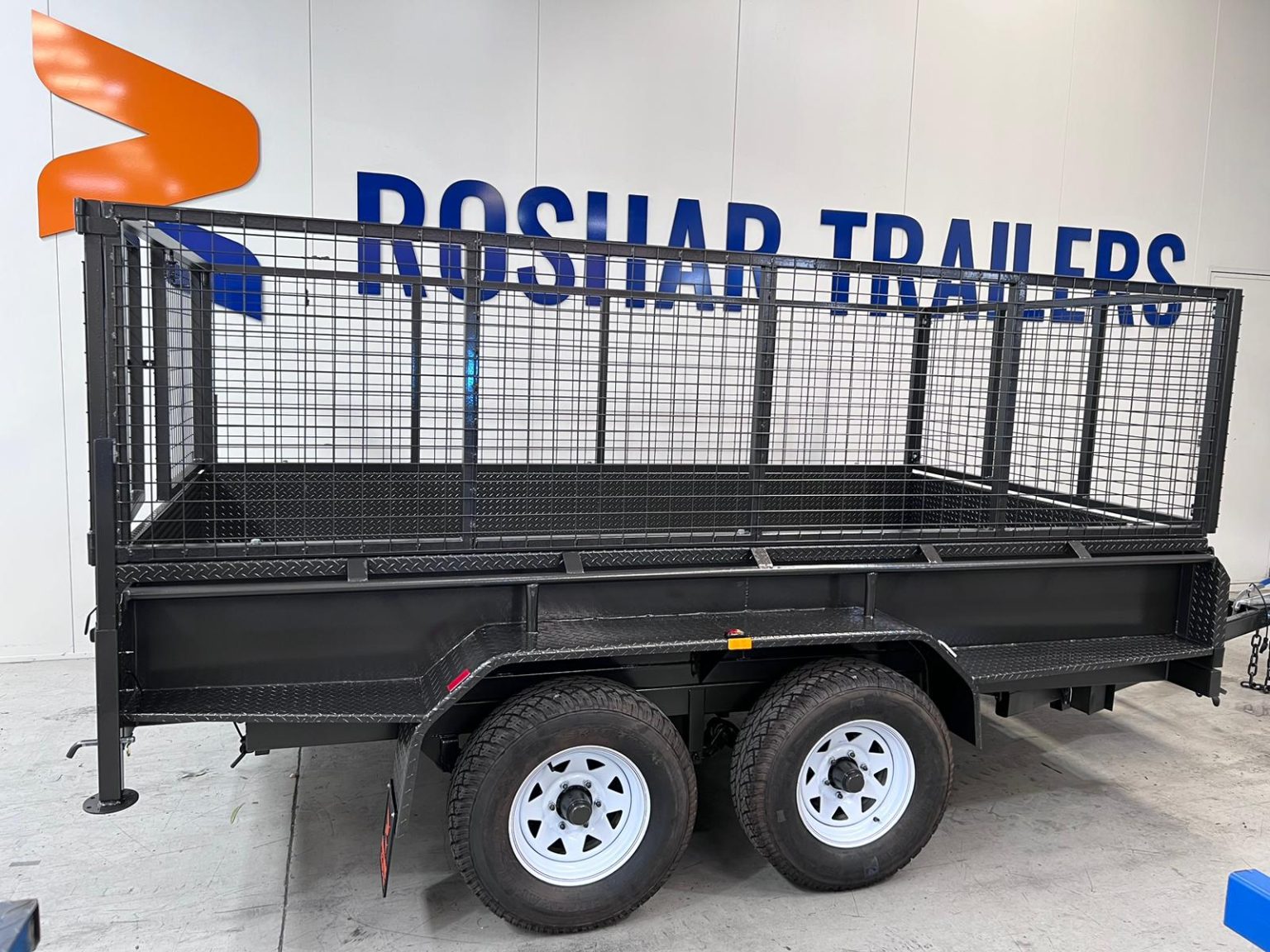
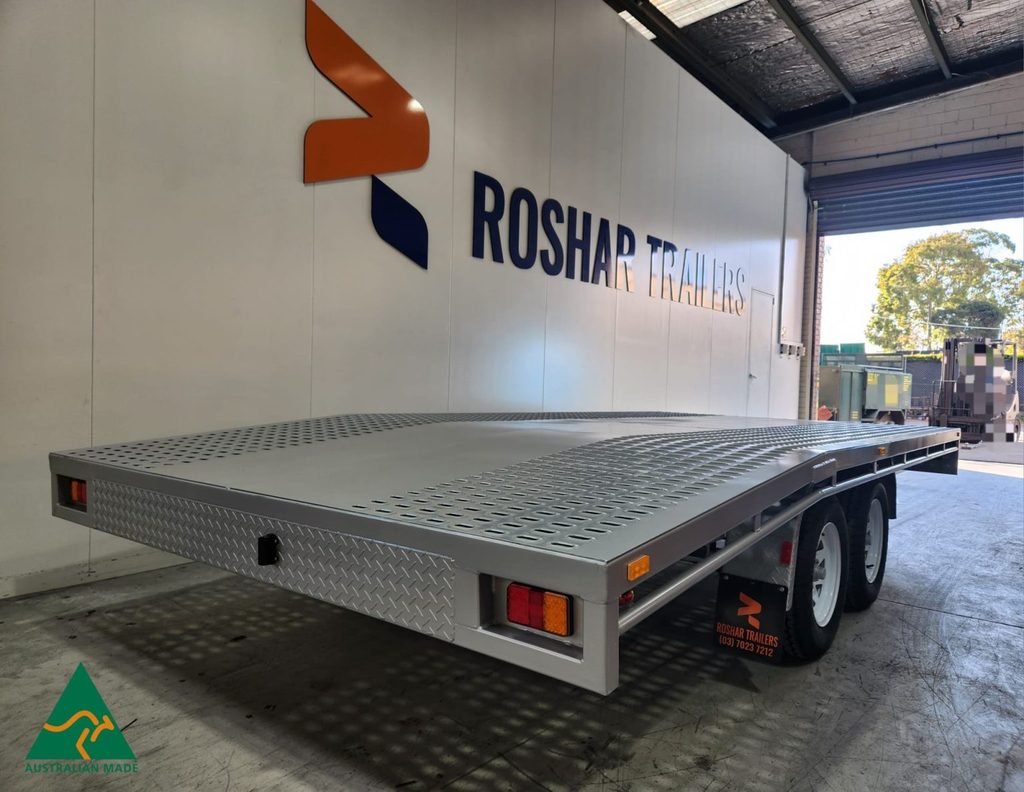
Coupling selection should follow the trailer’s specification and intended application. Roshar manufactures a wide range of trailers including box, cage, car carrier, flat top, machinery, plant, tandem, tipper and tradesman trailers.
For example, a general-purpose box trailer used primarily on sealed roads has different requirements from a machinery trailer that regularly carries equipment to worksites.
Roshar’s current range includes:
- Box trailers
- Cage trailers
- Car carrier trailers
- Custom-made trailers
- Excavator trailers
- Flat top trailers
- Hydraulic tipper trailers
- Machinery trailers
- Plant trailers
- Tandem trailers
- Tradesman trailers
- Tri-axle trailers
This is where talking to the trailer manufacturer can be useful. The coupling should be selected as part of the trailer configuration rather than treated as an isolated accessory.
For buyers looking at trailer couplings, the right starting point is the trailer’s approved specifications and intended use.
What should you ask before replacing a trailer coupling?
Before buying a replacement coupling, ask:
- What is the trailer’s ATM/GTM rating?
- What coupling is currently fitted?
- What tow-ball or hitch does the tow vehicle use?
- Is the trailer braked?
- What brake mechanism is fitted?
- What is the coupling mounting pattern?
- Does the replacement coupling have the required rating?
- Is the coupling approved for the intended application?
- Does the new coupling require changes to the drawbar?
- Does the manufacturer specify installation requirements?
Do not choose a coupling simply because it is advertised as “heavy duty”.
A coupling is part of a system. Increasing one component’s rating does not automatically increase the rating of the trailer.
Conclusion
Understanding trailer coupling types Australia buyers commonly encounter makes it easier to select the right connection for a trailer’s rating and intended use.
Fixed 50 mm couplings suit many conventional road trailers, while override couplings are used with compatible braked trailers. Larger 70 mm systems, polyblock couplings and articulated options such as DO35 and DO45 serve more specialised applications.
The safest approach is straightforward: match the coupling to the trailer, towing equipment, braking system and terrain then inspect the connection before every trip.
Roshar Trailers manufactures and supplies a broad range of trailers in Melbourne, including box, cage, car carrier, flat top, machinery, plant, tandem, tipper and tradesman trailers.
If you are unsure which coupling configuration suits a new or replacement trailer, speak with the trailer manufacturer or a qualified trailer professional before making changes.
Need help choosing the right trailer setup? Contact Roshar Trailers to discuss your requirements.
Braeside | Bayswater North | Dandenong
Contact Roshar Trailers for trailer advice
Roshar Trailers
FAQ’S
Can I use any tow ball with a trailer coupling?
No, the tow ball must match the coupling’s specified size, rating and compatibility requirements. A physically similar ball is not necessarily suitable. Check the coupling and tow-ball markings and manufacturer specifications before towing.
Do trailer couplings need lubrication?
Yes, but only where the coupling manufacturer specifies lubrication. Some coupling designs have different maintenance requirements, and off-road systems may use different connection arrangements. Follow the product manufacturer’s instructions rather than applying grease or lubricant to every component automatically.
Can a worn tow ball damage a trailer coupling?
Yes, a worn, damaged or incorrectly sized tow ball can affect the coupling connection and accelerate wear. Check the tow ball as part of the coupling inspection and replace components that do not meet the required specification.
Can I replace a 50 mm coupling with a different brand?
Yes, but only if the replacement is correctly rated, compatible with the trailer and installed according to the manufacturer’s requirements. Check the mounting arrangement, braking system, drawbar dimensions and coupling specifications before treating a different brand as a direct replacement.
Are off-road trailer couplings suitable for normal road towing?
Yes, some are designed for both road and off-road applications, but suitability depends on the specific coupling and trailer configuration. Do not assume an off-road coupling is automatically compatible with every tow vehicle or road trailer.
Should I replace the tow ball when replacing the coupling?
Yes, if the tow ball is worn, damaged, incorrectly rated or incompatible with the replacement coupling. A new coupling does not correct a defective tow ball, so inspect both parts before returning the trailer to service.