
37 Malcolm RD, Braeside, VIC
6 Trailer Axle Types Buyers Should Know
16 October 2026 | roshartrailers
Table of Contents
By Writer :- Ron
Roshar Trailers Team, Trailer Manufacturing and Sales Specialists
Published: 16/10/2026
If you’re comparing trailer axle types Australia buyers commonly encounter, the six worth understanding are straight beam, drop, torsion, single-axle, tandem-axle and tri-axle configurations. The first three describe axle design; the last three describe how many axles support the trailer.
The axle sits underneath the trailer, but it affects much more than the wheels. It influences load capacity, ride height, suspension behaviour, braking options, stability and how the trailer handles its intended workload.
For a homeowner buying a small box trailer, a single axle may be perfectly practical. A landscaper carrying equipment every day may need a tandem setup. A contractor moving heavier machinery may need a tri-axle configuration or another heavy-duty arrangement.
This guide explains the differences without getting buried in engineering jargon.
What are the main trailer axle types Australia buyers compare?
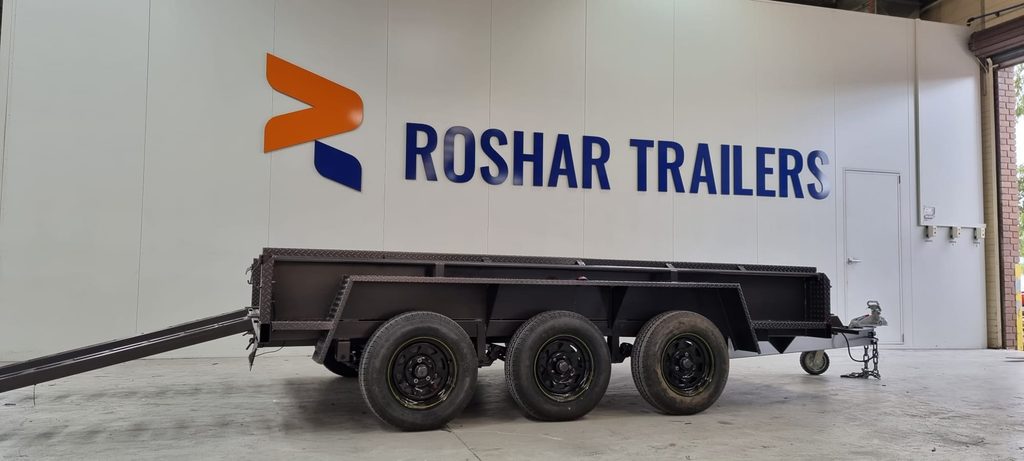
The main trailer axle types Australia buyers encounter fall into two groups: physical axle designs and axle configurations. Straight beam, drop and torsion describe how an axle works, while single, tandem and tri-axle describe how many axles support the trailer.
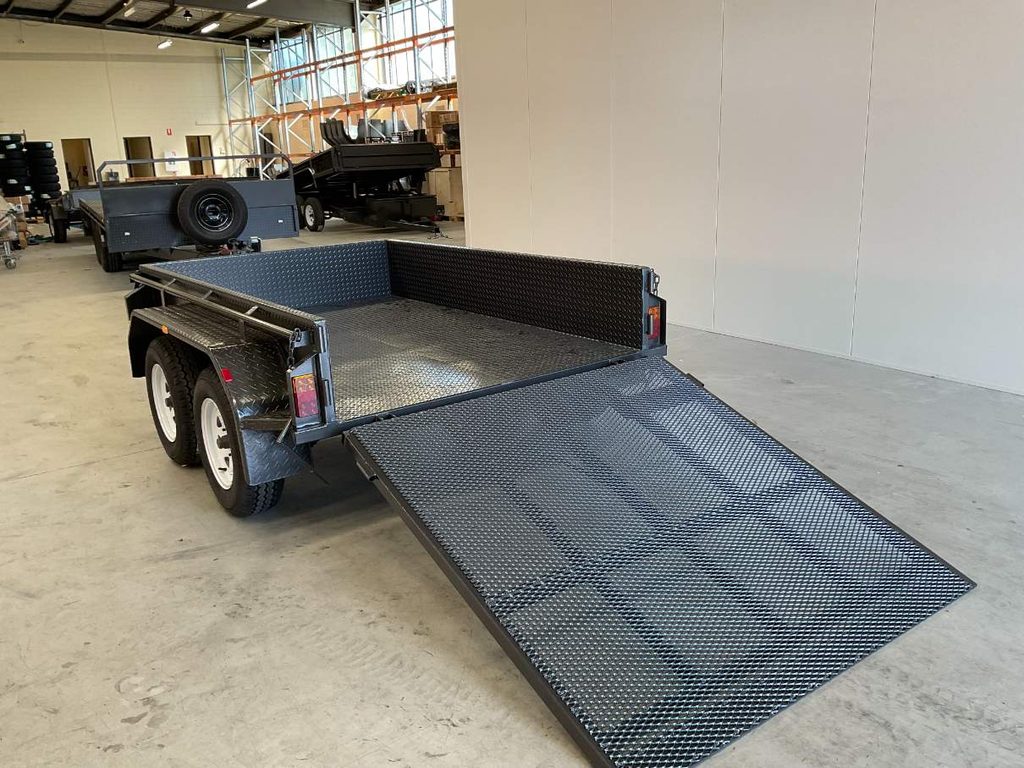
That distinction matters because a trailer can have, for example, a tandem configuration using a particular axle design. “Tandem” does not describe the axle beam itself; it describes the number and arrangement of axles.
Six axle types/configurations at a glance
| Type | What it describes | Typical advantage | Common application |
| Straight beam axle | Physical axle design | Simple, strong construction | General-purpose trailers |
| Drop axle | Physical axle design | Lower trailer height | Lower loading height |
| Torsion axle | Axle/suspension design | Independent wheel movement and compact setup | Applications where ride and packaging matter |
| Single axle | One-axle configuration | Manoeuvrability and simplicity | Light/general transport |
| Tandem axle | Two-axle configuration | Greater load distribution and stability | Trade, commercial and heavier work |
| Tri-axle | Three-axle configuration | Supports larger/heavier trailer builds | Heavy-duty transport |
Modern Trailers similarly separates straight, drop and torsion designs from single and tandem configurations. Modern Trailers
For buyers, this is the first important lesson: don’t compare “torsion vs tandem” as though they are two alternatives from the same category. One describes an axle/suspension design; the other describes axle count.
What is a straight beam axle?
A straight beam axle is a conventional axle running across the trailer between the wheels. It is a straightforward design commonly used where strength, simplicity, serviceability and predictable load support are more important than lowering the trailer deck.
A straight axle is the design many buyers picture when they think of a traditional trailer axle. It connects the wheel ends and works with the trailer’s suspension, hubs, bearings and brakes where fitted.
Why choose a straight axle?
A straight beam setup can make sense when:
- the trailer has adequate ground clearance already
- a conventional running-gear arrangement suits the build
- straightforward servicing matters
- the trailer is used for general transport
- the axle rating matches the required load
For example, a contractor using a general-purpose box trailer may not need a lowered deck. A conventional axle arrangement can provide a practical solution without adding unnecessary complexity.
Straight axle does not mean “light duty”
This is an important distinction.
Axle strength depends on the actual beam, material, dimensions, bearings, hubs, suspension, rating and complete trailer design. You cannot determine an axle’s capacity simply because it is straight.
When comparing trailer axles, check the manufacturer’s rating and the complete trailer’s approved configuration rather than relying on appearance.
What is a drop axle?
A drop axle has a lowered section in its design that allows the trailer deck or chassis to sit lower than it would with a conventional straight axle arrangement. The main practical benefit is reduced loading height and, depending on the design, a lower centre of gravity.
A lower deck can be useful when loading machinery, vehicles or other equipment where ramp angle and loading height matter.
When is a drop axle useful?
A drop axle can be considered when:
- equipment is difficult to load onto a high deck
- a lower loading angle is beneficial
- trailer height needs to be reduced
- centre-of-gravity considerations matter
- the trailer design requires additional clearance around the chassis
Imagine a contractor loading a low-clearance machine. A lower deck can make the ramp transition easier than a high trailer deck.
However, lowering the axle does not automatically make a trailer safer or better. Ground clearance, suspension movement, chassis design and the complete trailer configuration still need to work together.
The trade-off
The benefit is usually easier loading or a lower trailer profile.
The trade-off can be reduced ground clearance depending on the overall design.
That’s why drop axles should be selected as part of the whole trailer design, not as an isolated upgrade.
What is a torsion axle?
A torsion axle uses a torsion-based suspension arrangement rather than relying on a conventional leaf-spring setup. The suspension action is incorporated into the axle assembly, allowing wheel movement to absorb road impacts.
Torsion systems can offer a compact suspension package and independent movement between the wheel sides, depending on the specific design.
Why consider a torsion axle?
Potential advantages include:
- compact packaging
- independent wheel movement
- reduced number of conventional suspension components
- potentially smoother behaviour on suitable applications
- useful ride-height and suspension options depending on design
Torsion systems can be attractive for particular trailer applications, but they are not automatically superior to leaf-spring systems.
For a tradie or contractor, the important question is whether the system is correctly rated for the intended work.
A trailer carrying light equipment around metropolitan Melbourne has different requirements from a commercial trailer regularly carrying machinery between Melbourne and regional Victoria.
Torsion vs conventional suspension
| Consideration | Torsion system | Conventional leaf-spring system |
| Wheel movement | Can operate independently | Generally linked through axle/spring arrangement |
| Packaging | Compact | Simple and familiar |
| Servicing approach | Different components and procedures | Familiar spring, shackle and hanger components |
| Best choice | Application-dependent | Application-dependent |
| Heavy commercial use | Depends on rated system | Common in many work trailers |
There is no universal “best” suspension. The load, trailer design, road conditions, maintenance requirements and intended duty cycle should determine the choice.
What is the difference between single, tandem and tri-axle configurations?
Single, tandem and tri-axle describe the number of axles fitted to a trailer: one, two or three respectively. The correct configuration depends on the trailer’s approved mass, dimensions, load, towing vehicle and intended use.
Single axle
A single axle has one axle and two wheels in the simplest arrangement.
It can suit:
- light general transport
- compact box trailers
- homeowners
- small trade loads
- applications where manoeuvrability is important
Single axle trailers generally have fewer running-gear components and can be easier to manoeuvre in tight spaces.
Tandem axle
A tandem trailer uses two axles positioned close together, supporting the trailer across four wheels.
Roshar’s current tandem range includes box, cage, flat top, enclosed, tipper and custom configurations, with options across different sizes and GVMs. Roshar Trailers
Tandem setups are commonly considered for:
- heavier work
- larger trailer bodies
- frequent commercial use
- machinery and equipment
- larger cage trailers
- flat top trailers
- tippers
For example, a landscaper carrying green waste, equipment and materials every day may find a tandem trailer more suitable than a compact single-axle trailer.
Tri-axle
A tri-axle trailer has three axles.
Roshar’s tri-axle range includes heavy-duty box, flat-bed, car carrier and custom configurations. The company specifically positions tri-axle trailers for larger or heavier transport applications.
A tri-axle configuration can be appropriate when the trailer’s size, load and approved ratings justify three axles.
More axles do not automatically mean more legal payload. The complete trailer still has to remain within its approved mass, component and towing limits.
Which axle configuration is best for different trailer uses?
The best axle configuration depends on the trailer’s actual workload, with single axles often suited to lighter compact applications, tandem axles common for heavier trade and commercial work, and tri-axles reserved for larger configurations where their additional running gear is justified.
Axle configuration by use
| Application | Often suitable | Why |
| Home garden work | Single axle | Compact and manoeuvrable |
| Small box trailer | Single axle | Simple general-purpose setup |
| Electrician’s trailer | Single or tandem | Depends on trailer size and equipment load |
| Landscaper | Tandem | Useful for larger equipment and regular loads |
| Builder/contractor | Tandem | Suitable for larger work configurations |
| Machinery transport | Tandem or tri-axle | Depends on machinery weight and dimensions |
| Car transport | Tandem or tri-axle | Depends on vehicle, trailer design and approved mass |
| Heavy commercial transport | Tandem/tri-axle | Depends on the complete trailer configuration |
| Tiny-house chassis | Multi-axle configuration | Depends heavily on finished mass and chassis design |
Roshar’s trailer range shows this application-based approach: its product range includes single and tandem box trailers, tandem and heavy-duty plant configurations, and tri-axle options for larger transport applications.
Don’t choose axle count first
A common mistake is saying:
“I need a tandem because tandem is stronger.”
Instead, start with:
- What will the trailer carry?
- What will the loaded trailer weigh?
- What is the trailer’s approved GVM/ATM?
- What can the tow vehicle legally tow?
- What braking system is required?
- What type of work will the trailer perform?
The axle configuration should follow those answers.
How do ATM, GTM and axle ratings affect your choice?
Axle selection must match the trailer’s approved mass and component ratings. ATM is the maximum loaded mass of the trailer, while GTM is the mass transmitted through the trailer’s axle or axle group; these figures affect axle capacity, braking and legal towing decisions.
According to the Department of Infrastructure, trailers with an ATM of 4.5 tonnes or less fall under the low-ATM framework addressed by VSB 1 Revision 6, published in August 2026. Department of Infrastructure
ATM
Aggregate Trailer Mass (ATM) is the maximum permitted mass of the trailer when loaded and not coupled to the tow vehicle.
It includes the trailer itself and its load.
GTM
Gross Trailer Mass (GTM) is the mass transmitted to the ground through the trailer’s axle or axle group while connected to the tow vehicle.
This distinction matters because braking requirements use GTM.
South Australia’s current guidance states that trailers must be fitted with brakes when GTM exceeds 750 kg, with additional requirements applying as GTM increases. South Australia Government
NSW guidance similarly sets minimum brake requirements according to GTM and states that trailers in the 2,001 kg GTM to 4,500 kg ATM range require braking on all wheels and a breakaway system. NSW Government
The practical rule
Don’t calculate axle capacity by looking only at the trailer’s empty weight.
Consider:
Trailer tare + equipment + tools + materials + accessories = actual loaded mass
Then compare that figure against:
- ATM
- GTM
- axle rating
- tyre rating
- coupling rating
- tow vehicle limits
- braking requirements
How do you choose between single vs tandem axle setups?
The single vs tandem axle decision should be based on load, trailer size, towing frequency, manoeuvrability and the complete approved configuration. Single axle setups favour compact, lighter applications, while tandem setups are commonly selected for larger or heavier work trailers.
Choose single axle when:
- your loads are relatively light
- you want easier manoeuvrability
- the trailer is compact
- parking space is limited
- you don’t regularly carry heavy equipment
Choose tandem when:
- the trailer is larger
- loads are heavier
- the trailer is used frequently
- additional load distribution is useful
- you need a larger cage, flat top or tipper
- the business depends on the trailer every day
Roshar’s own tandem guidance recommends looking at what you carry, required GVM, towing capacity and trailer configuration rather than choosing a tandem solely because it sounds stronger.
Single vs tandem comparison
| Factor | Single axle | Tandem axle |
| Number of axles | 1 | 2 |
| Wheel count | Usually 2 | Usually 4 |
| Manoeuvrability | Generally easier | Requires more room |
| Running gear | Fewer components | More components |
| Typical application | Light/general work | Heavier/frequent work |
| Maintenance | Fewer components | More components to inspect |
| Trailer size | Often compact | Common on larger builds |
| Best deciding factor | Load and application | Load and application |
Neither configuration is automatically better. The correct answer depends on your actual trailer specification.
What does a trailer axle replacement cost in Australia?
Australian retail pricing shows that axle component costs vary significantly by axle diameter, length, finish, hubs and brakes. As a current guide, basic axle beams can start around A111–A195, galvanised 45 mm square examples can be around A200–A295, while complete braked assemblies can be several hundred dollars or more.
These figures are component examples, not fitted replacement quotes.
Current Australian examples
| Component example | Indicative retail price |
| 40 mm square axle | From about A$111 |
| 45 mm square black axle | About A190–A195 |
| 45 mm square galvanised axle | About A200–A295 |
| Complete mechanical disc-braked axle example | About A$430 |
| Complete axle/brake assemblies | Can reach A500–A1,000+ depending on specification |
For example, current Australian retailers list 40 mm square axles from around A111and45mmsquareaxlesfromaroundA134, while complete or braked assemblies cost more. Jagsingh Australia
What increases replacement cost?
Expect the price to change based on:
- axle length
- axle diameter
- load rating
- galvanised vs natural finish
- hubs
- bearings
- brake drums or discs
- electric or mechanical brakes
- wheel stud pattern
- installation labour
- suspension components
- custom machining
A replacement axle should not be chosen from price alone. A physically similar axle can still be the wrong rating, length or hub configuration.
When should you get professional axle advice?
You should get professional axle advice when replacing an axle, changing axle configuration, increasing trailer capacity, modifying suspension or building a trailer for a specific heavy load. Incorrect measurements or ratings can create alignment, braking, structural and compliance problems.
Professional advice is particularly worthwhile if:
- the axle is visibly bent
- tyres are wearing unevenly
- the trailer pulls to one side
- the trailer has suffered an impact
- you’re increasing the trailer’s capacity
- you’re converting single axle to tandem
- you’re adding heavier machinery
- you’re changing suspension
- you’re unsure about GTM or ATM
- you are building a custom trailer
Transport Victoria states that light trailer modifications must comply with the applicable standards and recommends consulting a VASS signatory where proposed modifications may affect VSB 1 compliance. Transport Victoria
Before ordering a replacement axle
Measure hub face to hub face: this determines the axle’s required overall wheel-mounting width.
Measure spring-centre distance: this determines where the axle will align with the trailer’s existing suspension mounting points.
Confirm axle rating: the replacement must be appropriate for the trailer’s approved load.
Confirm hub and brake configuration: stud pattern, bearings and braking components must match.
Confirm suspension and mounting arrangement: the axle must physically suit the chassis.
Confirm compliance implications: capacity or structural modifications may require additional assessment.
The right replacement is not simply “the same-looking axle”. Measurements and ratings matter.
What should buyers check before choosing an axle?
The most useful buyer check is to work from the trailer’s intended load back to the axle, suspension, brakes and tow vehicle rather than selecting an axle first.
Axle selection checklist
- Write down the heaviest realistic load: include tools, equipment, fuel, accessories and other items carried during normal work.
- Confirm the trailer’s ATM and GTM: use the compliance documentation rather than estimating the rating from appearance.
- Check axle capacity: ensure the axle or axle group is appropriate for the approved trailer configuration.
- Check tyre and wheel ratings: the weakest rated component can limit the overall setup.
- Check braking requirements: GTM determines the applicable braking requirements under Australian rules.
- Match the tow vehicle: confirm towing capacity, towbar, coupling and ball-load limits.
- Consider manoeuvrability: a larger axle configuration may be unnecessary if you regularly work in tight residential sites.
- Consider future work: if the trailer will move into heavier commercial use, discuss the correct configuration before purchasing.
Citability Asset: The Axle Decision Framework
Instead of asking “Which axle is strongest?”, use this five-question framework:
| Question | What it tells you |
| What will I carry? | Determines the application |
| How much will it weigh loaded? | Determines required capacity |
| How often will I tow? | Determines duty-cycle needs |
| Where will I load/unload? | Determines deck height, ramps and configuration |
| What can my tow vehicle legally handle? | Sets the practical towing ceiling |
Example 1: Electrician
An electrician carrying hand tools, cable, ladders and small equipment may not need a tri-axle trailer. A compact single or tandem tradesman configuration may be more practical depending on the finished trailer mass and load.
Roshar offers tradesman trailer configurations including single and tandem examples, with options such as toolboxes, ladder racks, shelving, brakes and heavy-duty axles.
Example 2: Landscaper
A landscaping business carrying mowers, green waste, soil and equipment every day may benefit from a tandem configuration, particularly where a larger cage or tipper setup is required.
Example 3: Machinery contractor
A contractor moving heavier equipment should consider a machinery or plant trailer with the correct ramps, tie-down points, axle group, braking system and approved mass.
The lesson is simple: axle choice should follow the job.
When should you choose a tri-axle trailer in Melbourne?
A tri-axle trailer should be considered when the trailer’s size, load requirements and approved configuration justify three axles; it is not simply an upgrade that automatically creates more legal payload. The complete trailer and towing combination still has to remain within its ratings.
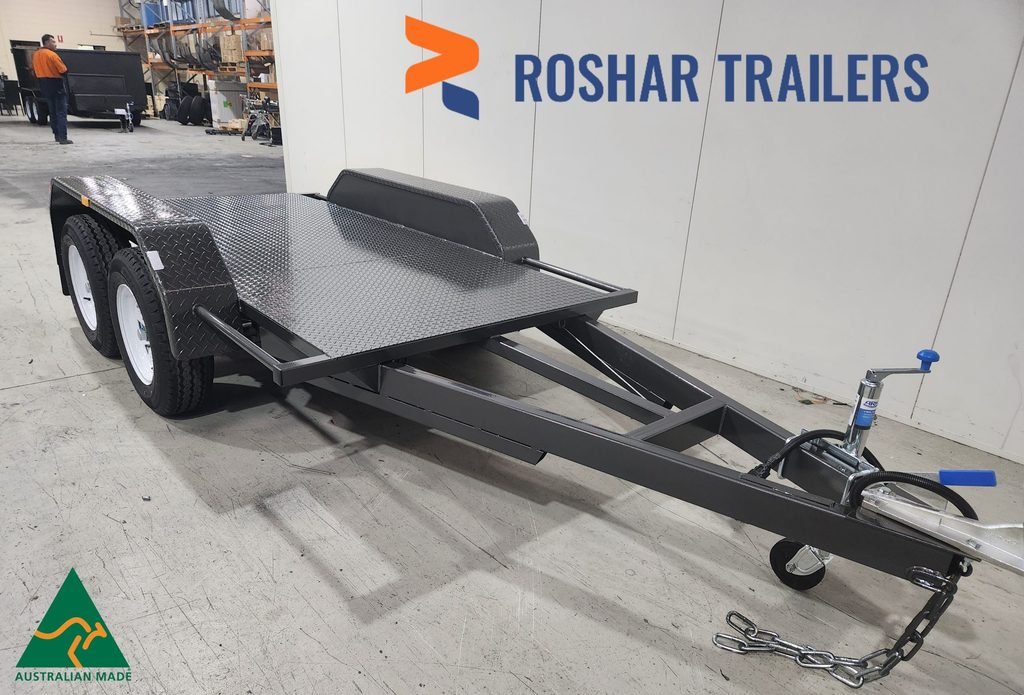
Roshar’s current tri axle trailer Melbourne range includes large box, car carrier, flat-bed, flat-top and custom builds, including configurations listed at up to 4.5 tonnes depending on the specific trailer.
A tri-axle setup may make sense for:
- larger machinery transport
- longer commercial trailers
- heavy vehicle transport
- large flat-bed applications
- specialised custom builds
If you’re comparing a tri-axle with a tandem, focus on the actual load and approved configuration rather than assuming three axles are always better.
For larger or specialised builds, Roshar’s custom trailer team can design the trailer around load size, axle setup, ramps, braking, storage and intended use.
Conclusion
Understanding trailer axle types Australia buyers encounter becomes much easier when you separate axle design from axle configuration. Straight, drop and torsion describe different axle designs, while single, tandem and tri-axle describe how many axles support the trailer.
For a light household trailer, single axle may be enough. For regular trade and commercial work, tandem is often worth considering. Larger machinery and specialised transport may require a tri-axle setup.
Before choosing, match the axle to the load, ATM, GTM, tyres, brakes, suspension, tow vehicle and intended use.
If you’re comparing a trailer for sale or planning a custom build, Roshar Trailers can help you compare the appropriate trailer configuration, including tandem, tri-axle and custom options.
Need help choosing the right trailer setup? Contact Roshar Trailers and discuss your load, towing vehicle and intended use before you order.
FAQ’S
Can I replace a single axle with a tandem axle?
Yes, but only after checking the trailer’s chassis, suspension, braking, mass ratings and compliance requirements. Adding another axle is a structural modification, not simply a wheel upgrade. In Victoria, modifications that may affect VSB 1 compliance can require assessment, so have the proposed change reviewed before work begins. Transport Victoria
Does a tandem axle always give a higher payload?
No, not automatically. Payload depends on the complete approved trailer configuration, including ATM, GTM, chassis, axles, suspension, tyres, brakes and tare weight. Adding an axle does not by itself authorise a higher legal mass. Always check the trailer’s compliance documentation and manufacturer’s approved rating.
Are torsion axles better for rough Australian roads?
No, there is no universal winner. Torsion systems can work well where their design, rating and suspension characteristics suit the trailer, while conventional suspension remains practical for many work trailers. The better choice depends on load, road conditions, duty cycle, serviceability and the complete trailer design.
How do I know whether my trailer axle is bent?
Look for a visibly bowed axle, uneven tyre wear, unusual wheel alignment or handling changes. A bent axle can also follow an impact or severe overload. If you suspect damage, don’t rely on visual inspection alone; have the axle, hubs, bearings, suspension and chassis checked before continuing regular towing.
Can I use a heavier-rated axle to increase my trailer capacity?
No, not by itself. A higher-rated axle does not automatically increase the trailer’s legal ATM or GTM. The chassis, suspension, brakes, tyres, coupling and other components must also support the approved configuration. Any capacity change should be confirmed with the manufacturer or an appropriately qualified professional.
Does axle type affect trailer maintenance?
Yes, different axle and suspension designs have different inspection and service requirements. Tandem and tri-axle trailers also have more running-gear components than a single-axle trailer. Regularly inspect tyres, bearings, hubs, brakes, suspension mounts, fasteners and alignment, particularly when the trailer is used commercially or on rough roads.
Is a tri-axle trailer harder to manoeuvre?
Yes, generally. A tri-axle trailer has more wheels and axles contacting the road, so tight turns can require more space and can create greater tyre scrub. That trade-off may be acceptable for larger or heavier applications, but a tri-axle should not be selected when a smaller approved configuration already suits the job.