
37 Malcolm RD, Braeside, VIC
10 Trailer Accessories That Can Improve a Tradie Setup
26 October 2026 | roshartrailers
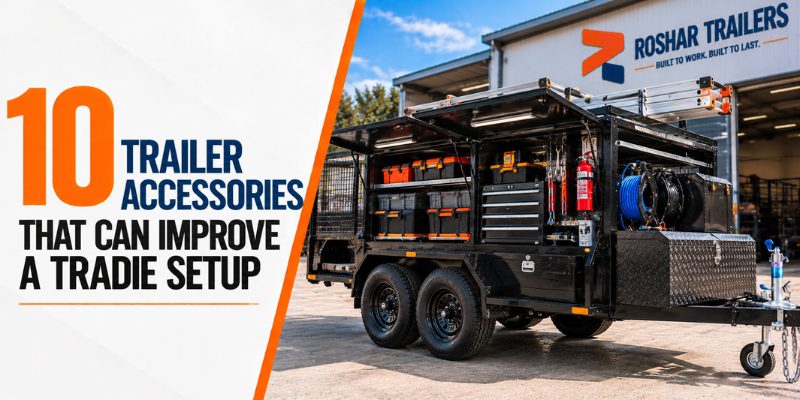
Table of Contents
By Writer :- Ron
Roshar Trailers Team, Trailer Manufacturing and Sales Specialists
Published: 26/10/2026
Trailer accessories for tradies can improve tool organisation, loading, security and daily workflow without replacing the trailer itself. The right upgrades depend on your trade, load, trailer layout and tow vehicle, so prioritise accessories that solve a real problem on your worksite.
A tradie trailer should do more than carry gear from A to B. If you spend every morning moving tools around, lifting heavy equipment without ramps or searching through an untidy toolbox, the setup is costing you time.
The good news is that you don’t always need a new trailer to improve the workflow. The right accessories can turn a basic setup into a much more practical mobile workspace.
This guide focuses on work trailer accessories that can make a noticeable difference for electricians, plumbers, builders, landscapers, maintenance crews and other Australian tradies.
Which trailer accessories for tradies make the biggest difference?
The most useful trailer accessories for tradies are the ones that improve storage, loading, load restraint, security or access. For most daily work trailers, prioritise a toolbox, ladder racks, tie-down points, ramps, spare wheel, security, shelving, lighting, jockey wheel and trade-specific storage.
| Accessory | Best for | Main benefit | Priority |
| Lockable toolbox | Electricians, plumbers, builders | Secure storage | High |
| Ladder racks | Electricians, carpenters, plumbers | Frees floor space | High |
| Tie-down points | Most trades | Better load restraint | High |
| Loading ramps | Landscapers, machinery users | Easier equipment loading | High |
| Spare wheel + carrier | All regular users | Reduces roadside downtime | High |
| Coupling/wheel security | Business users | Theft deterrence | High |
| Shelving/drawers | Tool-heavy trades | Faster access | High |
| LED lighting | Daily road users | Visibility and reliability | Medium–High |
| Heavy-duty jockey wheel | Frequent users | Easier manoeuvring | Medium |
| Trade-specific racks/holders | Specialist trades | Uses unused space | Medium–High |
Roshar already builds tradesman trailers with options including compressor boxes, ladder racks, internal shelving, toolboxes, lockable storage, cages, LED lighting, spare wheel mounts, tie-down points, upgraded flooring and heavy-duty axles.
How does a toolbox improve a tradie trailer?
A toolbox creates a dedicated, lockable place for tools, consumables and smaller equipment, helping tradies protect valuable gear while keeping frequently used items accessible. The best location depends on drawbar clearance, trailer balance, access and the equipment stored.
For an electrician, that could mean separating testing equipment from cable accessories. A plumber might use different compartments for fittings, hand tools and repair equipment. A carpenter could reserve drawers for fixings and keep larger tools elsewhere.
A toolbox also protects equipment from weather and general jobsite clutter.
When choosing one, check:
- Internal dimensions
- Locking mechanism
- Lid clearance
- Weather sealing
- Mounting position
- Added weight
- Access from the ground
Roshar’s current tradesman range includes toolboxes and lockable storage as customisable features, while its tradesman builds include examples such as compressor boxes and different trailer sizes.
Illustrative example: A mobile maintenance contractor who uses ten small hand tools throughout the day may benefit more from shallow drawers near the side access than from one large box where everything gets stacked together.
When are ladder racks worth adding?
Ladder racks are worth adding when you regularly carry ladders, conduit, pipes, timber or other long items that would otherwise consume floor space. They keep long materials separate from tools and can make loading the main trailer compartment much easier.
For electricians and plumbers, ladder racks can be particularly useful because long materials often travel alongside smaller tools.
The main benefits are:
- More usable floor space
- Easier loading
- Better organisation
- Dedicated long-item storage
- Less interference with tool compartments
Roshar offers custom racks on trailers, including landscaping equipment racks, tool-storage racks and other purpose-built rack solutions. Its rack range is designed around space optimisation and secure, organised transport.

If you are already comparing tradesman trailers, consider the rack requirement before finalising the build. Retrofitting later may be possible, but designing the rack around the trailer from the start can produce a cleaner overall setup.
Why should tradies upgrade tie-down points?
Tie-down points give you defined locations for securing equipment and materials instead of relying on whatever part of the trailer happens to be nearby. They are especially useful for machinery, generators, compressors, loose equipment and loads that can shift during towing.
According to the National Transport Commission, loads on light vehicles and trailers must be properly restrained, must not exceed applicable mass limits and must not dangerously overhang or obscure lights, indicators, reflectors or number plates. National Transport Commission
Transport Victoria also advises using suitable restraint equipment, positioning loads so they are stable and evenly distributed, and checking restraint equipment before use. Transport Victoria
How to make tie-down points more useful
Position anchors around your real loads: place them where straps can secure equipment without awkward angles.
Use rated restraint equipment: check the lashing capacity rather than assuming every strap is suitable.
Keep anchors accessible: hidden or blocked tie-downs are less useful when you’re rushing between jobs.
Avoid overloading one point: distribute restraint across suitable points according to the load.
This is one area where trailer parts and accessories should be selected for the actual load rather than simply added because they look useful.
Do loading ramps make a work trailer more useful?
Loading ramps make a trailer more useful when you regularly move wheeled equipment such as mowers, compact machinery or other heavy gear. They reduce the need for improvised loading methods and can make repeated loading and unloading more efficient.

Landscapers, gardeners and machinery contractors are the obvious examples. If a mower goes onto the trailer several times a day, a proper ramp setup can save repeated lifting and awkward handling.
Before choosing ramps, check:
- Ramp length
- Rated capacity
- Loading angle
- Width
- Storage position
- Surface grip
- Attachment method
Current Melbourne accessory listings provide a useful indication of the market: Ubeaut Trailers lists heavy-duty galvanised ramps from $595 and 2,500 kg-rated 2,000 × 350 mm ramps from $795. These are example market prices, not Roshar Trailers pricing, and prices can change.
If ramps are part of the trailer from day one, their storage and loading position can be designed into the overall layout.
Why should every work trailer carry a spare wheel?
A spare wheel can reduce downtime when a trailer tyre fails away from the workshop, particularly for tradies who travel between Melbourne suburbs, regional Victoria and multiple job sites. It is a simple accessory, but its value appears when you need it.
A spare wheel is most useful when:
- The trailer travels regularly
- Jobs are spread across different locations
- The trailer carries valuable equipment
- You cannot afford long roadside delays
- The correct spare is readily accessible
Don’t just buy any spare wheel. Match the wheel and tyre to the trailer’s specification and ensure the spare is stored securely.
A current Melbourne trailer-accessory listing shows a standard spare wheel from $140 as one market example. Again, this is a third-party current price reference, not Roshar pricing.
A spare wheel bracket also needs to be positioned so it doesn’t interfere with loading, storage or trailer balance.
How can security accessories protect a tradie setup?
Security accessories should protect two things: the trailer itself and the tools stored inside it. Coupling locks, wheel security, lockable toolboxes, alarms and tracking can add layers of protection, particularly when a trailer is parked overnight or left at a worksite.
Roshar’s own trailer-security guidance recommends layered protection such as coupling locks, wheel clamps, alarms, GPS tracking, secure storage and ownership records rather than relying on one device.
For a tradie trailer, think in layers:
- Trailer security: coupling lock or suitable wheel security.
- Storage security: lockable toolboxes and compartments.
- Site security: controlled parking, gates, lighting or CCTV where available.
- Recovery: GPS tracking and accurate VIN/registration records.
- Identification: photographs and records of distinctive trailer features.
A $50 accessory isn’t necessarily valuable because of its price. It is valuable if it removes a genuine weak point in your setup.
Can shelving and internal storage improve workflow?
Yes, well-planned shelving can improve a tradie trailer by giving every frequently used tool or consumable a defined location. It is particularly useful when several people use the trailer because consistent storage reduces time spent searching for equipment.
Roshar’s tradesman trailer range specifically lists internal shelving, toolboxes and lockable storage as customisable features.
Match storage to the way you work
Electrician: small drawers, cable storage and test equipment compartments.
Plumber: fittings, hand tools, pipe accessories and repair parts.
Carpenter: fixings, drills, saws and longer tools.
Landscaper: hand tools, blowers, smaller equipment and consumables.
Maintenance contractor: labelled drawers for replacement parts, fasteners and service equipment.
This is where trailer storage becomes more than simply adding boxes. The goal is to reduce unnecessary movement inside the trailer.
Illustrative example: If the tools used on nearly every job are stored at waist height near the side door, you don’t need to unload half the trailer just to reach them.
When should you upgrade trailer lighting and electrical accessories?
Trailer lighting should be treated as a reliability and road-safety item rather than a cosmetic upgrade. LED lighting, appropriate connectors and protected wiring can make a frequently used trailer easier to maintain and more dependable.
Modern Trailers recommends LED lighting as an accessory upgrade and notes that lighting is important for safety and compliance.
For a tradie setup, inspect:
- Tail lights
- Brake lights
- Indicators
- Number-plate lighting
- Wiring protection
- Trailer plug
- Connection points
The latest Australian VSB 1 Revision 6 applies to trailers with an aggregate trailer mass of 4.5 tonnes or less and assists manufacturers with applicable Australian Design Rule requirements. Department of Infrastructure
That doesn’t mean every aftermarket light or electrical modification is automatically compliant. Check compatibility and applicable requirements before fitting components.
How should you choose accessories without overloading the trailer?
Choose accessories by solving the biggest daily workflow problems first, then check the combined weight and placement of every addition. Toolboxes, racks, ramps, cages, spare wheels and shelving all consume payload that could otherwise carry tools or materials.
This is one of the most commonly overlooked parts of a customised work trailer.
For example, adding:
- A large toolbox
- Ladder racks
- Compressor box
- Spare wheel
- Heavy shelving
- Ramps
can substantially change the finished trailer compared with its basic configuration.
According to the Department of Infrastructure, VSB 1 Revision 6 covers low-ATM trailers up to 4.5 tonnes and explains applicable requirements for common trailer types under Australian vehicle standards.
A practical accessory priority framework
| Priority | Add first when… | Examples |
| Essential | It solves a safety or major workflow problem | Tie-down points, suitable lighting, spare wheel |
| High value | It saves time every working day | Toolbox, shelving, ladder racks |
| Job-specific | Your trade genuinely needs it | Ramps, compressor box, specialised rack |
| Convenience | It improves handling | Upgraded jockey wheel, extra holders |
| Optional | It adds little practical value | Cosmetic or rarely used accessories |
The best setup isn’t the one with the most accessories. It’s the one where every accessory earns its space and weight.
How much should tradies budget for trailer accessories?
Accessory costs vary widely by size, material, rating, mounting method and whether the item is fitted during trailer construction or added later. Current Melbourne listings show examples ranging from about $140 for a spare wheel to $795 for heavy-duty ramps.
| Accessory example | Current example price | Source |
| Standard spare wheel | From $140 | Ubeaut Trailers |
| Jockey wheel | From $150 | Ubeaut Trailers |
| Ladder rack pair | From $300 | Ubeaut Trailers |
| Steel toolbox | From $330 | Ubeaut Trailers |
| Galvanised ramps | From $595 | Ubeaut Trailers |
| Heavy-duty 2,500 kg ramps | From $795 | Ubeaut Trailers |
These are indicative third-party Melbourne prices checked during research, not Roshar Trailers prices or quotes.
For a new trailer, ask for an itemised quote covering:
- Accessory price
- Fitting cost
- Added weight
- Warranty implications
- Mounting location
- Compatibility
- Any required electrical work
A cheaper accessory isn’t automatically better if it needs replacing sooner or doesn’t suit the daily load.
When should you have accessories professionally fitted?
Professional fitting is worthwhile when an accessory affects structural components, load restraint, electrical systems, braking, security or the trailer’s overall weight distribution. Simple removable items can often be handled by an owner, but structural modifications deserve specialist attention.
Get professional advice before modifying:
- Chassis components
- Drawbar
- Coupling
- Brake systems
- Suspension
- Structural racks
- Electrical wiring
- Rated tie-down points
Transport Victoria states that equipment and accessories fitted to vehicles must be secure and must not create hazards such as sharp edges or protrusions likely to increase injury risk.
For a new build, the easiest approach is usually to discuss accessories before fabrication is complete. Roshar’s tradesman trailer range already supports custom options including toolboxes, shelving, ladder racks, compressor boxes, LED lighting, cages and tie-down points.
Which accessories should different tradies prioritise?
| Trade | First accessories to consider | Why |
| Electrician | Toolbox, shelving, ladder racks, secure storage | Small tools + long materials |
| Plumber | Toolbox, racks, shelving, tie-downs | Mixed tools, fittings and pipes |
| Builder | Toolbox, racks, tie-downs, ramps | Tools + materials + equipment |
| Carpenter | Shelving, ladder racks, toolbox, racks | Tool organisation + long items |
| Landscaper | Ramps, tie-downs, spare wheel, racks | Mowers + outdoor equipment |
| Mobile mechanic | Toolbox, compressor box, shelving, lighting | Heavy tools + service equipment |
| Maintenance contractor | Drawers, toolbox, racks, spare wheel | Parts organisation + daily travel |
| Construction contractor | Tie-downs, ramps, toolbox, heavy-duty storage | Equipment and site materials |
This is a workflow framework, not a universal specification. The actual accessory combination should be based on your load, trailer rating and tow vehicle.
Conclusion
The best trailer accessories for tradies are the ones that make daily work faster, safer and more organised without compromising payload or compliance. Start with storage, loading, restraint and security, then add trade-specific upgrades around your actual workflow.
If you’re planning a new build or upgrading an existing trailer, Roshar Trailers can discuss custom layouts, racks, storage and other trailer requirements across Melbourne.
Build the trailer around the work, not the other way around.
FAQ’S
Can I add accessories to an older trailer?
Yes, many accessories can be retrofitted, but compatibility depends on the trailer’s construction, available mounting points, condition and intended load. Before adding structural racks, heavy storage, ramps or electrical equipment, check the trailer’s existing ratings and have the modification assessed if it affects structure, brakes, lighting or load restraint.
Do trailer accessories count towards payload?
Yes, accessories add weight to the trailer and therefore reduce the remaining capacity available for tools, equipment and materials. A toolbox, racks, ramps, shelving, spare wheel and compressor box should all be considered when calculating the finished trailer’s usable payload.
Can I move a toolbox or rack from one trailer to another?
Yes, in some cases. Transfer depends on the mounting method, dimensions, condition and compatibility of the accessory with the second trailer. A rack or toolbox designed for one frame may need different brackets or reinforcement on another, so don’t assume a direct bolt-on transfer will be suitable.
Are aftermarket trailer lights automatically legal?
No, aftermarket lights are not automatically compliant simply because they are sold for trailers. The lighting arrangement must meet applicable Australian requirements for the trailer. Check the component, installation, positioning and wiring before fitting an aftermarket lighting upgrade.
Should I install accessories when ordering a new trailer?
Yes, when the accessory affects the trailer’s structure, storage layout or weight distribution. Planning racks, toolboxes, shelving and tie-down points during fabrication can produce a cleaner setup and avoids adding unnecessary weight or drilling into a finished structure later.
Can I customise a trailer for a specific trade?
Yes, a custom layout can be designed around your tools, equipment, access requirements and daily workflow. Electricians, plumbers, builders and landscapers may all need different combinations of shelving, racks, toolboxes, ramps and storage, so a trade-specific setup can be more practical than a generic layout.