
37 Malcolm RD, Braeside, VIC
Towing a Trailer on Highways: Safety Guide for Australia
13 July 2026 | roshartrailers
Towing a trailer on highways is safest when you match the trailer to the tow vehicle, balance the load, secure every item, drive below the posted conditions, leave longer gaps, and recheck tyres, coupling, lights and restraints during stops.
For tradies, landscapers, farmers, builders and small business owners, towing is often part of the workday, not a weekend extra. You might be carrying tools from Dandenong to a site, green waste from a garden job, a small excavator to a rural block or a project car across Victoria.
For Roshar Trailers customers comparing box, tandem, tipper, flat top and car carrier trailers, the highway question is usually practical: what load will sit on the trailer, how often will it travel, and how will that load be tied down safely?
The danger usually comes from boring details: one under-rated strap, one soft tyre, one load sitting too far back or one rushed lane change. This guide keeps the focus on practical highway decisions you can use before you leave, while driving and when choosing the right trailer.
What should you check before highway trailer towing?
Before a highway trip, check the tow rating, trailer ATM, coupling, chains, breakaway system, lights, tyres, bearings, load restraints and number plate visibility. Highway speeds expose small defects quickly, so a five-minute walk-around is cheaper than roadside recovery.
Start with the ratings. Your trailer may be strong enough, but the tow vehicle, towbar, coupling or tyre rating can still be the weak point. Use the lowest rating as your limit. For example, a ute that can tow 3,500 kg still cannot safely tow that amount if the towbar, ball mount or trailer tyres are rated lower.
Then check road-use basics. The coupling should lock fully. Safety chains should be attached to rated points, not just hooked loosely wherever they reach. The trailer plug should power brake lights, tail lights and indicators. Tyres should be inflated to the correct pressure, with no cracking, bulges or exposed cords.
According to the NSW Government, trailer braking requirements depend on GTM: trailers up to 750 kg GTM do not require brakes, 751–2,000 kg GTM need an efficient braking system on at least one axle, and 2,001–4,500 kg GTM need efficient brakes on all wheels.
10-minute highway pre-trip process
1. Confirm the loaded weight before leaving: guessing is risky when tools, soil, machinery or scrap metal are involved.
2. Check the compliance plate and ratings: ATM, GTM, tyre load rating, coupling rating and towbar rating must all suit the job.
3. Lock the coupling and fit the safety chains: the connection must stay secure through bumps, braking and turning.
4. Test every light with another person watching: rear lights are your only warning system for drivers behind the trailer.
5. Inspect tyres and wheel nuts: highway heat and speed punish soft tyres, old rubber and loose hardware.
6. Secure doors, ramps, cages and toolboxes: a loose ramp pin or toolbox latch can become a highway hazard.
7. Check number plate visibility: the plate must remain clean, upright and visible once the trailer is loaded.
8. Carry basic recovery items: a jack rated for the load, wheel brace, spare wheel, gloves and a torch can prevent a small issue becoming a major delay.
What rules matter when towing a trailer on highways in Australia?
When towing a trailer on highways in Australia, you must follow state road rules, vehicle ratings and load restraint laws together. The safest approach is to use the lowest applicable limit across your tow vehicle, towbar, coupling, trailer, tyres and load.
Rules can vary by state and territory, especially around learner and provisional drivers, speed limits and registration exemptions. If you are towing interstate for work, buying from another state or moving a tiny house trailer, check the relevant transport authority before the trip.
For trailer road use, three areas matter most: registration, restraint and control. A registered or exempt trailer still needs to be safe on the road. A strong trailer still needs a properly restrained load. A powerful tow vehicle still needs enough braking room, steering control and legal visibility.
According to the National Transport Commission, a vehicle or trailer load must be properly restrained, must not overhang dangerously, must not exceed mass limits, and must not cover lights, indicators, reflectors or the number plate.
Highway towing rule summary
| Rule area | What to check | Why it matters on highways |
| Tow capacity | Vehicle manual, towbar plate, coupling plate and trailer ATM | The weakest rating controls the legal and safe limit |
| Trailer brakes | GTM, brake type and breakaway requirement where applicable | More speed and more weight mean longer stopping distances |
| Load restraint | Rated straps, chains, nets, tarps, headboards and tie-down points | Wind and vibration can lift or move loads at speed |
| Overhang | Rear, side and total width limits | Overhanging loads are harder for other drivers to judge |
| Registration | State rules, business use and exemption conditions | Work use can change how a small trailer is treated |
| Driver restrictions | Licence class, L/P rules and state limits | Some drivers cannot tow, or can only tow limited trailers |
How should you load a trailer for highway stability?
Load the trailer low, centred and slightly forward of the axle group, then restrain it so nothing can slide, bounce, lift or spill. The goal is simple: stable ball weight, clear visibility, legal overhang and no movement at speed.
Bad loading is one of the fastest ways to create sway. Too much weight at the back can make the trailer feel like it is steering the vehicle. Too much weight on the coupling can lighten steering, strain suspension and make braking feel unsettled.
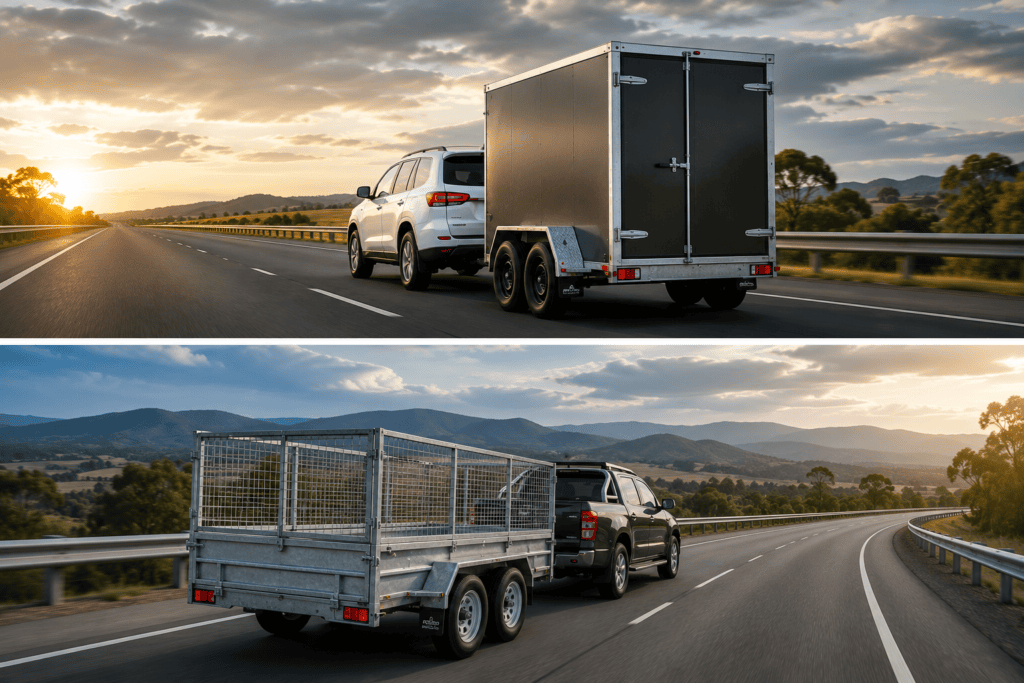
For a landscaper, that means soil, pavers or green waste should sit low and even, not piled high at the rear gate. For a tradie, compressors and toolboxes should be positioned so they cannot slide sideways during a lane change. For a farmer, drums, fencing gear and water tanks need both containment and restraint.
Transport Victoria says loads should be stable and evenly distributed, with heavy items underneath lighter items, and suitable restraints such as rated webbing straps, chains, cargo nets or tarpaulins chosen for the load. It also notes that chains are best suited for heavy loads because they stretch less than webbing straps or ropes.
Load placement guide
| Load type | Better trailer choice | Highway loading tip |
| Garden waste, mulch, loose soil | Box trailer or hydraulic tipper trailer | Cover the load and keep weight below the side height where possible |
| Tools, compressors, toolboxes | Tradesman trailer or enclosed trailer | Use internal tie-downs so weight cannot slide during braking |
| Machinery or mini loaders | Plant trailer or flat top trailer | Use rated ramps, wheel chocks and chains suited to the machine |
| Cars or project vehicles | Car carrier trailer | Tie down by wheels or approved points and recheck after a short distance |
| Long steel, timber or pipes | Flat top trailer or trailer with racks | Mark legal overhang and prevent sideways movement |
| Repeated heavy business loads | Tandem or tri-axle trailer | Choose braking and suspension for the real loaded weight, not the empty trailer |
A realistic scenario: the Friday afternoon site run
A builder loads a tandem trailer with offcuts, a compressor, two ladders and leftover materials after a long week. Nothing looks too heavy, so the crew straps the top layer and leaves.
At 100 km/h, the problem is not just weight. The compressor can move sideways, the ladders can vibrate under the strap, and light sheeting can lift in the wind. The safer version is simple: heavy gear low and forward, gaps filled, ladders tied separately, loose material covered, and straps checked again after the first short drive.
In practical trailer selection conversations, this is where the right trailer design matters. A cage, toolbox, headboard, ramp set, tie-down point or tandem axle setup is not just a feature list; it affects how easily the owner can restrain the load before a highway trip.
What driving habits reduce sway, heat and braking stress?
Smooth inputs protect the whole towing combination. Accelerate gradually, brake earlier, steer gently, leave a larger following distance and avoid sudden lane changes. At highway speed, small steering or braking mistakes can turn into sway, jackknifing or overheated brakes.
The vehicle will take longer to accelerate, stop and merge. Plan earlier than you normally would. Indicate sooner, avoid jumping between lanes, and leave a larger gap so you are not forced into hard braking when traffic compresses.
If sway starts, do not fight the steering wheel aggressively. Ease off speed smoothly, keep the vehicle straight and avoid sudden braking unless there is no other choice. If the trailer has a separate brake controller and you know how to use it, gentle trailer braking can help settle the trailer; panic braking through the tow vehicle can make sway worse.
According to the NSW Government, heavy trailer loads should be concentrated towards the centre of the trailer and kept low and close to the axle or axles, with about 60 per cent of the total weight forward of the axle centre.
Highway driving process
1. Build speed gradually on the entry ramp: sudden acceleration can unsettle the load and stress the drivetrain.
2. Leave a longer gap than normal: extra weight increases stopping distance and reduces emergency options.
3. Keep steering inputs small: sharp corrections can start or worsen trailer sway.
4. Brake earlier and lighter: heat builds quickly in tow vehicle and trailer brakes on long runs.
5. Use mirrors every few seconds: you are watching the load, trailer tracking, tyres, straps, traffic and blind spots.
6. Avoid rushed overtaking: the extra length needs more room to pass and return safely.
7. Back off in rain or crosswinds: slippery roads and side gusts reduce the margin for error.
How do you handle hills, overtaking and high-speed lanes?
Hills, descents and overtaking need more planning than normal driving. Select a lower gear before long descents, build speed gradually on climbs, avoid rushed overtakes and move left early so faster traffic can pass safely.
On a long climb, the engine and transmission work harder. Watch temperature gauges and listen for changes in engine load. If the vehicle is struggling, do not force it to hold highway speed just because the road is signed that way.
On descents, control speed before it runs away. Use a lower gear, keep braking smooth and avoid riding the brakes continuously. If you smell hot brakes or feel pulsing, pulling or fade, stop safely and let the setup cool before continuing.
Overtaking is where many drivers underestimate distance. You need extra time to accelerate, extra length to pass, and extra room to return to the lane without cutting in. For most work trips, staying left and driving steadily is safer than trying to save a few minutes.
For Roshar’s trade and business audience, this matters most on repeated routes: freeway runs between suburbs, regional deliveries, tip runs, site-to-site equipment moves and customer drop-offs. The load may be safe in the yard but still need slower, smoother driving once traffic speed increases.
How often should you stop and recheck the trailer?
Stop early, then stop regularly. Recheck after the first 10 to 20 kilometres, then at fuel, rest or job-site breaks. Heat, vibration and wind can loosen straps, expose tyre problems and reveal coupling issues you missed at home.
The first stop is the most important because it shows how the load behaves once the trailer is moving. Put your hand near, not on, hubs and tyres to feel for unusual heat. Look for strap slack, rubbed edges, loose hooks, shifted load, tyre bulges, hot brake smell, damaged wiring and loose ramp pins.
For daily work use, build checks into the job routine. A contractor towing from Braeside to a morning site can check before leaving, again after entering highway conditions, and again before returning with waste or equipment. The trailer may be carrying a completely different load on the way back.
Recheck frequency table
| Situation | Recheck timing | What to inspect |
| First highway trip with a new trailer | After 10–20 km | Coupling, lights, straps, heat, tyre pressure and load movement |
| Heavy machinery or car transport | After the first short drive, then every stop | Chains, wheel straps, ramps, brake controller and load position |
| Landscaping waste or loose material | Before departure and after wind exposure | Cover, tailgate, tarp, side load height and spillage |
| Long regional trip | Every fuel or rest stop | Tyres, bearings, hubs, lights, chains and driver fatigue |
| Rain, gravel or roadworks | At the next safe stop | Mud, stone damage, light visibility and strap wear |
| Borrowed or hired trailer | Before loading, after loading and after 10–20 km | Ratings, brakes, tyres, coupling type and roadworthiness |
Which trailer setup suits highway work trips?
The right trailer depends on load weight, shape, job frequency, access points and braking needs. A light household run may suit a box trailer, while machinery, landscaping, car carrying or trade tools usually need stronger axles, brakes and purpose-built restraint points.
A homeowner doing occasional tip runs may only need a well-maintained box trailer. A landscaper towing wet green waste and soil every week should think about a hydraulic tipper trailer because unloading speed and controlled load containment matter. A tradie carrying expensive gear may be better served by a tradesman trailer with secure storage.
For construction and rural work, flat top trailers, plant trailers and tandem trailers make more sense when loads are heavy, awkward or repeated. For vehicle transport, a car carrier trailer is safer and easier than trying to adapt a general-purpose trailer.
Roshar Trailers builds and supplies practical trailers for work, business, construction, landscaping, machinery transport, vehicle carrying and everyday towing across Victoria. If you are comparing options, start with the full range of trailers for sale, then match the trailer to the load rather than choosing by size alone.
For common highway use cases, see box trailers for general hauling, tandem trailers for heavier loads, flat top trailers for machinery and palletised materials, hydraulic tipper trailers for landscaping and waste, car carrier trailers for vehicles and tradesman trailers for tool storage.
When should you repair, upgrade or choose a different trailer?
Repair or upgrade when the trailer no longer matches the load or the route. If it sways when loaded correctly, runs hot, brakes poorly, damages tyres, rattles at the coupling or lacks tie-down points, treat it as a safety problem.
Highway towing makes weak points obvious. A trailer that is acceptable for short local trips may not be suitable for repeated freeway use, rough rural roads, commercial loads or long-distance work. Do not keep adding weight, racks, toolboxes or machinery to a trailer that was never built for that job.
The most common upgrade triggers are brakes, suspension, tyres, ramps, tie-down points, cages and storage. If the load has changed from household furniture to business equipment, the trailer should change too.
According to the Department of Infrastructure, low ATM trailers with an aggregate trailer mass of 4.5 tonnes or less are expected to comply with the applicable Australian Design Rules, and VSB 1 Revision 6 helps manufacturers understand those requirements.
Before towing a trailer on highways with a heavier, wider or more specialised load, weigh the loaded setup if you are unsure. The National Measurement Institute says public weighbridge operators must be contacted directly for operating hours and pricing information.
Professional-help guide
| Issue | DIY check | When to use a professional | What to ask for |
| Unknown loaded weight | Use a public weighbridge before a long trip | Use a specialist if ball weight or axle weights are unclear | A written weight record and advice on ATM, GTM and ball weight |
| Wheel bearing noise or heat | Check for rumbling, grease leaks and wheel play | Use a mechanic if there is heat, movement, noise or long-distance towing planned | Bearing inspection, repack or replacement quoted in AUD |
| Brake weakness | Test at low speed before highway use | Use a trailer repairer for electric, hydraulic or breakaway brake faults | Brake inspection, parts list and written quote before work starts |
| Sway despite correct loading | Recheck ball weight, tyre pressure and speed | Use a trailer specialist if sway remains | Suspension, axle, tyre, coupling and load-position review |
| Poor restraint points | Inspect tie-down locations | Use a fabricator or trailer manufacturer for rated points | Rated tie-down options suited to the real load |
If you are registering or buying a trailer in Victoria, Roshar’s guide on how to register a trailer in Victoria is a useful next read before putting the trailer into regular road use.
Conclusion
Towing a trailer on highways is about preparation, restraint, smooth driving and using the right trailer for the job. When the trailer, tow vehicle, load and driver all work together, highway trips become safer, calmer and easier to repeat.
For a trailer suited to trade, landscaping, farming, construction, vehicle transport or everyday business use, explore Roshar Trailers Australian-made range and choose the setup around your real load, not just the nearest size.
Faq’s
Can I tow a trailer in strong wind?
Yes, but only if the load is secure, the trailer is stable and you reduce speed early. Empty box trailers, tall cages and light bulky loads can move around in side gusts. If wind is pushing the trailer across the lane, pull over safely and wait.
Should I use cruise control while towing?
No, not as a default habit. Cruise control can hold speed when the safer choice is easing off for hills, rain, traffic or crosswinds. Manual throttle control gives you a better feel for engine load, trailer movement and the space needed to brake smoothly.
Can ropes be used instead of rated straps?
Yes, but only for light loads where rope is suitable and in good condition. For highway loads, rated webbing straps or chains are usually safer because you can match the restraint to the load. Damaged, frayed or stretchy restraint gear should not be used.
What should I do when a large truck passes?
Keep a steady line, hold the steering gently and avoid braking suddenly. The air movement from a passing truck can nudge the trailer, especially with a tall or lightly loaded setup. If the trailer continues to move after the truck passes, slow down gradually.
Do business trailers have different road-use issues?
Yes, business use can affect registration, insurance, load restraint expectations and how often the trailer should be checked. A trailer used by a landscaper, builder or mobile service business is exposed to more weight variation, more stops and more wear than casual household use.
Can I tow a borrowed or hired trailer on the highway?
Yes, but only after checking the trailer’s rating, tyre condition, brakes, lights, coupling size, safety chains and registration status. Do not assume a borrowed trailer is safe because it looks tidy. Load it lightly first, test it locally, then recheck before highway speeds.