
37 Malcolm RD, Braeside, VIC
9 Trailer Features Plumbers Should Consider
9 October 2026 | roshartrailers
By Writer :- Ron
Roshar Trailers Team, Trailer Manufacturing and Sales Specialists
Published: 09/10/2026
Table of Contents
A good plumber trailer setup should combine secure storage, pipe and fitting organisation, easy access, weather protection, load restraint, durable flooring, useful power, safe towing features and enough room for the equipment your plumbing work actually requires.
Plumbing work rarely involves one type of gear. A typical day can mean carrying hand tools, power tools, fittings, pipe, hoses, consumables and job-specific equipment. That makes trailer layout just as important as trailer size.
The best setup isn’t necessarily the biggest one. It is the one that lets you find the right fitting quickly, load longer materials safely and keep heavier equipment where it belongs.
This guide explains the nine features worth considering when planning a plumber trailer setup for Australian trade work.
What should a plumber trailer setup include?
A practical plumber trailer setup should include secure tool storage, pipe racks, fitting compartments, easy-access doors, weather protection, tie-down points, suitable flooring, useful electrical provisions and enough payload for tools and materials.
Plumbers carry a wider mixture of items than many trades. A service call might require a compact set of hand tools, while an installation or larger repair could require pipe, fittings, hoses, equipment and additional materials.
That means the trailer needs to accommodate different load types without becoming difficult to work from.
Roshar’s current tradesman range is designed for plumbers and other tradies, with options for custom configurations around tools, equipment and workflow. The range includes 6×4, 7×4, 7×5, 8×5 and custom sizes.
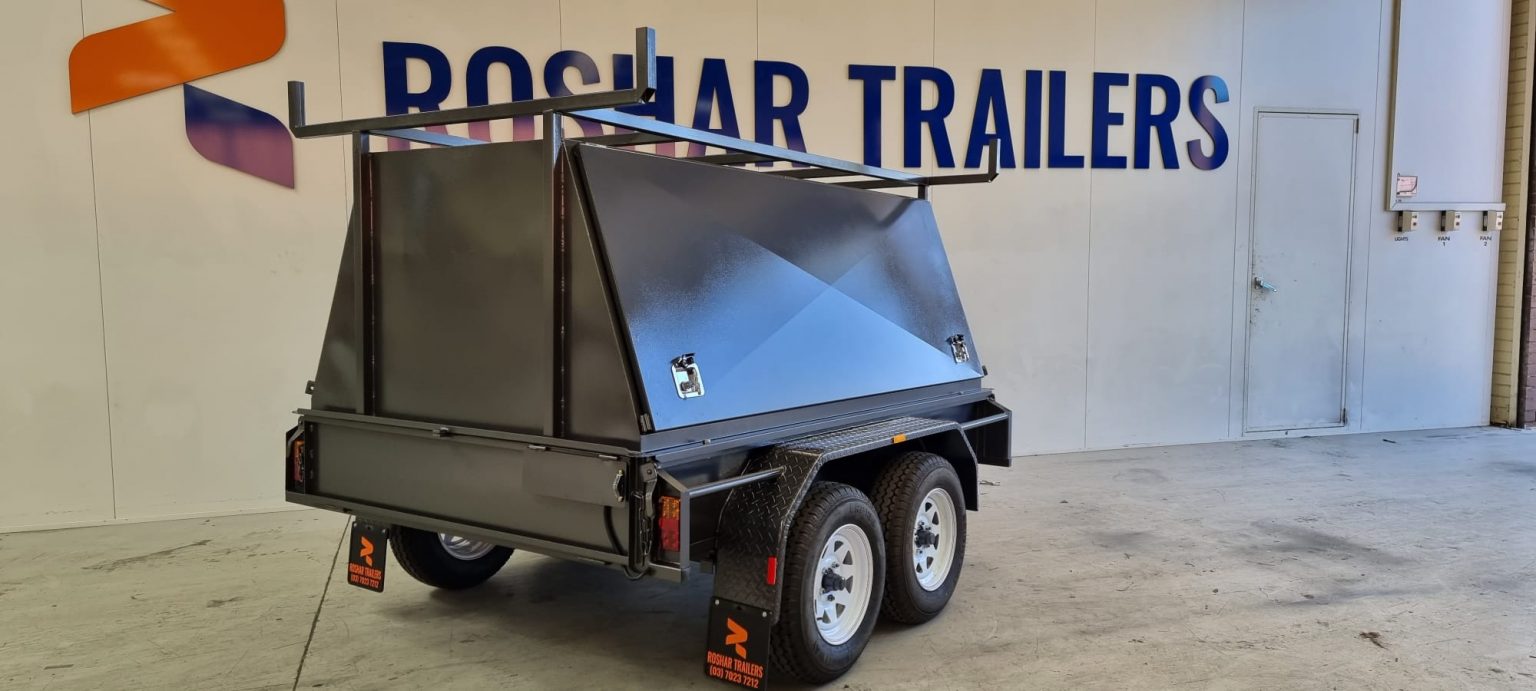
For plumbers looking at tradesman trailers, the first question should be: What do I need to reach quickly, and what can stay stored until I need it?
Nine features worth prioritising
| Feature | Main purpose | Best for |
| 1. Lockable storage | Protect tools and equipment | Daily service work |
| 2. Pipe racks | Carry long materials separately | Pipe and conduit |
| 3. Deep compartments | Store bulky fittings | Installation work |
| 4. Shelving/drawers | Organise small components | Repairs and maintenance |
| 5. Easy-access doors | Reach frequently used gear | Service calls |
| 6. Water-resistant areas | Protect equipment from moisture | Plumbing environments |
| 7. Tie-down points | Secure heavier items | Equipment and materials |
| 8. Durable flooring | Handle repeated loading | Daily commercial use |
| 9. Electrical provisions | Support charging and equipment | Mobile trade setups |
Why is flexible storage important for plumbers?
Plumbers need flexible storage because their loads change from job to job. A trailer may carry hand tools and fittings on a service call, then need room for pipe, hoses, equipment or additional materials for a larger installation.
That variation is the biggest difference between a general storage trailer and a genuinely useful plumbing setup.
A rigid layout can work against you. If every compartment is designed for one specific item, you may end up with empty storage in one area while another section is overflowing.
A flexible layout gives you:
- Adjustable shelving
- Different compartment depths
- Open areas for bulky items
- Dedicated pipe storage
- Space for job-specific equipment
- Room to accommodate changing stock
This is also where plumber trailer storage ideas should start: with the work, not the accessories.
RedDirt’s current Australian tradesman-trailer guide makes a similar distinction between trades, describing plumbers as needing a broader mix of tools, fittings and materials and therefore a flexible, usable layout.
Think in three storage zones
A useful way to plan the trailer is to divide it into three zones:
Zone 1 – Daily-use gear:
Keep your most frequently used tools, fittings and testing equipment near the easiest access points.
Zone 2 – Stock and consumables:
Store fittings, connectors, valves, sealants and other replacement items in labelled compartments.
Zone 3 – Bulky or occasional equipment:
Keep pipe, hoses, larger tools and less frequently used equipment in open or deeper areas.
That simple separation prevents the trailer from becoming a single large storage box where everything gets mixed together.
Which storage features are most useful for plumbing work?
The most useful plumbing storage features are deep compartments for fittings, shelving for stock, drawers for smaller tools, pipe racks for long materials and lockable sections for expensive equipment.
Halco’s current industry-specific trailer layout guide identifies pipe storage racks, deep tool compartments, an open rear loading area, secure shelving, water-resistant storage and space for larger plumbing equipment as useful features for plumbers.
The important point isn’t to copy a standard layout. It is to use these features according to your own work.
1. Pipe racks
Pipe is awkward to store inside a normal toolbox or shelf. A dedicated rack keeps longer materials separate and makes them easier to load and unload.
A pipe rack can also stop long materials from occupying valuable floor space.
2. Deep tool compartments
Plumbers often carry bulky tools that don’t fit neatly into shallow drawers.
Deep compartments can accommodate:
- Larger hand tools
- Power tools
- Repair equipment
- Hoses
- Service accessories
3. Fitting drawers
Small plumbing components are easy to lose in a large open compartment.
Use separate drawers or labelled containers for items such as:
- Connectors
- Washers
- Valves
- Adaptors
- Clips
- Sealants
- Consumables
4. Lockable storage
If expensive tools remain in the trailer between jobs, security deserves serious consideration.
Roshar’s tradesman trailers are designed with lockable storage options and can be customised around different trade requirements.
5. Water-resistant storage
Plumbing work naturally involves wet environments. Water-resistant compartments can help protect tools, electrical equipment, paperwork and stock from unnecessary moisture exposure.
How should a plumber organise the trailer?
Organise a plumber’s trailer by frequency of use, weight and job function: daily tools near access points, small fittings in labelled compartments, heavy equipment low and long materials on dedicated racks.
A useful test is simple: Can you find the five tools you use most without moving anything else?
If the answer is no, the layout needs work.
A practical organisation system
1. Group by task: Keep repair tools, installation tools and testing equipment together because grouping by job reduces unnecessary searching.
2. Store heavy items low: Place heavier equipment close to the trailer floor and distribute it sensibly because weight placement affects trailer handling.
3. Keep small parts visible: Use labelled drawers or containers because a mixed box of fittings quickly becomes difficult to manage.
4. Put daily-use gear near access points: Store frequently used tools where you can reach them without opening multiple compartments.
5. Review the setup regularly: Remove unused items and change storage positions as your work changes.
Roshar’s existing guide on trailer organisation similarly recommends dedicated storage, easy access, labelled compartments and keeping frequently used tools close to entry points.
Example plumber layout
| Trailer area | Suggested contents |
| Front section | Less-used equipment and heavy items |
| Side compartments | Hand tools and service equipment |
| Drawer units | Small fittings and consumables |
| Pipe rack | Long pipe and materials |
| Rear access | Frequently used tools and equipment |
| Lower storage | Heavier equipment |
| Dedicated secure section | High-value tools |
This is an illustrative layout, not a universal specification. Your actual setup should reflect your equipment, trailer dimensions and towing requirements.
What loading and safety features should plumbers consider?
Plumbers should consider rated tie-down points, safe loading access, appropriate payload, sensible weight distribution, suitable braking and secure storage when designing a work trailer.
A storage-focused trailer still has to function as a road-going trailer.
The National Transport Commission says light-vehicle loads must be properly restrained, must not exceed mass limits, must not dangerously overhang and must not obstruct lights, indicators, reflectors or the number plate.
The NTC’s guide also explains that trailers can help contain loads, but heavy items may need separate tie-down or other direct restraint methods. ntc.gov.au
6. Tie-down points
Tie-down points are useful when carrying equipment that could move during transport.
Don’t rely on the trailer’s sides or storage compartments alone for every load. The restraint method needs to suit the item being transported.
7. Load capacity
Calculate your realistic loaded weight rather than choosing a trailer based only on physical dimensions.
Consider:
- Trailer tare
- Tools
- Pipe
- Fittings
- Equipment
- Water or other liquids where applicable
- Racks
- Toolboxes
- Additional accessories
8. Braking
The braking system needs to suit the trailer configuration, loaded mass and applicable requirements.
The Department of Infrastructure’s current VSB 1 Revision 6 applies to trailers with an aggregate trailer mass of 4.5 tonnes or less and sets out guidance around applicable Australian Design Rules for common trailer types. Department of Infrastructure
9. Access and loading
A good setup should let you load and unload without unnecessary lifting, climbing or moving unrelated equipment.
For plumbers carrying longer materials, pipe racks and suitable access can be more useful than simply increasing the trailer’s overall size.
Should plumbers choose an enclosed or hybrid trailer?
An enclosed trailer suits plumbers who prioritise tool security and weather protection, while a hybrid layout can be better when the business needs both secure storage and open space for pipe, equipment or bulky materials.
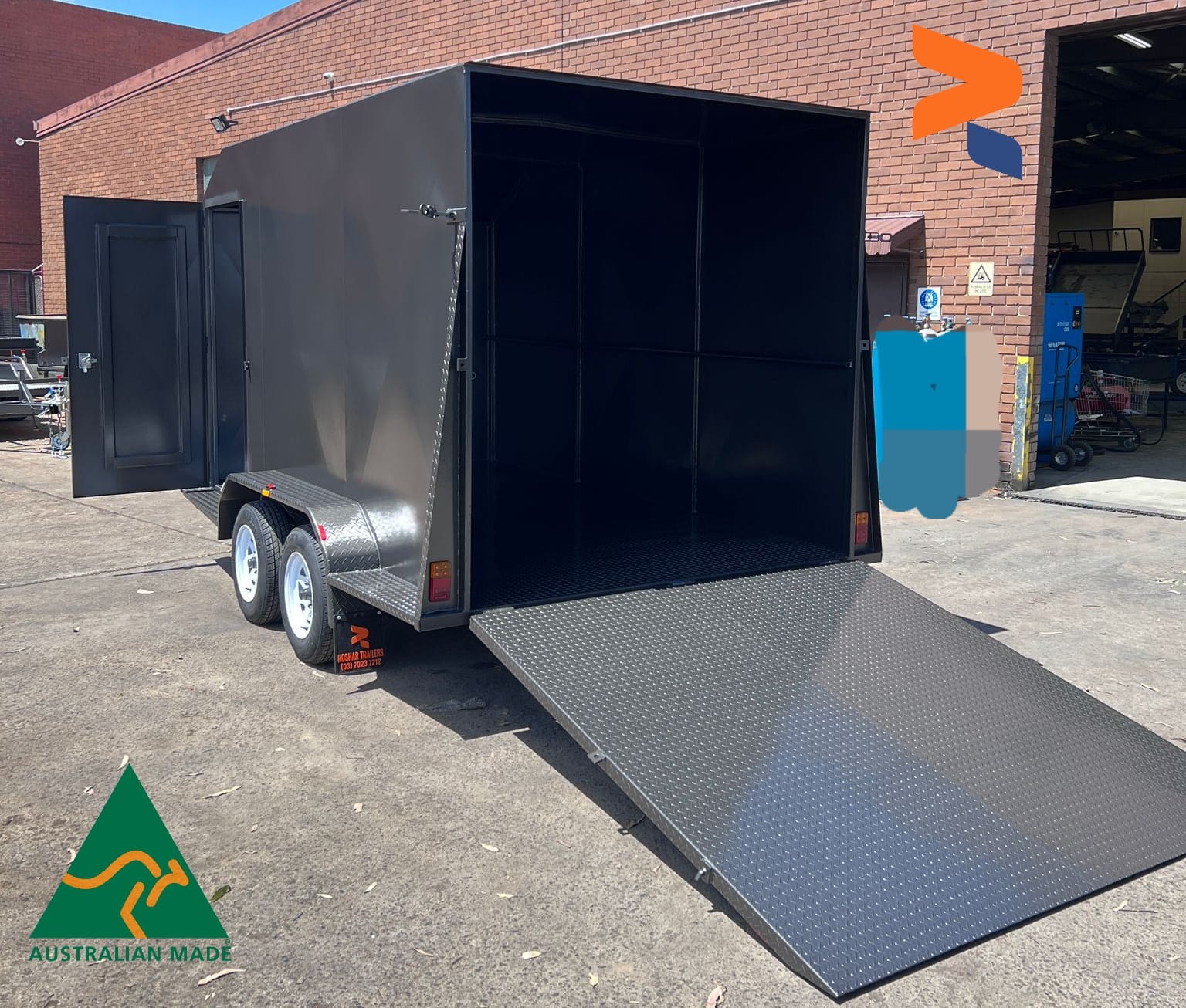
There isn’t one correct answer.
Enclosed setup
An enclosed layout works well when you carry:
- Expensive power tools
- Testing equipment
- Fittings
- Consumables
- Documentation
- Small equipment
Its main advantages are security, weather protection and controlled storage.
Hybrid setup
A hybrid trailer combines enclosed storage with an open section.
This can be useful for a plumber who carries:
- Tools
- Fittings
- Pipe
- Hoses
- Larger equipment
- Job-specific materials
For many plumbing businesses, this approach makes more sense than filling the entire trailer with cabinets.
Open setup
An open layout can work when bulky equipment and materials are more important than enclosed storage.
The trade-off is reduced protection from weather and greater reliance on suitable load restraint.
When does a custom trailer make sense for a plumber?
A custom trailer can make sense when a standard layout wastes space or cannot accommodate your pipework, tools, equipment, storage requirements and daily workflow without compromises.
Roshar’s custom trailer service allows buyers to discuss size, axle configuration, flooring, ramps, cages, toolboxes, tie-down points, braking, suspension and storage around the intended application.
For a plumber, customisation could mean:
- Dedicated pipe racks
- Deeper storage compartments
- Custom drawer widths
- Additional toolboxes
- Equipment-specific mounting
- Extra tie-down points
- Open rear loading space
- Custom ramp arrangements
- Electrical provisions
- Branding and finish options
The key is to customise for a genuine workflow problem rather than adding every available accessory.
When customisation is particularly useful
If your trailer carries a jetter, large compressor, specialised inspection equipment or other substantial machinery, the layout needs to account for its footprint, access, servicing and weight.
Plumbing and drainage equipment suppliers also offer specialised trailer packages built around jetters, water tanks, hose reels and tool storage, showing how different plumbing businesses can require very different trailer configurations. East Coast Water Blasters
How much can a plumber trailer setup cost?
The cost of a plumber trailer setup varies according to trailer size, GVM, axle configuration, brakes, storage, racks, equipment and custom fabrication; a basic tradesman trailer and a specialised plumbing build should not be compared as identical products.
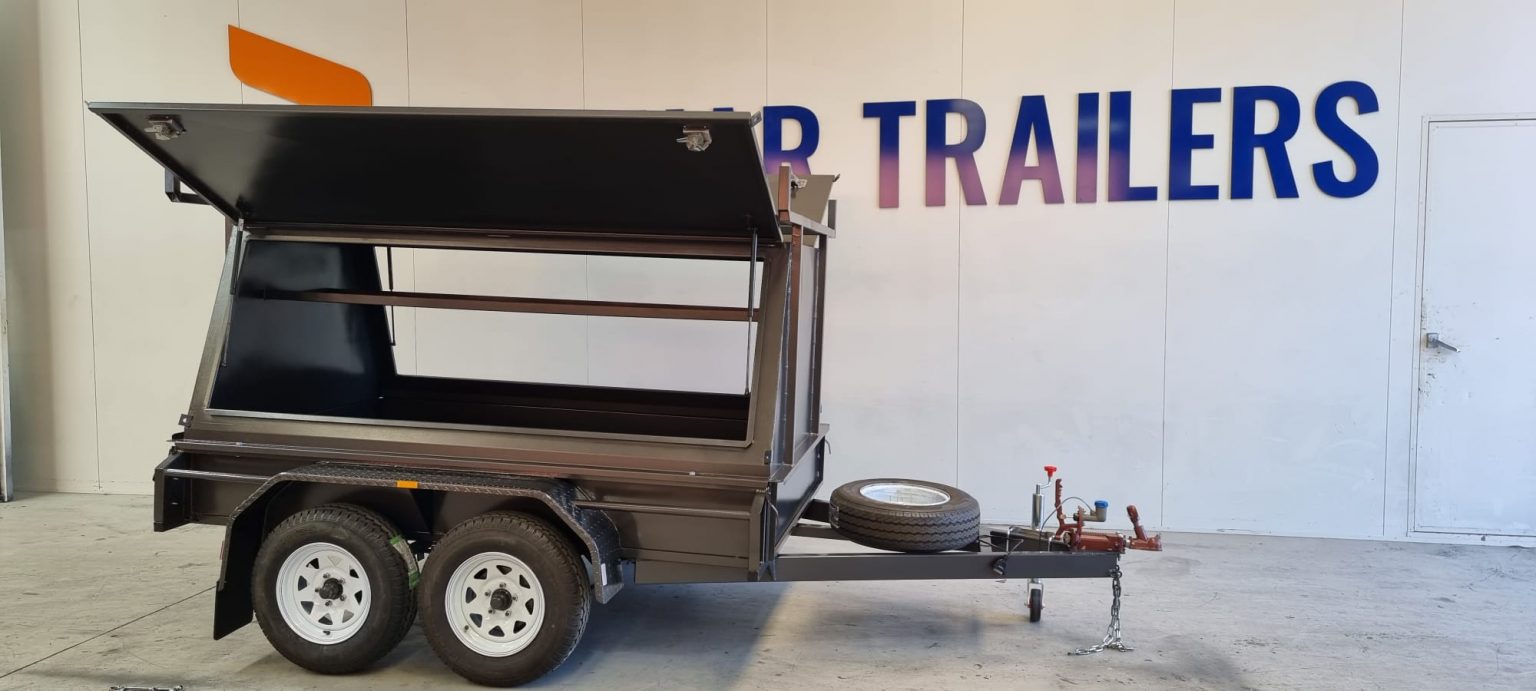
Roshar’s current website listing shows an 8×5 Tradesman Trailer at $6,600 as a listed special, while its broader range includes different sizes and configurations. A custom plumbing setup can cost more depending on the selected specifications and equipment.
What changes the price?
| Cost factor | Why it changes the price |
| Trailer size | More material and carrying capacity |
| Axle configuration | Different running gear and load requirements |
| Brakes | Specification depends on trailer/load requirements |
| Toolboxes | Adds secure storage capacity |
| Shelving/drawers | Adds organisation and fabrication |
| Pipe racks | Adds dedicated long-material storage |
| Custom flooring | Changes durability and use case |
| Electrical setup | Adds charging/power capability |
| Ramps | Adds loading functionality |
| Custom equipment mounting | Requires application-specific fabrication |
The important comparison is cost against workflow, not just purchase price.
A cheaper trailer that forces you to unload half the contents to reach one fitting can become frustrating very quickly. A well-planned layout can be more valuable if it makes daily work easier.
When should you speak with a trailer manufacturer?
Speak with a trailer manufacturer when you carry unusual equipment, need a specific storage layout, are unsure about the required capacity or want a trailer designed around your daily plumbing workflow.
A manufacturer can help you work through the practical details before fabrication.
Before requesting a quote, prepare these details
List your equipment: Write down your major tools, machines, fittings, pipe sizes and materials.
Measure bulky items: Record the length, width and height of equipment that must remain in the trailer.
Estimate your loaded weight: Include tools, stock, accessories and equipment rather than looking only at the trailer’s empty weight.
Identify access requirements: Decide which equipment needs to be reached several times a day.
Separate fixed and flexible storage: Decide what should have a dedicated mount and what can share open storage.
Consider future work: Leave sensible capacity for equipment your business is likely to add.
Roshar’s custom-trailer process starts with discussing what the trailer needs to carry, followed by configuration, quote confirmation, build and final handover.
For Melbourne plumbers, Roshar has sales locations in Braeside, Bayswater North and Dandenong, making local discussions and trailer inspections practical for customers in those areas.
Conclusion
The best plumber trailer setup is one that keeps daily tools accessible, long materials organised, heavy equipment secure and the trailer easy to load and tow. Storage should follow your real workflow rather than simply filling every available space.
If a standard layout doesn’t suit your plumbing work, a custom trailer can provide a more practical combination of storage, access, racks and load support.
Need a trailer designed around your plumbing work? Talk to Roshar Trailers about a tradesman or custom trailer setup.
Braeside | Bayswater North | Dandenong
Contact Roshar Trailers for a quote
FAQ’S
Do plumbers need a tandem trailer?
No, not every plumber needs a tandem trailer. A single-axle tradesman trailer can suit lighter service work, while a tandem configuration may be more appropriate when the business regularly carries heavier equipment, larger quantities of materials or a larger custom setup.
Can a plumber trailer be customised for drain-cleaning equipment?
Yes, specialised plumbing equipment can be incorporated into a custom design, but the trailer needs to account for equipment dimensions, mounting, access, weight and restraint. Jetters, hose reels and tanks can create very different requirements from a standard plumbing tool setup.
Should I leave spare plumbing fittings in the trailer overnight?
Yes, if they are stored securely and you regularly need them for work. Keep frequently used fittings organised in labelled, lockable compartments and review stock regularly so the trailer doesn’t become overloaded with materials you rarely use.
Is an enclosed trailer always better for plumbers?
No, an enclosed trailer isn’t always better. It provides stronger protection for tools and equipment, but a hybrid design may be more practical when you regularly carry pipe, hoses or bulky equipment that needs open access.
Can I use a tradesman trailer for both plumbing work and general business use?
Yes, provided the trailer’s capacity, storage and layout suit both applications. A flexible setup with secure compartments plus some open loading space can make the trailer useful when your work changes between service calls, installations and general contractor jobs.
Should plumbing tools and materials have separate storage areas?
Yes, separating tools, fittings, consumables and bulky materials makes the trailer easier to manage. Dedicated areas also make stock checks quicker and reduce the chance of small fittings getting buried beneath larger equipment.
How often should I review my plumber trailer layout?
At least every few months, and sooner if your work changes. A growing plumbing business often adds equipment, stock or new services, so the trailer layout should be adjusted before overcrowding starts affecting access and safe loading.