
37 Malcolm RD, Braeside, VIC
How to Tie Down a Car on a Trailer Safely for Transport
19 June 2026 | roshartrailers
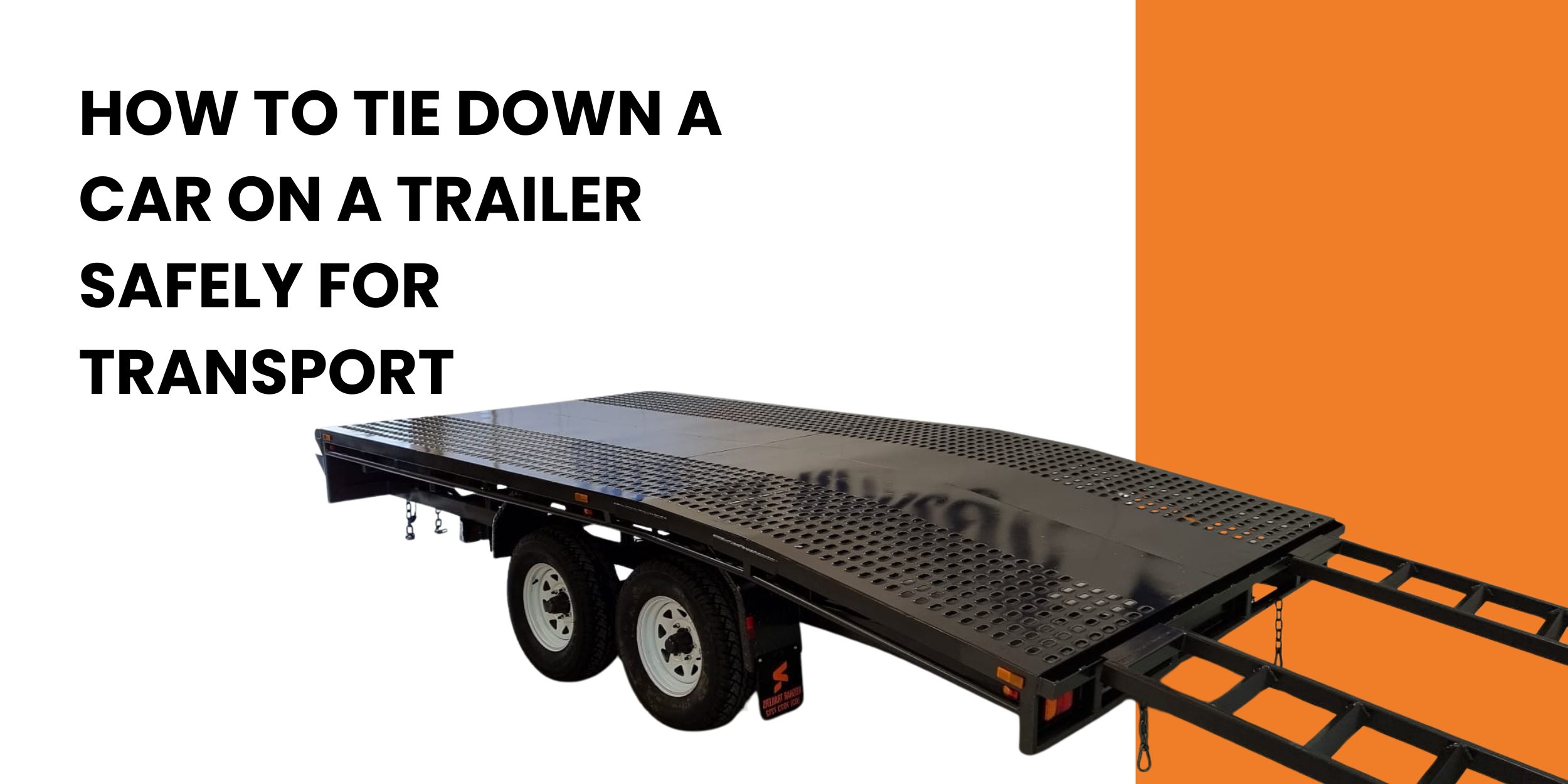
Moving a vehicle on a trailer looks simple until something shifts. Whether you’re a tradie moving a work ute, a landscaper transporting equipment, a farmer towing a paddock vehicle, or a car enthusiast taking a project car to a workshop, knowing how to tie down a car on a trailer the right way is essential.
Quick answer: The safest way to tie down a car on a trailer is to use four rated vehicle transport straps, secure the car at all four corners using proper car trailer tie down points, balance the load using the 60/40 rule, tighten the straps evenly, and re-check them after the first 20 km.
Australian drivers are responsible for making sure their load is safely restrained. The National Transport Commission notes that trailer load restraint laws apply to everyone involved in packing, loading, moving, or unloading light vehicles not just the driver.
Why Proper Vehicle Tie-Down Matters
A car does not stay still just because it is parked on a trailer.
When you brake, accelerate, turn, or hit a bump, the vehicle can move forward, backward, sideways, or upward. Even a small amount of movement can loosen straps, damage the trailer, or create dangerous trailer sway. This is what proper trailer load restraint prevents not just damage to the vehicle, but genuine road safety incidents that affect everyone on the road.
For example, a contractor towing a ute to a job site may only notice the load has shifted when the trailer starts swaying at highway speed. By then, the situation can become risky fast.
Proper trailer load restraint helps protect:
- The vehicle being transported
- The trailer and towing vehicle
- Other road users
- Your tools, machinery, and business assets
- Your legal and insurance position
What Is the Best Way to Tie Down a Car on a Trailer?
The best method is a four-point tie-down system using rated wheel straps, axle straps, or chassis straps.
That means the vehicle is restrained at four separate points: front left, front right, rear left, and rear right.
For most everyday vehicle transport, wheel straps are a safe and practical option because they secure the tyres without putting stress on suspension parts. For 4WDs, work utes, and some commercial vehicles, axle straps may also be suitable when attached correctly.
A strong setup usually includes:
| Item | Purpose |
| Four rated vehicle transport straps | Secures each corner of the vehicle |
| Wheel chocks | Stops movement during loading |
| Rated trailer anchor points | Provides secure attachment |
| Soft loops | Protects painted or delicate areas |
| Final inspection | Confirms nothing is loose or twisted |
Essential Equipment Needed to Secure a Car on a Trailer
Before loading the vehicle, check your gear. The quality of your vehicle transport straps determines everything; this is not the place to use old hardware-store gear with no load rating.
Understanding Working Load Limit (WLL) vs Break Strength
This is one of the most important things to understand before you buy straps, and almost no one explains it clearly.
Every strap has two ratings: the break strength (the force at which the strap fails entirely) and the Working Load Limit (WLL) which is the maximum load the strap is rated to safely restrain in use. The WLL is always significantly lower than the break strength, and it is the WLL that matters for legal compliance and safe transport.
Australian Standard AS 4380 covers vehicle restraint straps. As a general rule, the combined WLL of all your straps must equal or exceed the weight of the vehicle you are transporting. If you are towing a 1,800kg 4WD, your four straps combined need a WLL of at least 1,800kg. Check the label on every strap before you buy or use it.
Ratchet Straps
Ratchet straps are commonly used for vehicle transport because they allow controlled tightening. Yes, you can use ratchet straps to tie down a car, but they must be rated, undamaged, and suitable for the vehicle’s weight. Always check the WLL label, not just the break strength figure.
Wheel Straps
Wheel straps wrap around the tyres. They are useful for classic cars, sports cars, lowered cars, and vehicles where you want to avoid chassis or suspension damage. For most road-registered vehicles, wheel straps are the safest and most practical choice.
Axle Straps
Axle straps loop around strong axle components. They work well for utes, 4WDs, and heavier vehicles with solid axle configurations, but you must avoid brake lines, steering arms, and weak suspension parts when attaching them.
Soft Loops
Soft loops prevent metal hooks from scratching or damaging vehicle components. Use them any time a hook would otherwise contact a painted surface or a part not designed to bear a sharp load.
Wheel Chocks
Wheel chocks are simple but valuable. Place them before loading and keep them in place until all straps are secured.
Choosing the Right Trailer for Vehicle Transport
The trailer matters just as much as the straps. A poorly matched trailer makes loading harder, reduces stability, and limits your tie-down options.
Flat Top Trailer
A flat top trailer gives you a wide, open deck suitable for cars, pallets, equipment, and machinery. Because the deck is unobstructed, you have maximum flexibility for positioning the vehicle and accessing anchor points from all sides. If you transport vehicles alongside other loads, a flat top is the most versatile option.
Tandem Trailers
Tandem trailers offer better weight distribution and road stability than single-axle trailers, especially for heavier loads or longer trips. If you are regularly moving vehicles or heavy equipment, a tandem axle configuration reduces sway and gives you greater payload capacity. For tradies, contractors, landscapers, and small businesses doing this work regularly, tandem models are often the smarter long-term investment.
Plant Trailer
A plant trailer is built for machinery and equipment. Contractors and landscapers often use them for mini excavators, compact loaders, and work vehicles that need drive-on access and strong anchor points across the full deck.
4.5 Tonne Trailer
A 4.5 tonne trailer suits heavier commercial transport needs. Construction companies, rural operators, and businesses moving heavier vehicles or machinery will find the payload and structural strength of a heavy-duty trailer significantly more appropriate than a lighter-rated unit.
Understanding Load Distribution: What Is the 60/40 Rule on Trailers?
Getting load balance right is one of the most overlooked parts of how to tie down a car on a trailer straps alone won’t save you if the weight is wrong from the start.
The 60/40 rule means placing about 60% of the load weight toward the front of the trailer and about 40% behind the axle group. This reduces trailer sway and improves towing stability across braking, cornering, and highway speeds.
If you load a car too far back, the trailer may feel light at the tow ball and start swaying. If you load it too far forward, the rear of the towing vehicle may sag, affecting braking and steering.
Before strapping the car down, check that:
- The vehicle is centred side to side
- The heaviest section sits slightly forward of the axle group
- The tow vehicle sits level when the trailer is hitched
- The trailer does not feel nose-heavy or tail-heavy
Also check your towing vehicle’s Gross Combined Mass (GCM) the combined weight of the tow vehicle plus the loaded trailer must not exceed this figure. It is marked on your vehicle’s compliance plate or in the owner’s manual. Exceeding your GCM is illegal and affects braking performance and vehicle stability.
Identifying the Correct Car Trailer Tie Down Points
Choosing the right car trailer tie down points prevents damage and keeps the vehicle secure across the full trip.
Wheel Tie-Down Points
Wheel straps secure the tyres and allow the vehicle’s suspension to move naturally during transport. This is the safest option for valuable, lowered, or delicate vehicles. Attach to rated car trailer tie down points on the trailer frame never improvise with unrated hooks or loops.
Chassis Tie-Down Points
Some vehicles have manufacturer-approved chassis points specifically designed for transport. These can be very secure, but only use them if you have confirmed they are rated for restraint purposes. Check the vehicle’s owner manual or workshop documentation if unsure.
Points to Avoid
Do not attach straps to:
- Steering arms
- Brake lines
- Exhaust components
- Thin sheet metal
- Suspension links not designed for restraint
- Plastic bumper brackets
A real-world example: tying a strap around a suspension arm may seem solid, but if the strap rubs on a brake hose during travel, you could arrive with a damaged braking system. Another common error is attaching a strap to a plastic bumper bracket on a modern car, it may look sturdy, but it is designed for cosmetic fitment only and will fail under load restraint stress.
How to Tie Down a Car on a Trailer: Step-by-Step Guide
Step 1: Park on Level Ground
Load the vehicle on firm, flat ground. Avoid slopes where possible. Uneven ground makes it harder to judge vehicle position and creates uneven strap tension before you even start moving.
Step 2: Drive or Winch the Vehicle Onto the Trailer
Move slowly and keep the vehicle centred side to side on the deck. Use a spotter if visibility is limited or if the vehicle is low to the ground. Take your time repositioning after the vehicle is partially loaded is harder than getting it right on the way in.
Step 3: Set the Position Using the 60/40 Rule
Place slightly more of the vehicle’s weight forward of the trailer axle group. Step back and check that the towing vehicle sits level. If the tow vehicle’s rear sags significantly, the vehicle may be loaded too far forward.
Step 4: Apply the Parking Brake
Engage the vehicle’s parking brake before attaching any straps. This prevents movement while you work around the trailer.
Step 5: Add Wheel Chocks
Place chocks against at least one front wheel and one rear wheel before attaching straps. This is your backup if the parking brake slips.
Step 6: Attach the Front Straps
Secure the front left and front right using rated vehicle transport straps and proper car trailer tie down points. Straps should angle forward and slightly outward from the vehicle toward the anchor point. Do not attach to steering arms, brake lines, or sheet metal.
Step 7: Attach the Rear Straps
Secure the rear left and rear right. Rear straps should pull backward and slightly outward. Mirror the front strap angle to create balanced restraint across all four corners.
Step 8: Tighten Evenly
Tighten each strap in sequence front left, front right, rear left, rear right then go around again. Tighten until the vehicle is firm and cannot shift when pushed by hand. Do not over-tighten to the point where you compress the tyres excessively or put stress on suspension components.
Step 9: Do a Final Walk-Around
Check every hook, ratchet, anchor point, and strap angle. Nothing should be twisted, rubbing on a sharp edge, or hanging loose. Confirm the ratchets are fully locked before moving.
Can I Use Ratchet Straps to Tie Down a Car?
Yes, ratchet straps can be used to tie down a car but only if they are rated for vehicle transport and used correctly.
Do not use old hardware-store straps with no visible load rating. For vehicle transport, use proper vehicle transport straps with a clearly marked Working Load Limit (WLL).
Before every trip, inspect straps for:
- Fraying or cuts in the webbing
- UV degradation (fading, brittleness)
- Rusty or stiff ratchet mechanisms
- Bent or deformed hooks
- Damaged stitching at connection points
If a strap looks questionable in any of these areas, replace it. A failed strap during transport is not just a vehicle damage problem it can become a road hazard for other drivers.
Wheel Straps vs Axle Straps vs Chassis Straps
Choosing the right type of vehicle transport straps depends on the vehicle you’re moving and where you can safely attach them.
| Strap Type | Best For | Pros | Watch Out For |
| Wheel straps | Most cars, classics, EVs, lowered vehicles | Reduces vehicle damage risk, easy to fit | Needs correct fitment around the tyre |
| Axle straps | Utes, 4WDs, solid axle vehicles | Strong and versatile | Avoid brake lines, steering, and thin suspension parts |
| Chassis straps | Race cars, modified vehicles, approved chassis points | Very secure when done correctly | Must use manufacturer-approved points only |
For most homeowners, DIY users, and automotive businesses, wheel straps are the safest and most straightforward choice.
How Tight Should Ratchet Straps Be?
Ratchet straps should be tight enough that the car cannot shift, but not so tight that you damage the vehicle.
A practical test: once all four straps are secured, push the vehicle firmly from the front, rear, and sides. It should not rock or roll in any direction.
After driving 10–20 km, stop in a safe place and re-check the straps. Straps often settle after the first section of a trip as the vehicle settles onto the deck and the ratchets bed in.
On trips over two hours, check strap tension at every fuel stop. Heat, vibration, and varying road surfaces all affect strap tension over longer distances. This takes two minutes and can prevent a serious incident.
Common Mistakes When Tying Down a Car
Most problems people have when learning how to tie down a car on a trailer come down to the same handful of avoidable errors:
- Using only two straps always :- use four, one at each corner
- Tying to weak suspension or bumper parts :- only use rated attachment points
- Using unrated or damaged straps :- check the WLL label before every use
- Loading the car too far back :- follow the 60/40 rule from the start
- Forgetting to re-check after driving :- check at 20km and again at every fuel stop
- Letting straps rub against sharp edges :- reposition before you move
- Ignoring trailer anchor point ratings :- your straps are only as strong as the anchor they connect to
- Cranking ratchets as hard as possible :- correct tension and correct attachment matter more than maximum tightening
One of the most common assumptions is that “tighter is always better.” It isn’t. Over-tightened straps can damage tyres, compress suspension components, and create stress on anchor points that weren’t designed for extreme loads.
How to Tie Down a Car on a Trailer in Australia
In Australia, your load must be properly restrained under trailer load restraint regulations and must not create a safety risk for other road users. The NTC states that light vehicle loads must be properly restrained, must not exceed mass limits, and must not obscure lights, reflectors, indicators, or number plates.
For safe trailer load restraint in Australia:
- Use rated restraints with visible WLL markings
- Secure the vehicle at four points
- Check the trailer’s ATM and payload capacity against the vehicle’s weight
- Confirm your towing vehicle’s GCM is not exceeded
- Keep number plates and trailer lights fully visible
- Re-check straps during long trips
- Follow state-specific rules where they apply
Every item on this checklist is part of your legal obligation around trailer load restraint in Australia. Victoria’s transport authority notes that fines can apply for unsecured loads even if the load does not fall from the trailer.
Special Tips for Different Vehicle Types
Classic Cars
Use wheel straps or soft loops to avoid damaging older chassis components or restored paintwork. Many classic cars do not have manufacturer-approved transport tie-down points, making wheel straps the default safe choice. Avoid any attachment points that show rust, fatigue, or previous repair work.
Lowered Cars
Use low-profile ramps and check the approach angle carefully before loading. The clearance between a lowered vehicle and the trailer deck edge is often minimal. A spotter is highly recommended for loading lowered vehicles.
4WDs
Use higher-rated straps appropriate for the vehicle’s weight and confirm the trailer has sufficient payload capacity. A loaded touring 4WD can exceed 3,000kg check your combined WLL before you assume standard straps are adequate.
Electric Vehicles
EVs deserve special attention. Many are significantly heavier than equivalent petrol vehicles due to underbody battery packs; a mid-size EV can weigh 500–700kg more than a comparable petrol model. Because of the battery pack location, chassis straps are often unsuitable for EVs, and wheel straps are almost always the correct choice. Some manufacturers publish specific transport tie-down points in their documentation check before loading. Also note that many EVs should not be towed with their wheels on the ground due to regenerative braking system considerations, making trailer transport the correct method.
Non-Running Vehicles
Use a winch to load a non-running vehicle rather than pushing it. Once on the trailer, use wheel chocks front and rear before attaching straps, as there is no parking brake to assist.
Safety Checks Before Hitting the Road
Every item on this list is part of your trailer load restraint obligation. Before leaving:
- Hitch is fully locked and safety pin is in place
- Safety chains are connected and correctly crossed
- All trailer lights are working (brake, indicator, tail)
- Trailer tyres are correctly inflated
- All four straps are tightened and ratchets are locked
- The vehicle is centred on the deck
- Number plate and lights are fully visible and unobstructed
- Towing vehicle sits level (not sagging at the rear)
After 20 km, stop and check:
- Strap tension across all four corners
- Anchor point condition
- Any tyre movement on the trailer deck
- Overall trailer balance and tracking
At every fuel stop on longer trips, do a two-minute walk-around. It takes less time than dealing with a shifted load.
If you’re new to towing altogether, read our guide on how to reverse a trailer before your first trip. It covers the techniques that make manoeuvring with a loaded trailer significantly easier.
Choosing the Best Trailer for Long-Term Vehicle Transport
If you transport vehicles regularly, choose a trailer based on the actual work you do rather than the cheapest available option. The right trailer reduces loading time, improves safety, and handles more jobs without needing to hire or borrow equipment.
| Trailer Type | Best For |
| Car trailer / car carrier | Regular vehicle transport |
| Flat top trailer | Mixed loads vehicles, pallets, equipment |
| Plant trailer | Machinery and contractor use |
| Tandem trailer | Heavier loads and longer trips |
| 4.5 tonne trailer | Commercial and heavy-duty transport |
If you need one trailer across many different jobs, flat top trailers are the most flexible option, they suit vehicles, machinery, and building materials without modification.
If stability and payload are the priority, compare tandem trailers the dual axle configuration makes a meaningful difference on longer tows and with heavier vehicles.
For construction, landscaping, and equipment transport, a plant trailer or heavy-duty trailer is usually the better long-term business investment.
Before you head out, make sure your trailer is legally registered and road-legal in Victoria. Read our complete guide on how to register a trailer in Victoria for the full VicRoads process, ATM categories, and the July 2023 compliance changes.
Final Thoughts
Learning how to tie down a car on a trailer safely is about more than tightening a few straps. You need the right trailer, the correct load balance, proper car trailer tie down points, rated vehicle transport straps with the right WLL, and regular checks throughout the trip.
For tradies, contractors, landscapers, farmers, automotive businesses, homeowners, and small business owners, a safe setup protects your vehicle, your trailer, and everyone else on the road. The few extra minutes it takes to do this properly are worth it every time.
Ready to transport vehicles with confidence? Roshar Trailers builds Australian-made car carriers, flat top trailers, plant trailers, tandem trailers, and heavy-duty trailers for tradies, contractors, landscapers, and businesses across Victoria. Visit us in Braeside, Bayswater North, or Dandenong or get a quote online.
Faq’s
What is the best way to tie down a car on a trailer?
The best method is a four-point tie-down system using rated vehicle transport straps at each corner of the vehicle. Use wheel straps for most passenger vehicles to avoid chassis damage, ensure the combined Working Load Limit of your straps meets or exceeds the vehicle’s weight, and re-check strap tension after the first 20 km of travel.
How do you tie down a car on a trailer in Australia?
In Australia, use rated restraints with a visible WLL, secure the vehicle at four points using proper car trailer tie down points, follow the 60/40 weight distribution rule, ensure trailer lights and number plates remain unobstructed, and check strap tension during the trip. Trailer load restraint obligations apply to everyone involved in loading, not just the driver.
Can I use ratchet straps to tie down a car?
Yes, but only use ratchet straps specifically rated for vehicle transport with a clearly marked Working Load Limit. Avoid unrated, worn, frayed, or damaged straps regardless of how they appear externally. Inspect the webbing, stitching, hooks, and ratchet mechanism before every use and replace any strap that shows signs of wear or damage.
What is the 60/40 rule on trailers?
The 60/40 rule means distributing approximately 60% of the load weight forward of the trailer’s axle group and 40% behind it. This improves towing stability, reduces the risk of trailer sway, and prevents the rear of the tow vehicle from sagging under excess nose weight. Check that the tow vehicle sits level once the trailer is hitched and loaded.
How many straps do I need to secure a car on a trailer?
Use four straps as a minimum two at the front and two at the rear, one at each corner of the vehicle. Using only two straps leaves the vehicle free to rock or pivot around the secured points, which creates movement and increases the risk of load shift during braking or cornering.
Can I transport a car on a flat top trailer?
Yes. A flat top trailer can safely transport a car provided it has sufficient payload capacity for the vehicle’s weight, suitable ramps for loading, and rated anchor points positioned correctly for a four-point tie-down. Flat top trailers are a versatile option because the open deck accommodates a range of vehicle sizes and load types.