
37 Malcolm RD, Braeside, VIC
Flatbed Trailer Features To Compare Before Choosing One
13 April 2026 | roshartrailers
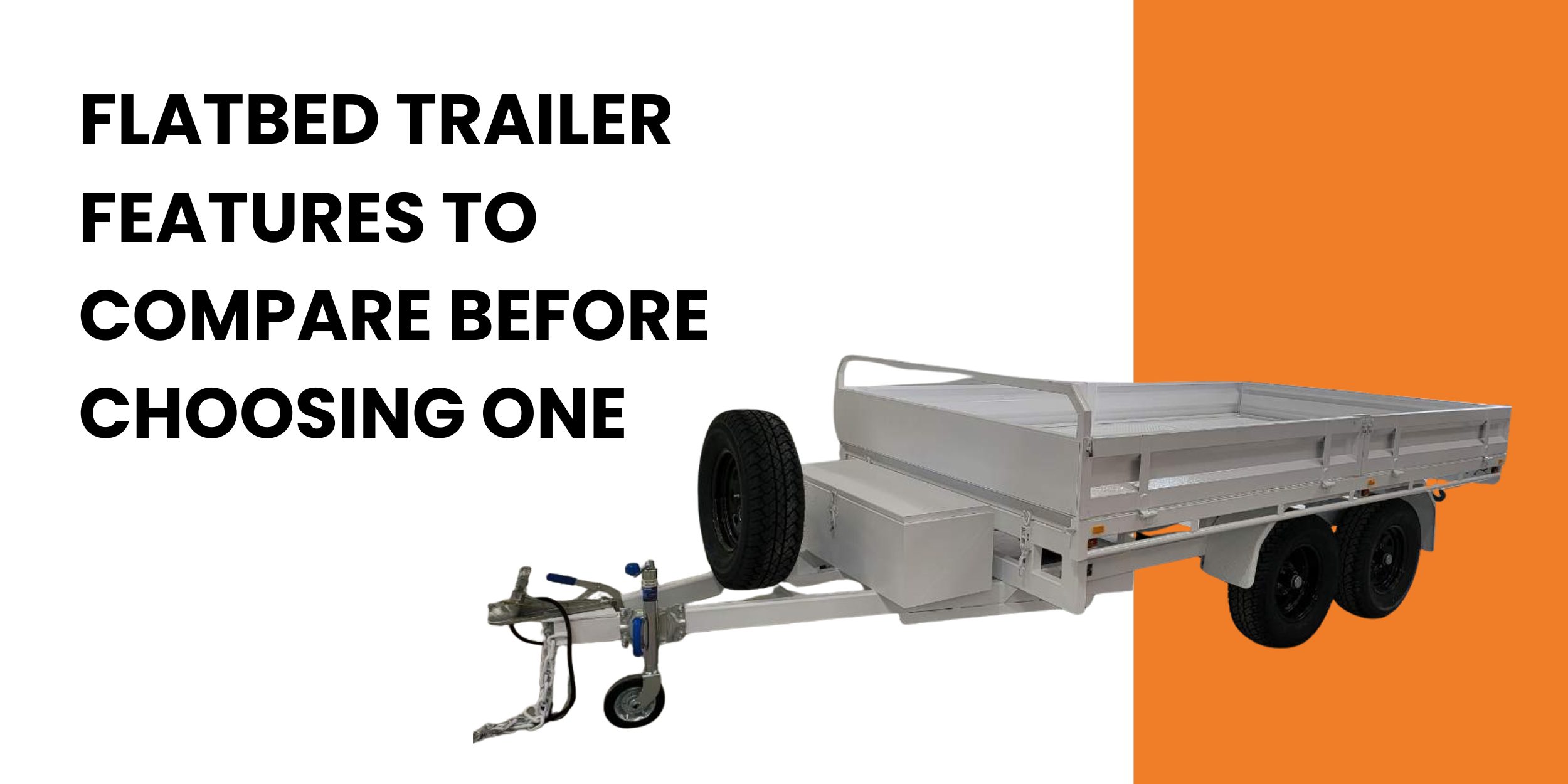
Choosing a flatbed trailer is not only about size or price. The right trailer depends on what you carry, how often you tow, how the load is secured, and whether the trailer is built for the conditions it will face.
A flatbed trailer, also known as a flat top trailer or open deck trailer, is commonly used for transporting machinery, pallets, building materials, landscaping supplies, equipment and other bulky loads. Because the deck is open, it gives users more loading flexibility than enclosed or high-sided trailers.
Before choosing one, it is worth comparing the main features that affect safety, durability, loading efficiency and long-term suitability. This is especially important for Australian tradies, landscapers, builders, machinery operators and businesses that carry changing loads across different worksites.
Compare Roshar’s flat top trailer options before choosing the right setup for your load.
This guide explains the practical features to compare before deciding what type of flatbed trailer suits your work. For available sizes, build options and quote enquiries, visit Roshar’s flat top trailer page.
Reviewed by: Roshar Trailers Team
Last updated: June 2026
One of the main reasons businesses prefer a flatbed trailer Australia solution is flexibility. Without height or width restrictions, these trailers can carry oversized materials with ease.
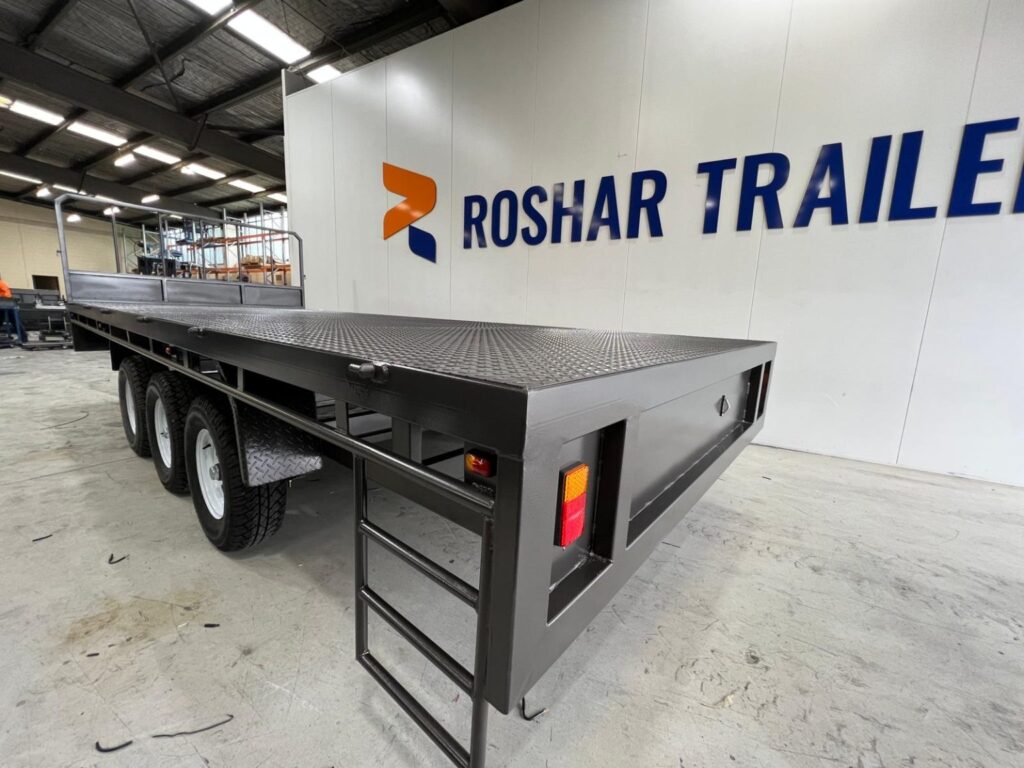
Chassis Strength
The chassis is the foundation of a flatbed trailer. It supports the deck, load, axles, suspension, coupling and braking components. If the chassis is not suited to the load, the trailer may flex, wear faster or become unsafe over time.
A strong chassis is especially important when carrying machinery, pallets, steel, timber, construction supplies or other concentrated loads.
What to compare
| Feature | Why it matters |
| Steel thickness and profile | Affects structural strength and long-term durability |
| Cross-member spacing | Helps support the deck and reduce flex under load |
| Drawbar design | Impacts towing stability and load transfer |
| Weld quality | Poor welds can weaken high-stress areas |
| Corrosion protection | Important for outdoor storage, wet worksites and long-term use |
| Reinforcement points | Useful for machinery, pallets or heavy trade equipment |
A lighter-duty frame may be suitable for occasional use, but regular commercial or trade work usually requires a stronger chassis. The goal is to match the frame to the load pattern, not just the trailer’s visual size.
Trailer Deck Size
Deck size affects what the trailer can carry and how easily the load can be positioned. A trailer that is too small may force awkward loading, while a trailer that is too large may be harder to tow, store and manoeuvre.
The best deck size depends on the most common load, not the largest possible load that might be carried once or twice.
Common deck size considerations
| Question | Why it matters |
| What is the longest item you regularly carry? | Helps determine deck length |
| Do you need to load pallets? | Affects deck width and side access |
| Will machinery be loaded with ramps? | Impacts deck length and ramp angle |
| Do you carry mixed loads? | Extra deck space may help separate items |
| Where will the trailer be stored? | Larger trailers need more turning and parking space |
| What vehicle will tow it? | Deck size must match towing capacity and practical use |
For example, a landscaper may need space for equipment and materials on the same trip. A builder may need extra length for timber, steel or frames. A machinery operator may need enough deck space for the machine plus safe tie-down angles.
A reliable trailer must support heavy loads safely. Always check the trailer load capacity and Gross Vehicle Mass rating before making a purchase.
Deck size should make loading easier, not just make the trailer look more capable.
Load Capacity And Weight Ratings
Load capacity is one of the most important features to compare before choosing a flatbed trailer. A trailer may physically fit a load, but that does not mean it is rated to carry it.
In Australia, trailer weight ratings are important for legal, mechanical and safety reasons. The Australian Government’s Vehicle Standards Bulletin 1 explains that trailers with an aggregate trailer mass of 4.5 tonnes or less are expected to comply with applicable Australian Design Rules. It also explains that ATM minus tare mass gives the maximum load the trailer can carry.
Key weight terms to understand
| Term | Meaning |
| Tare mass | The weight of the trailer when empty |
| Payload | The maximum load the trailer can carry |
| ATM | Aggregate Trailer Mass: the total trailer mass when fully loaded |
| GTM | Gross Trailer Mass: the load carried by the wheels when coupled to the tow vehicle |
| Tow vehicle capacity | The maximum weight your vehicle is rated to tow |
A common mistake is choosing a trailer based only on deck size. A better approach is to list your regular loads, estimate their actual weight and compare that against the trailer’s rated capacity.
Load capacity checklist
Before choosing a trailer, compare:
- The weight of your usual load
- The weight of your heaviest expected load
- Trailer tare mass
- Trailer ATM
- Tow vehicle rated capacity
- Axle rating
- Tyre rating
- Brake requirements
- How the load weight is distributed across the deck
A trailer should have enough capacity for the load without constantly operating at its limit.
Axle And Braking Setup
The axle and braking setup affects how the trailer handles weight, corners, braking and uneven road surfaces. This is especially important for trade, construction, landscaping and machinery transport.
Single axle trailers can be suitable for lighter loads and easier manoeuvring. Tandem axle trailers are often preferred for heavier or more frequent transport because the load is spread across more wheels.
Single axle vs tandem axle
| Feature | Single axle | Tandem axle |
| Best suited to | Lighter or occasional loads | Heavier and regular loads |
| Manoeuvrability | Easier to move by hand | More stable but heavier |
| Load support | Lower overall support | Better load distribution |
| Tyre wear | Fewer tyres to maintain | More tyres, more contact with road |
| Towing feel | Simpler for light use | More stable for larger loads |
Brakes should also be matched to the trailer’s rating, load type and towing requirements. If the trailer will regularly carry machinery, pallets or heavy materials, braking performance becomes a major selection factor.
What to compare
- Single axle or tandem axle design
- Axle rating
- Suspension type
- Brake type
- Tyre rating
- Wheel size
- Stability under loaded conditions
- Ease of servicing
A stronger trailer is not only about the frame. The running gear underneath must also suit the load.
Tie-Down Points And Load Restraint
Tie-down points are essential on a flatbed trailer because the deck is open. Without suitable restraint points, even a well-built trailer can become unsafe.
Transport Victoria recommends choosing suitable restraint equipment for the load, such as webbing straps, chains, ropes, cargo nets or tarpaulins. It also recommends using rated equipment where possible and notes that chains are best suited to heavy loads because they do not stretch as much as webbing straps or ropes.
Source: https://transport.vic.gov.au/road-and-active-transport/road-rules-and-safety/securing-loads
Tie-down features to compare
Ramps, Headboards And Custom Add-Ons
Flatbed trailers can often be adapted with features that make loading, restraint and daily use easier. These add-ons should be chosen based on how the trailer will actually be used.
For machinery transport, ramps may be essential. For long materials, a headboard may help protect the towing vehicle and improve load control. For trade use, toolboxes and storage points may improve efficiency.
Useful flatbed trailer add-ons
| Add-on | Best suited to |
| Removable ramps | Machinery, mowers, compact equipment |
| Slide-under ramps | Saving deck space when ramps are not in use |
| Headboard | Timber, steel, pipe and forward load protection |
| Drop sides | Mixed loads that sometimes need containment |
| Toolboxes | Trade equipment, straps, chains and site gear |
| Spare wheel bracket | Longer trips and worksite reliability |
| Winch points | Machinery or equipment loading assistance |
| Mesh floor or checker plate | Grip, durability and worksite use |
| Custom tie-down layout | Repeated machinery or equipment transport |
The best add-ons are the ones that solve regular problems. If a feature is only useful once a year, it may add unnecessary cost or weight. If it saves time every week, it may be worth including from the start.
When To Speak With A Trailer Builder
A standard trailer may suit simple transport needs, but it is worth speaking with a trailer builder when the load is heavy, unusual, repeated or difficult to secure.
This is especially important if the trailer will be used for commercial work, machinery transport, pallet loading, construction materials or trade equipment.
Speak with a trailer builder if:
- You regularly carry the same machine or equipment
- You are unsure what ATM or payload you need
- You need specific deck dimensions
- You need forklift side-loading access
- Your load needs custom tie-down positions
- You need ramps designed around equipment height and weight
- You work on uneven or rough access sites
- You need toolboxes, headboards or removable sides
- You want the trailer to suit a specific tow vehicle
- Your current trailer is slow, unsafe or awkward to load
A trailer builder can help compare chassis strength, deck size, payload, axle setup, braking, ramps and restraint points as one complete system. That matters because these features work together.
A trailer with a strong chassis but poor tie-down access may still be impractical. A trailer with a large deck but insufficient payload may still be unsuitable. A trailer with ramps that do not match the equipment may create loading issues.
The right choice is the trailer that matches the load, towing vehicle, worksite conditions and frequency of use.
Final Thoughts
A flatbed trailer should be chosen by comparing how its features match the work it needs to do. Chassis strength, deck size, load ratings, axles, brakes, tie-down points, ramps and custom add-ons all affect how practical and safe the trailer will be in daily use.
The best trailer is not always the largest or heaviest option. It is the one that suits your regular load, towing vehicle, loading method and worksite conditions.
If you are comparing trailer options for regular machinery, pallet, trade or construction transport, review Roshar’s flat top trailer options before requesting a quote.
Frequently Asked Questions
What features should I compare before choosing a flatbed trailer?
Compare chassis strength, deck size, load capacity, ATM, axle setup, braking, tie-down points, ramps, headboards and custom add-ons. These features affect how safely and practically the trailer can carry your regular loads.
Why is chassis strength important on a flatbed trailer?
Chassis strength matters because the chassis supports the deck, load, axles and towing forces. A stronger chassis is important for machinery, pallets, trade equipment and repeated commercial use.
How do I choose the right flatbed trailer deck size?
Choose deck size based on the loads you carry most often. Consider the length, width, loading method, tie-down access, storage space and towing vehicle capacity before choosing a trailer size.
What does ATM mean on a trailer?
ATM stands for Aggregate Trailer Mass. It means the total mass of the trailer when carrying the maximum load recommended by the manufacturer. Payload is calculated by subtracting tare mass from ATM.
Are tandem axle flatbed trailers better than single axle trailers?
Tandem axle trailers are often better for heavier or more regular loads because weight is spread across more wheels. Single axle trailers may be more suitable for lighter loads and easier manoeuvring.
Why are tie-down points important on a flatbed trailer?
Tie-down points are important because flatbed trailers have an open deck. Suitable restraint points help secure machinery, pallets, timber, steel, landscaping materials and other loads so they do not move during transport.
Is a flatbed trailer suitable for machinery?
A flatbed trailer may be suitable for machinery when the trailer has the correct deck size, ATM, payload, ramps, brakes, tyres and tie-down points for the equipment being transported. Heavier machinery may require a dedicated machinery trailer or custom trailer configuration.
When should I consider a custom flatbed trailer?
Consider a custom flatbed trailer when your load is repeated, heavy, unusual, difficult to restrain or requires specific ramps, deck dimensions, tie-down points, headboards or storage features.