
37 Malcolm RD, Braeside, VIC
7 Trailer Features Fencing Contractors Should Consider
27 November 2026 | roshartrailers
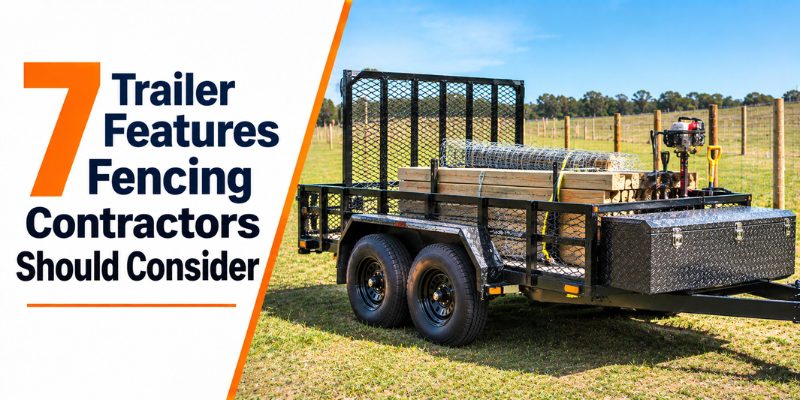
Table of Contents
By Writer :- Ron
Roshar Trailers Team, Trailer Manufacturing and Sales Specialists
Published: 27/11/2026
A fencing contractor trailer should be built around the materials, tools and equipment you carry every day, with enough deck space, secure tie-downs, storage, racks, ramps and payload capacity to make loading safer and repeated job-site transport more efficient.
Fencing work rarely involves one simple load. A typical day can mean carrying posts, rails, wire rolls, mesh, gates, tools, concrete, a generator and small equipment to different properties. The trailer needs to make that combination manageable.
The best setup also depends on the type of fencing you install. Residential timber fencing, rural wire fencing and commercial fencing can have very different transport requirements.
This guide breaks down seven features worth considering before you buy or customise a fencing trailer.
What trailer features should fencing contractors consider?
Fencing contractors should prioritise seven features: usable deck space, material racks, rated tie-down points, loading ramps, secure storage, suitable payload and a build that can be customised around the way fencing materials are actually loaded and unloaded.
A fencing trailer has to work as a transport system, not just a large platform. The useful test is simple: can the crew load the materials in a sensible order, secure them properly, access the tools they need and unload without repeatedly shifting the rest of the load?
Roshar’s current 12×6 fencing trailer is specifically designed for fencing contractors and lists options including 600 mm or 900 mm cages, removable ladder racks, tube inserts, flush-floor tie points, slide-under ramps, a full-width grid mesh ramp, an extended drawbar, U-shaped tie-down points and a toolbox. It also offers multiple ATM configurations from 1,000 kg to 4,500 kg depending on the build.
Feature priority for fencing work
| Feature | Daily priority | Most useful for |
| Usable deck length | High | Posts, rails, mesh and gates |
| Material racks | High | Posts, rails and long fencing materials |
| Tie-down points | High | Wire, mesh, gates and equipment |
| Tool storage | High | Hand tools, fixings and small equipment |
| Ramps | Medium–High | Mowers, compact machinery and generators |
| Payload capacity | Critical | Heavy posts, concrete, tools and equipment |
| Custom layout | High for regular contractors | Businesses with repeated loading patterns |
How much deck space does a fencing contractor need?
A fencing contractor needs enough deck space for the longest regular materials plus tools and equipment, but the trailer should still suit the tow vehicle, storage area and payload requirements. A larger deck is useful only when its capacity can be used safely.
Fencing materials can be awkward because length and weight don’t always increase together. Timber rails may be long but relatively manageable, while concrete bags, steel posts and gates can add substantial weight.
Roshar currently lists a 12×6 fencing trailer with approximately 3,658 mm of length and 1,829 mm of width as a common 12×6 configuration, while its product range also includes 10×6 fencing trailers.
For a contractor, the right size should come from the work rather than a standard “bigger is better” approach.
Match deck space to the load
Residential fencing: You may prioritise timber rails, posts, tools, fixings and smaller gates.
Rural fencing: Wire rolls, star pickets, strainers, posts, tools and repair equipment can create a much more varied load.
Commercial fencing: Larger gates, mesh panels, heavier posts and additional installation equipment may require more deck space and stronger load restraint.
Repair work: A smaller, organised setup can sometimes be more useful than a large trailer if the goal is to arrive with the most commonly needed tools already accessible.
The key is to measure your regular materials before ordering. Measure the longest items, widest gates and heaviest recurring loads rather than guessing from the trailer name.
What racks and holders make fencing materials easier to carry?
Dedicated racks and holders make fencing trailers more practical by separating long materials from tools and smaller equipment. Post racks, wire holders, tube inserts and removable racks can reduce floor clutter and make repeated loading more consistent.
This is one of the biggest opportunities for trade-specific trailer design.
A fencing crew shouldn’t have to stack everything flat on the deck if some materials can be held vertically or along the trailer sides. That can free usable floor area for tools, concrete, generators or other equipment.
Useful rack and holder options
Post racks: Keep posts grouped together and make them easier to load and unload.
Wire holders: Give wire rolls a defined position instead of leaving them loose on the deck.
Tube inserts: Useful when the trailer needs dedicated locations for long materials or equipment.
Removable racks: Useful when the trailer performs more than one job and needs to be converted between fencing projects.
Extended drawbar: Can provide additional front-end space for selected equipment or improve the overall layout when properly engineered.
Roshar’s 12×6 fencing trailer lists removable ladder racks, tube inserts or cut-corner slots and an extended drawbar among its available options.
The advantage isn’t just appearance. A dedicated position for each recurring load makes it easier for the crew to load the trailer the same way each morning.
How important are tie-down points on a fencing trailer?
Tie-down points are critical because fencing materials can be long, heavy, uneven or prone to movement. A trailer should provide suitable restraint locations so straps or chains can be positioned around the actual load rather than improvised around unsuitable parts.
According to Transport Victoria, loads must be properly secured, and the method used should reflect the type of load being carried. The authority also advises that heavy-load headboards and racks need to be strong enough to restrain the load.
The National Heavy Vehicle Regulator’s current Load Restraint Guide also says load positioning should maintain stability, steering and braking, while restraint equipment should be rated, serviceable and suitable for the load.
What fencing loads need careful restraint?
- Bundled timber rails
- Steel posts
- Mesh panels
- Wire rolls
- Gates
- Generators
- Compactors
- Portable machinery
- Toolboxes and loose equipment
Roshar’s fencing trailer includes flush-floor tie points and U-shaped tie-down points as available features.
A practical restraint test
Before leaving the job, ask:
- Is the load positioned so it doesn’t make the trailer unstable?
- Can individual items slide, roll or topple?
- Are the restraint points suitable for the load?
- Are the straps or chains rated and in good condition?
- Could any material move into lights, indicators or the number plate?
- Will the load remain secure after braking, turning and road vibration?
The exact restraint method depends on the load. When the setup is unusual or the load is difficult to restrain, seek qualified advice rather than guessing.
When are ramps useful for fencing contractors?
Ramps are useful when a fencing contractor regularly carries wheeled equipment such as mowers, compact machinery, generators or other equipment that cannot be conveniently lifted onto the trailer. A ramp should be selected for its rated capacity, width, storage and loading angle.
Not every fencing business needs ramps. If your trailer carries only posts, rails, wire and hand tools, ramps may add weight without much practical benefit.
But if the same trailer doubles as a general work trailer, ramps can make it much more versatile.
Situations where ramps make sense
Mower transport: A lawn-care or fencing business may use the same trailer for property maintenance work.
Compact machinery: A small loader or other equipment may need drive-on access.
Generators and compressors: Wheeled equipment is easier to load using a suitable ramp.
Mixed contracting work: A contractor may use the trailer for fencing one day and general site work the next.
Roshar’s current fencing trailer offers slide-under ramps and a full-width grid mesh ramp as available options.
The ramp should be treated as part of the overall trailer design. Check its rated capacity, loading angle, width, surface grip and storage position rather than adding the cheapest available ramp.
What storage features should a fencing trailer have?
A fencing trailer should have secure storage for hand tools, fixings, PPE, straps and smaller equipment that would otherwise get buried under posts or materials. A toolbox, dedicated compartments and sensible access points can save time throughout the workday.
Fencing crews carry plenty of small items that are easy to lose in a large open trailer.
Think about:
- Post-driving tools
- Hammers
- Pliers
- Shovels
- Crowbars
- Tape measures
- Levels
- Fasteners
- Brackets
- Straps
- Gloves
- PPE
- Spare parts
These items don’t necessarily need the same storage solution.
Storage by frequency of use
| Item | Suggested storage | Why |
| Daily hand tools | Easy-access toolbox | Used repeatedly |
| Straps and chains | Dedicated restraint storage | Keeps them available before loading |
| Fixings | Small labelled compartments | Prevents mixing |
| PPE | Weather-protected storage | Keeps equipment cleaner and accessible |
| Spare parts | Closed toolbox | Protects smaller components |
| Long tools | Side rack or tube holder | Keeps deck clear |
| Generator/compressor | Dedicated equipment area | Prevents movement and clutter |
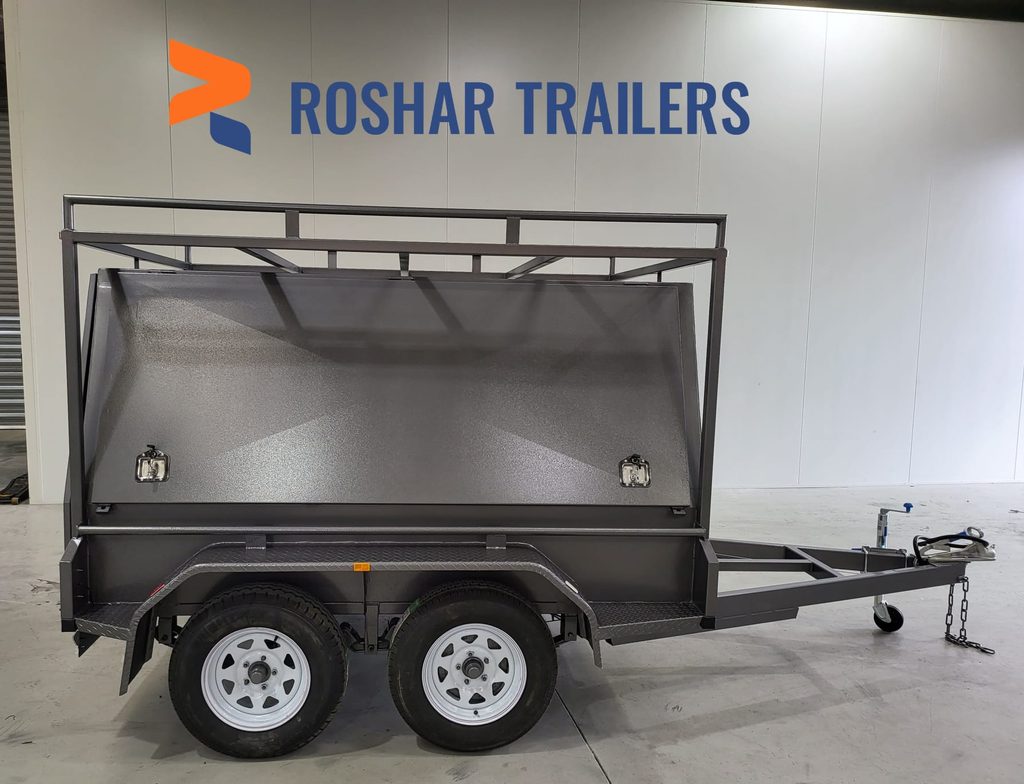
Roshar’s broader tradesman trailer range includes toolboxes, internal shelving, lockable storage, compressor boxes and ladder racks, which can be useful when a fencing contractor wants a more organised mobile-workshop setup.
The practical rule is to store the items you reach for most often where they can be accessed without unloading the trailer.
How should fencing contractors choose payload, axles and brakes?
Fencing contractors should choose payload, axle and brake specifications from the heaviest realistic working load, not the empty trailer size. Posts, concrete, gates, tools, racks, ramps and cages all contribute to the finished weight.
A trailer can have plenty of deck space and still be unsuitable if its payload is too low.
Roshar’s 12×6 fencing trailer offers GVM/ATM configurations ranging from 2,000 kg to 4,500 kg in the listed build specifications, with heavy-duty slipper suspension, 40 mm solid axles and hydraulic/electric brake options depending on configuration.
The important point is that higher capacity is not automatically better. The tow vehicle, towbar, coupling, trailer rating, tyres and braking setup all need to work together.
Payload planning example
Imagine a contractor carries:
- Timber and steel posts
- Rails
- Wire or mesh
- Two gates
- Concrete
- Tools
- Straps and chains
- Generator
- Toolbox
- Racks and ramps
The accessories themselves contribute to the trailer’s tare weight. If the finished trailer weighs more because of cages, racks, toolboxes and ramps, less capacity remains for the actual fencing materials.
That is why a fencing contractor trailer should be specified from the finished working setup, not the bare trailer.
What about Australian trailer standards?
The Department of Infrastructure states that low-ATM trailers with an aggregate trailer mass of 4.5 tonnes or less are expected to comply with applicable Australian Design Rules, with VSB 1 Revision 6 providing guidance for common trailer types.
For buyers, this reinforces the importance of checking the final specification, ratings and compliance information rather than assuming an accessory upgrade is automatically suitable.
How should you plan fencing trailer loading ideas around the job?
The best fencing trailer loading ideas start with the unloading sequence: place the materials needed first where they can be reached first, keep heavy items low and central, separate long materials from small tools, and leave restraint equipment accessible.
The National Heavy Vehicle Regulator recommends choosing a suitable vehicle for the load, positioning the load to maintain stability, using appropriate restraint equipment and checking the load and restraints during the journey.
A practical six-step loading workflow
- Load heavy items low and centrally: this helps maintain trailer stability and avoids creating an unnecessarily high centre of gravity.
- Place long materials in their dedicated rack or load zone: posts, rails and similar items should not block access to tools or other materials.
- Keep the first-use items accessible: tools and materials needed immediately at the job should not be buried under the rest of the load.
- Separate loose and bundled materials: wire, fittings and small items should be contained so they cannot move around the deck.
- Secure the load using suitable rated restraints: select straps, chains and restraint points according to the actual load rather than using one method for everything.
- Recheck before and during the trip: loads can settle or restraints can loosen, so inspect them at suitable stops, especially after the first part of the journey.
Illustrative fencing load layout
| Trailer zone | Suggested load |
| Front | Heavy tools or equipment positioned appropriately |
| Centre | Dense/heavy fencing materials |
| Side rack | Posts and rails |
| Wire holder | Wire rolls |
| Toolbox | Hand tools and fixings |
| Rear | Materials needed first or suitable equipment |
| Under-deck/side area | Straps, chains and smaller accessories |
This is a planning framework, not a universal restraint specification. The final arrangement must suit the actual trailer, load and applicable requirements.
When is a custom fencing trailer worth the investment?
A custom fencing trailer is worth considering when standard layouts repeatedly create loading delays, wasted deck space, poor tool access or difficult material restraint. If the same problem occurs across dozens of jobs, designing around it can be more valuable than continually working around the trailer.
This is where the difference between a general trailer and a work-specific trailer becomes obvious.
Kellybuilt Engineering describes developing its fencing tray after repeated frustration with missing equipment and inefficient trips to rural fence-repair jobs. Its design includes wire handling, post-driver holders, toolbox storage, fork pockets and dedicated areas for fencing equipment.
Walters Fencing similarly offers a fencing trailer fit-out service that includes design work, fabrication and custom material for mounting equipment, demonstrating the broader Australian market for trade-specific fencing setups.
The lesson isn’t that every contractor needs a specialised trailer. It’s that repeated workflow problems are useful evidence for customisation.
Customise when you regularly:
- Carry the same long materials
- Transport wire rolls
- Use a post driver
- Carry a generator or compressor
- Need dedicated tool storage
- Load a mower or compact machine
- Work across rural properties
- Spend time rearranging materials
- Need a specific ramp or rack arrangement
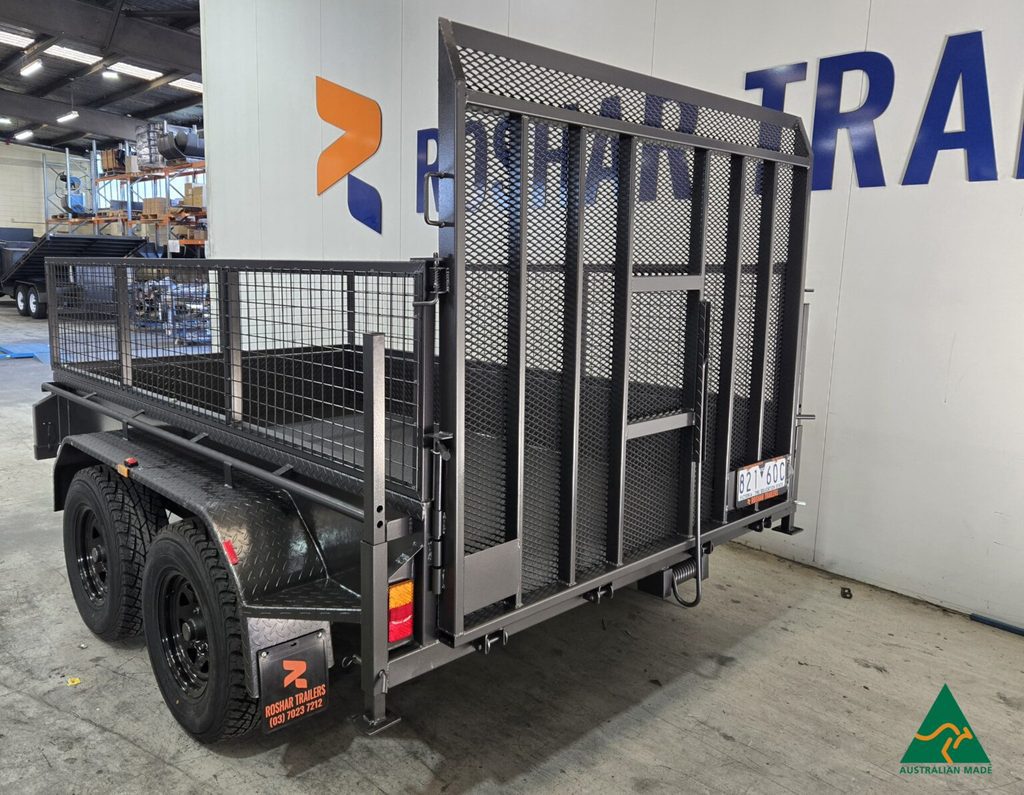
Roshar states that its fencing trailer can be customised with racks, cages, toolboxes, tie-down points, ramps, wheel upgrades and ATM/GVM configurations.
What does a fencing trailer setup typically cost?
The cost of a fencing trailer setup varies with trailer size, payload, axle configuration, brakes, racks, cages, toolboxes, ramps and other custom fabrication. As a market reference, Walters Fencing currently lists a fencing trailer fit-out from $2,500, but that is a third-party fit-out price, not Roshar Trailers pricing.
For a meaningful quote, give the manufacturer a complete specification rather than asking only for the cheapest 12×6 or 10×6 trailer.
Include:
- Trailer size
- Expected payload
- Longest materials
- Wire-roll requirements
- Number and type of racks
- Toolbox requirements
- Ramp requirements
- Cage height
- Tie-down requirements
- Brake preference
- Tow vehicle
- Typical work environment
Roshar’s current 12×6 fencing trailer page provides multiple ATM/GVM configurations and lists a wide range of available options, which shows why two trailers with the same floor dimensions can have very different final specifications and prices.
The real cost question
Instead of asking only “How much is the trailer?”, ask:
“How much time will this setup save across a normal working week?”
If a better rack arrangement means fewer unloading and reloading tasks, or dedicated storage prevents tools from being buried under materials, the value is operational rather than cosmetic.
What should you check before ordering a fencing trailer?
Before ordering, confirm the finished trailer specification, payload, accessories, towing requirements and intended load rather than relying on the advertised base model. Every added rack, cage, toolbox or ramp should be considered part of the final trailer weight.
Use this checklist:
- Trailer dimensions confirmed
- Longest fencing materials measured
- Heaviest regular load estimated
- Payload confirmed after accessories
- ATM/GTM requirements checked
- Tow vehicle capacity checked
- Brake configuration confirmed
- Post racks discussed
- Wire storage discussed
- Toolbox/storage layout confirmed
- Tie-down locations agreed
- Ramp requirement confirmed
- Cage height confirmed if required
- Spare wheel location confirmed
- Final build specification written into the quote/invoice
- Compliance information confirmed before delivery
Roshar specifically advises buyers to check build specifications on the invoice before deposits and after agreed changes, and states that the owner is responsible for ensuring the tow vehicle can tow the trailer’s ATM, the trailer has suitable payload and loads are secured correctly.
Conclusion
The right fencing contractor trailer should make the working day easier by giving long materials, wire, tools and equipment a logical place while maintaining suitable payload, restraint and towing capability.
For contractors doing regular fencing work, features such as racks, tie-down points, tool storage, ramps and custom load zones can turn a general trailer into a much more useful work platform.
Roshar Trailers offers fencing trailer configurations and custom options from its Melbourne manufacturing operation, with locations in Braeside, Bayswater North and Dandenong.
If your current trailer makes you repeatedly rearrange the same materials, it may be time to design the trailer around the work instead.
FAQ’S
Is a 12×6 trailer suitable for fencing contractors?
Yes, a 12×6 trailer can suit many fencing contractors because it provides a larger working deck for posts, rails, wire, gates, tools and equipment. The actual suitability depends on the finished trailer’s payload, ATM/GTM, axle configuration, tow vehicle, load layout and the materials carried on a typical working day.
Do fencing contractors need a tandem trailer?
No, not every fencing contractor needs a tandem trailer. A single-axle setup can suit lighter work, while tandem configurations can be more appropriate for heavier regular loads. The decision should be based on the finished trailer rating, payload, tow vehicle and braking requirements rather than choosing tandem simply because it is larger.
Can a fencing trailer carry a post driver?
Yes, if the trailer is designed and rated to carry the equipment safely. A dedicated holder or mounting arrangement can keep a post driver secure and accessible, but its weight, mounting method and effect on payload and balance need to be considered before fabrication.
Should fencing materials be stored vertically?
Yes, where the trailer design and material allow it, vertical or dedicated rack storage can free deck space and keep long materials organised. Posts, rails and similar items should still be secured appropriately, and the storage arrangement must not create an unstable or excessively high load.
Can I use one trailer for fencing and landscaping work?
Yes, a multi-purpose trailer can make sense for contractors who handle both types of work. A combination of racks, tie-down points, ramps, toolbox storage and removable containment can provide flexibility, but every configuration should still stay within the trailer and tow vehicle ratings when fully loaded.
Is a custom fencing trailer better than a standard trailer?
Yes, when the same loading or storage problem occurs repeatedly. A custom trailer can place racks, toolboxes, tie-downs, ramps and storage around your actual workflow. If your loads change constantly or the trailer has only occasional fencing use, a versatile standard trailer may provide better value.
What should I carry on a fencing trailer?
Carry only what your normal work requires, with tools, fencing materials, restraint equipment and emergency items organised by use. Common loads can include posts, rails, wire, mesh, gates, tools, fixings, straps, chains and selected equipment. The final load must remain within the trailer’s ratings and be properly restrained.