
37 Malcolm RD, Braeside, VIC
10 Must-Have Trailer Features for Electricians
15 September 2026 | roshartrailers
Table of Contents
A practical electrician trailer setup should put frequently used tools within easy reach, separate small electrical parts from larger equipment, protect valuable gear, provide secure ladder and cable storage, and maintain sensible weight distribution for safe towing.
By Writer :- Ron
By Roshar Trailers Team, Trailer Manufacturing and Sales Specialists
Published: 15/09/2026
Last updated: 15/09/2026
An electrician’s trailer can quickly become either a mobile workshop or a mobile headache.
If every job starts with opening boxes, moving cable drums, searching for breakers and climbing over equipment to find a tester, the trailer is costing you time. A well-planned setup does the opposite: the equipment you use most often is accessible, materials have defined locations and valuable tools can be secured when the trailer is unattended.
Electricians also have a different storage problem from many other trades. A trailer may need to accommodate power tools, hand tools, test equipment, conduit, cable, fittings, switchgear, ladders, consumables and job-specific equipment without turning into one large storage box.
The following trailer features for electricians focus on that practical problem.
What makes a good electrician trailer setup?
A good electrician trailer setup is organised around the sequence of a typical job: access frequently used tools first, keep consumables visible, separate dirty or bulky equipment, secure valuable gear and reserve dedicated positions for ladders, conduit and cable.
That sounds simple, but it changes how the trailer should be designed.
An electrician who mainly handles service calls has different requirements from an electrical contractor carrying cable, switchboards and installation equipment to larger construction sites.
The first step is therefore to divide the trailer into working zones.
A practical four-zone layout
| Zone | Typical contents | Priority |
| Fast-access zone | Testers, hand tools, drills, common fittings | Highest |
| Consumables zone | Connectors, breakers, plates, terminals, screws | High |
| Bulk-material zone | Cable, conduit, larger equipment | Medium |
| Secure-storage zone | Expensive tools, batteries, specialist equipment | High security |
A useful real-world principle is “use frequency before size.” The tools you reach for several times a day should not be buried behind equipment you use once a month.
Reddit discussions from electricians reflect this same practical approach: one contributor described keeping frequently used bins within arm’s reach and placing less-used items higher or further inside to reduce unnecessary climbing and movement.
How should you organise the trailer storage?
The best electrical contractor trailer organisation uses clearly defined storage zones, labelled bins, accessible shelving and a fixed home for every frequently used item. The objective is not maximum storage; it is being able to identify and retrieve the right equipment without unpacking the trailer.
Feature 1: Dedicated Internal Shelving
Internal shelving is one of the most useful features for an electrician because it turns unused wall space into organised storage.
Shelves can separate:
- Test equipment
- Hand tools
- Power tools
- Fittings
- Boxes of connectors
- Switches and accessories
- Personal protective equipment
- Job-specific components
Roshar specifically lists internal shelving as a customisable feature on its tradesman trailers.
The key is shelf depth. Very deep shelves may technically hold more but can make smaller items disappear behind larger boxes.
Feature 2: Clear Bins and Labelled Consumables Storage
Small electrical components are where trailer organisation can fall apart.
Use separate, clearly labelled containers for categories such as:
- Cable connectors
- Screws and fixings
- Terminals
- Switches
- Plates
- Breakers
- Clips
- Glands
- Fuses
- Other commonly replaced consumables
Clear bins make stock levels easier to see.
A useful rule is to keep high-frequency consumables close to the access door and less frequently used items further inside.
Feature 3: Dedicated Cable and Conduit Storage
Cable and conduit should have their own storage area rather than competing with hand tools.
Depending on the work, this may involve:
- Cable reel storage
- Vertical conduit holders
- Long-item compartments
- External racks
- Internal retaining points
This prevents long materials from becoming obstacles when accessing smaller tools.
Which toolbox setup works best for electricians?
The best electrician trailer toolbox setup separates daily-use hand tools from larger power tools, consumables and specialist equipment. Drawers or shallow compartments work well for small items, while larger lockable boxes can accommodate bulky equipment.
Feature 4: Lockable Toolboxes
A dedicated toolbox gives valuable equipment a defined storage location.
Roshar’s tradesman trailer range includes toolboxes and lockable storage, along with compressor boxes and other trade-focused options.
For an electrician, toolbox planning should answer three questions:
- What do I use every day?
- What equipment needs protection from weather and dust?
- What would be expensive or difficult to replace if stolen?
The answers determine where the toolbox should sit and how much capacity it needs.
Feature 5: Drawer-Based Small-Parts Storage
Drawers can be particularly useful for electricians carrying many small components.
Instead of one large toolbox containing dozens of loose packets, dedicate drawers to specific categories.
For example:
Drawer 1: Connectors
Drawer 2: Terminals
Drawer 3: Fixings
Drawer 4: Switches and plates
Drawer 5: Testing accessories
The exact categories should follow your actual work.
A simple storage hierarchy
| Storage type | Best for |
| Shallow drawers | Small parts and consumables |
| Medium shelves | Tool cases and component boxes |
| Lockable toolbox | High-value equipment |
| Tall compartment | Long tools and materials |
| Floor-level area | Heavy equipment |
This creates a storage system rather than simply adding more boxes.
How should ladders, conduit and long materials be stored?
Ladder storage for electrician trailers should keep ladders and long materials secure, accessible and clear of doors, walkways and other equipment. Racks should be positioned so that loading does not require repeatedly moving smaller tools or opening multiple compartments.
Feature 6: Dedicated Ladder Racks
Ladder racks are particularly valuable for electricians because ladders can consume a large amount of internal trailer space.
Modern Trailers and other Australian tradesman-trailer suppliers commonly position ladder racks as a core feature for carrying ladders and other long materials.
Roshar also lists ladder racks among its available tradesman trailer features.
A good rack should:
- Hold the ladder securely
- Avoid blocking access doors
- Keep the load within the trailer’s overall requirements
- Allow practical loading and removal
- Work with the size of ladder you actually carry
Feature 7: Dedicated Conduit and Long-Material Storage
Ladders are not the only long items electricians transport.
Depending on the job, the trailer may also carry:
- Conduit
- Cable
- Trunking
- Pipe
- Long installation materials
A dedicated rack or internal pocket can keep these items separate from hand tools.
A practical setup is to use vertical storage for rigid materials and reel or horizontal storage for suitable cable products, subject to the manufacturer’s and restraint requirements.
How can you improve tool security?
Tool security for electrician trailers starts with strong locking points and continues with sensible parking, internal organisation and minimising unnecessary visibility of high-value equipment. The goal is to make valuable tools harder to access without turning the trailer into an impractical storage vault.
Feature 8: Secure Locking System
An electrician may have thousands of dollars’ worth of equipment in the trailer, depending on the business and equipment carried.
Security therefore deserves its own design stage.
Consider:
- Lockable external compartments
- Strong door hardware
- Secure hasps or integrated locks
- Protected hinges where appropriate
- Internal separation of high-value equipment
- Secure coupling when parked
A Reddit discussion among electricians specifically raised door latches, security fasteners, protected locks and trailer tracking as possible security measures after repeated break-ins.
That is useful first-hand context, but security equipment should be selected according to your actual risk, parking location and insurance requirements.
Keep high-value equipment out of the obvious access path
A trailer that opens directly onto expensive equipment presents a different security risk from one where high-value items are stored in an additional locked compartment.
Think in layers:
Trailer door → storage compartment → toolbox → individual tool case
You do not necessarily need all four layers, but separating valuable equipment from general storage can be worthwhile.
How should lighting and power be planned?
Lighting and power should be planned around how the trailer will actually be used. Internal lighting helps identify tools and materials in poor light, while any onboard electrical system should be designed and installed to suit the intended equipment and applicable electrical requirements.
Feature 9: Practical Internal Lighting
An electrician may open the trailer early in the morning, late in the afternoon or inside a poorly lit work area.
Internal LED lighting can make it easier to:
- Identify tools
- Read labels
- Find small components
- Check stock
- Load equipment
Roshar lists LED lighting among the available tradesman-trailer features.
Lighting placement matters as much as having lights. Avoid positioning lights where shelves, doors or stored equipment create unnecessary shadows.
Power planning
If your setup requires battery charging, power tools or other equipment inside the trailer, plan the system before fabrication.
Potential requirements may include:
- Battery storage
- Charging locations
- Appropriate outlets
- Ventilation
- Cable management
- Isolation and protection
Do not treat an electrical fit-out as an afterthought. Have electrical work designed and installed by an appropriately licensed professional and ensure the completed system meets applicable requirements.
How do you manage trailer weight and towing requirements?
An electrician’s trailer must be designed around its loaded weight, not the empty trailer. Toolboxes, shelving, cable, batteries, ladders and equipment all add mass, so the final setup needs to stay within the trailer’s ratings and the towing vehicle’s limits.
Feature 10: A Suitable Chassis, Axle and Payload
Storage features are useful only if the trailer can safely carry the finished load.
Roshar’s tradesman trailer range includes heavy-duty chassis options, high-load-rated axles and different configurations from compact 6×4 setups through larger 8×5 and custom builds.
Its 8×5 tandem trailer, for example, has a listed 2,000 kg ATM configuration with other upgrade options available depending on the selected build.
Do not assume that a trailer’s advertised ATM equals the amount of tools you can add. Payload is affected by the trailer’s tare mass and fitted equipment.
The Department of Infrastructure’s current VSB 1 Revision 6 covers trailers with an aggregate trailer mass of 4.5 tonnes or less and explains applicable Australian Design Rule requirements for common trailer types.
The NTC also states that loads on light vehicles and trailers must be properly restrained, must not exceed mass limits and must not dangerously overhang or obscure required lights, reflectors or number plates.
Weight distribution matters
Heavy equipment should not simply be placed wherever there is room.
As a practical planning exercise:
- Keep very heavy equipment low.
- Avoid creating an unnecessarily heavy rear or front section.
- Store dense equipment where the trailer design allows it to be carried appropriately.
- Secure loose equipment so it cannot move.
- Recheck the loaded setup after major changes.
A Reddit electrician described deliberately keeping heavier equipment close to the wheels and paying attention to tongue weight. That is a useful practical example of how experienced users think about trailer layout, although your own trailer must follow its rated specifications.
When should an electrician choose a custom trailer?
A custom trailer makes sense when standard storage does not match the way you work. If you carry unusual cable sizes, specialist testing equipment, multiple ladders, generators, compressors or large quantities of consumables, custom fabrication can turn unused space into useful workflow zones.
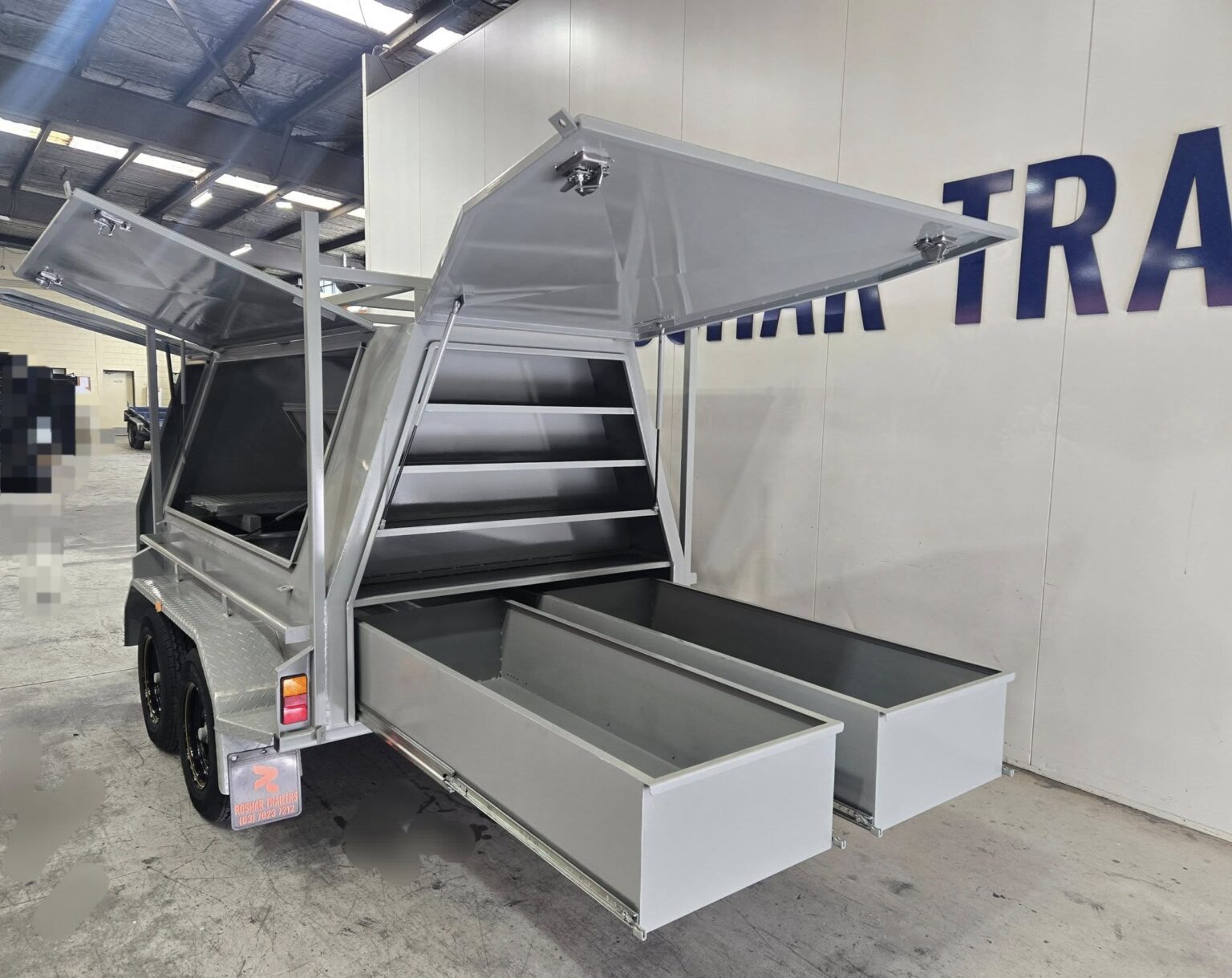
Roshar specifically offers custom fabrication and lists options such as side-opening toolboxes, canopies, compressor boxes, mesh cages and specialised shelving.
When customisation is worthwhile
Consider a custom build if you regularly:
- Carry the same equipment every day
- Need specialist storage
- Transport long materials
- Carry expensive test equipment
- Need additional lockable compartments
- Want dedicated shelving
- Need a compressor box
- Require ladder racks
- Have a growing electrical contracting team
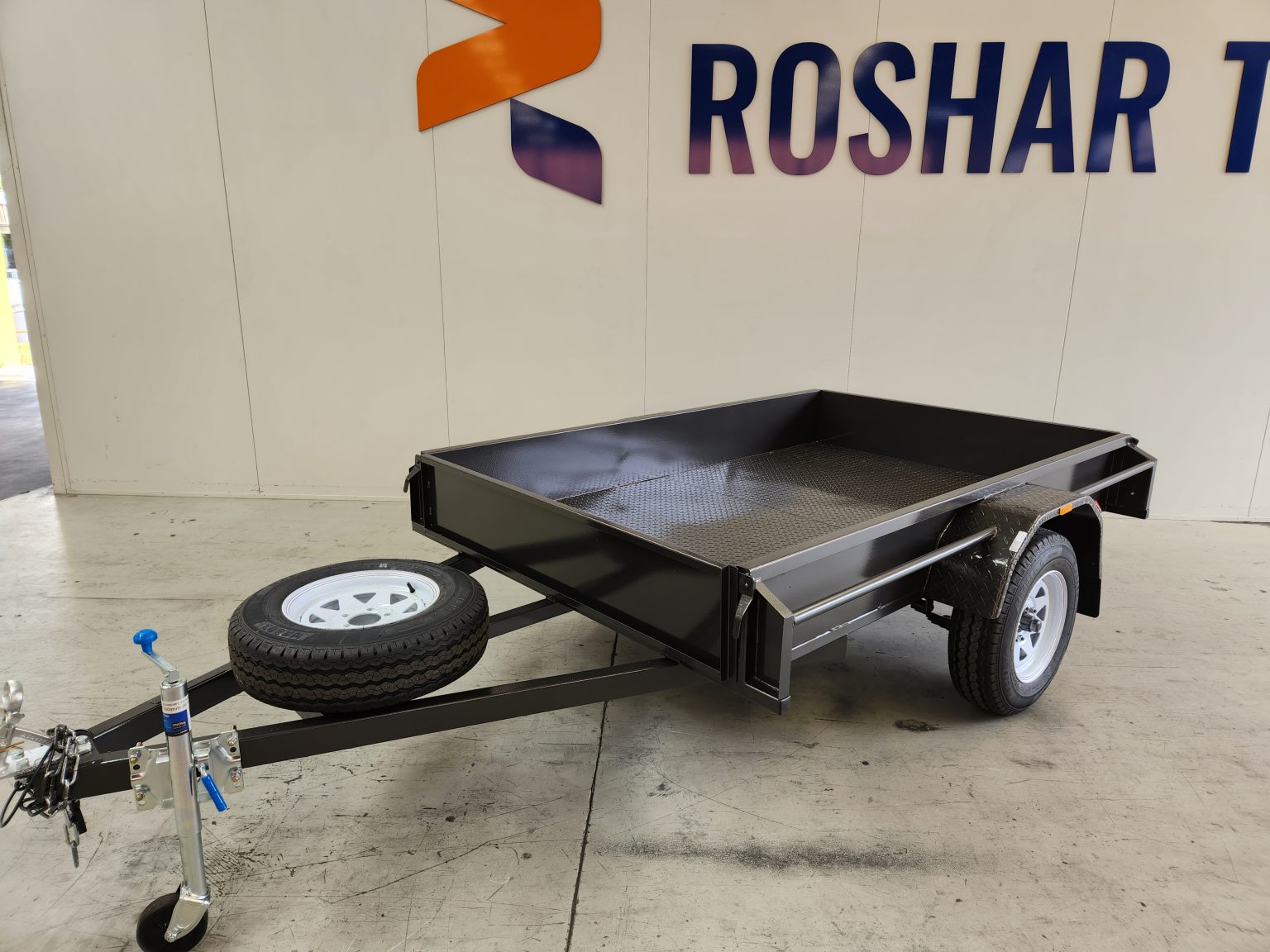
Roshar’s existing tradesman range includes compact 6×4 models, 7×5 configurations and an 8×5 tradesman option, alongside custom builds.
For businesses comparing tradesman trailers for sale, start with a standard configuration if it already solves the workflow. Move to custom fabrication when the standard layout forces repeated compromises.
What should you check before ordering the trailer?
Before ordering an electric trailer, map the equipment you actually carry, measure the largest items, identify the fastest-access tools and confirm the loaded weight. Then decide which storage, security, ladder and electrical features are genuinely necessary.
Use the 5-step electrician trailer planning framework
1. Inventory – list everything.
Write down tools, cable, conduit, ladders, batteries, testing equipment, consumables and machines.
2. Prioritise – rank usage.
Mark each item as daily, weekly, occasional or emergency-use equipment.
3. Zone – assign a home.
Give every category a defined location before deciding shelf and toolbox dimensions.
4. Secure – protect valuable equipment.
Decide which items require lockable storage and which can remain in open shelving.
5. Load – check the finished weight.
Include the trailer, storage fit-out, tools, materials and accessories when assessing payload.
Electrician trailer planning checklist
| Requirement | Question to ask |
| Tool storage | Can I reach daily-use tools without moving other equipment? |
| Small parts | Are consumables separated and labelled? |
| Cable | Is there a dedicated location for reels or cable storage? |
| Conduit | Can long materials be carried without blocking access? |
| Ladders | Can I load and remove them quickly? |
| Security | Which equipment needs lockable storage? |
| Lighting | Can I see inside every main storage zone? |
| Power | Do I need a planned charging or electrical system? |
| Payload | What will the fully loaded trailer weigh? |
| Access | Can I reach equipment from the side and rear where needed? |
If you are comparing a trailer for sale, use this checklist before comparing prices. A lower-priced trailer that lacks the features your workflow needs may require modifications later.
Which trailer configuration suits different electricians?
Different electrical businesses can benefit from different layouts. A residential service electrician may prioritise fast access and compact storage, while a larger electrical contractor may need more payload, cable capacity and secure equipment storage.
| Electrician type | Useful configuration | Key priorities |
| Residential service electrician | Compact tradesman trailer | Fast-access tools, bins, lockable storage |
| Commercial electrician | Medium/large tradesman trailer | Shelving, consumables, cable and equipment |
| Electrical contractor | Custom tradesman trailer | Workflow zones, security, bulk storage |
| Construction electrician | Tradesman or tandem setup | Materials, tools, cable and site equipment |
| Maintenance electrician | Secure enclosed/tradesman setup | Test equipment, parts and quick access |
| Larger electrical team | Custom or tandem configuration | Shared storage, payload and equipment separation |

For heavier applications, tandem trailers may provide a more suitable platform depending on the required trailer size, load and towing vehicle. Roshar’s tandem range includes box, cage, flat top, enclosed, tipper and custom configurations.
What are the biggest electrician trailer setup mistakes?
The biggest mistakes are designing around empty space rather than workflow, overloading the finished trailer, putting frequently used equipment too far inside, leaving valuable tools without adequate security and adding storage without considering access or weight.
Mistake 1: Filling every available space
More storage does not automatically mean better organisation.
Leave practical access space around doors, shelving and frequently used equipment.
Mistake 2: Ignoring small parts
An electrician can carry hundreds of small components. Without dedicated bins or drawers, these quickly become mixed together.
Mistake 3: Putting heavy equipment wherever it fits
Weight distribution should be considered during the design stage, not after the trailer is full.
Mistake 4: Treating ladder storage as an afterthought
Ladders can consume valuable interior space if they are not planned into the original design.
Mistake 5: Choosing security only after purchase
Locking systems and secure compartments are much easier to integrate when the trailer is being designed.
Conclusion
The best electrician trailer is not necessarily the biggest or most expensive option. It is the trailer that lets you find tools quickly, carry materials securely, protect valuable equipment and move between jobs without constantly rearranging the load.
Start with your actual workday. Map your tools, consumables, ladders, cable and equipment. Then build the trailer around that workflow.
Roshar Trailers offers Melbourne tradies a range of tradesman configurations, including compact and larger options, plus custom fabrication for storage, ladder racks, compressor boxes, toolboxes and other work-specific requirements.
If you are looking at tradesman trailers for your electrical business, compare the storage layout and payload alongside the headline price.
Need an electrician trailer built around your workflow? Talk to Roshar Trailers about a custom setup.
Braeside | Bayswater North | Dandenong
Contact Roshar Trailers for a quote
Roshar Trailers
FAQ’S
Can I add shelving to an existing tradesman trailer?
Yes, but the available options depend on the trailer’s construction, existing storage and available mounting points. Before modifying an existing trailer, check that the changes do not compromise structural integrity, load capacity, electrical systems or compliance. A purpose-planned shelving layout is usually easier to integrate when the trailer is being built.
Should I keep spare electrical parts in the trailer overnight?
Usually, it depends on the value, storage conditions and security of the equipment. Frequently needed consumables can be convenient to keep onboard, while expensive specialist equipment may warrant additional secure storage or removal when the trailer is parked. Consider your insurance requirements and the conditions in which the trailer is stored.
How often should an electrician reorganise their trailer?
A practical approach is to review the layout whenever your regular workload or equipment changes. If the same tools repeatedly end up in the wrong location, that is a sign the storage plan needs adjustment. A short monthly stock and organisation check can also identify missing consumables before they interrupt a job.
Is a custom trailer worth it for a small electrical business?
Yes, when the standard layout does not accommodate the equipment you use regularly. A custom build can make sense when you need dedicated shelving, specialist storage, ladder racks, compressor space or additional security. For a smaller operation with a predictable tool load, however, a well-configured standard tradesman trailer may be sufficient.
Can batteries and chargers be stored inside an electrician trailer?
Yes, but storage should account for the manufacturer’s requirements, temperature, moisture, ventilation and safe handling of the particular battery system. Chargers should also be used according to their manufacturer’s instructions and connected to an appropriately designed electrical supply. Do not create an improvised charging installation inside the trailer.
Should I choose a single axle or tandem trailer for electrical work?
It depends on the finished trailer weight, required payload, trailer size and towing vehicle. A compact service electrician may have no need for a tandem configuration, while a contractor carrying substantial equipment and materials may need a larger setup. Choose based on the fully loaded requirements rather than axle count alone.
How can I stop small electrical components from getting mixed together?
Use shallow, labelled containers or drawers and assign each category a fixed location. Keep frequently used components near the main access point and reserve deeper storage for less frequently used items. The objective is to make the location of every common component predictable rather than relying on memory.