37 Malcolm RD, Braeside, VIC
10 Trailer Features for Earthmoving Contractors
23 October 2026 | roshartrailers
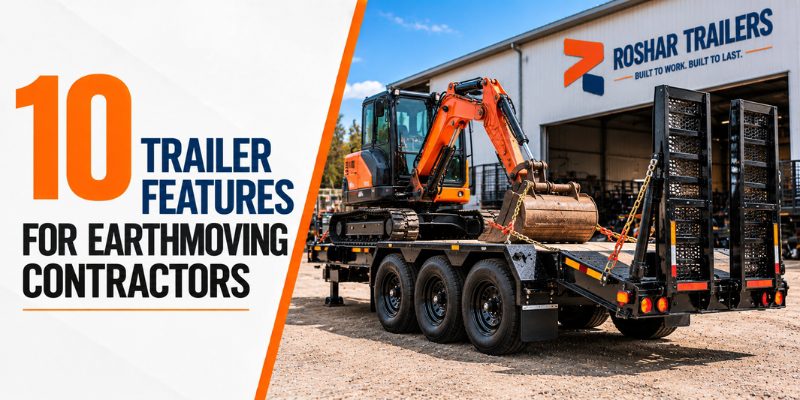
Table of Contents
By Writer :- Ron
Roshar Trailers Team, Trailer Manufacturing and Sales Specialists
Published: 23/10/2026
The right earthmoving trailer features make machinery transport safer, easier to load and more practical for contractors. Ramps, payload capacity, tie-down points, braking, suspension, deck design and equipment storage all need to match the machine, tow vehicle and worksite.
For an earthmoving contractor, a trailer is working equipment. It may carry a mini excavator to one site in the morning, a skid steer to another job in the afternoon or landscaping equipment across town the next day.
That means choosing a trailer based only on deck size or advertised price can create problems later. The trailer needs to work with the machine, towing vehicle, loading method and road-use requirements.
Roshar Trailers builds plant and machinery trailers in Melbourne for contractors, landscapers, builders and earthmoving operators. Its current range includes plant trailers with different sizes, floor types, ramp configurations, braking systems and load capacities.
What are the most important trailer features for earthmoving contractors?
The most important features are suitable payload, strong chassis construction, low-angle loading, heavy-duty ramps, rated tie-down points, appropriate brakes, load-sharing suspension, suitable tyres and a deck designed for machinery. Storage and attachment features can then be added around the contractor’s workflow.
10 features worth prioritising
| # | Feature | Why it matters |
| 1 | Correct payload | Keeps machinery within the trailer’s rated capacity |
| 2 | Heavy-duty chassis | Supports concentrated machinery loads |
| 3 | Low loading angle | Makes machines easier to drive or roll onto the deck |
| 4 | Strong ramps | Supports controlled loading and unloading |
| 5 | Rated tie-down points | Helps secure machinery during transport |
| 6 | Suitable brakes | Provides braking capability appropriate to the trailer |
| 7 | Appropriate suspension | Supports stability and load handling |
| 8 | Durable deck | Handles tracked and wheeled machinery |
| 9 | Attachment storage | Keeps buckets, augers and equipment organised |
| 10 | Practical custom options | Allows the trailer to suit the machine and workflow |
Competitor coverage shows a similar emphasis on reinforced chassis construction, low loading angles, ramps, tie-down points, brakes and suspension. FSP, for example, highlights reinforced frames, low load angles, heavy-duty components, adjustable ramps and tie-down points for machinery trailers. FSP Trailers and Parts
The opportunity for contractors is to look at these features as one system rather than choosing each component independently.
How important is trailer load capacity for earthmoving machinery?
Load capacity is critical because the trailer must safely accommodate the machinery, attachments and any additional equipment while remaining within its approved ratings and the towing vehicle’s limits. A trailer that looks large enough can still be unsuitable if its payload is insufficient.
The first step is to establish the actual operating weight of the machine.
That means considering more than the base machine:
- Bucket
- Auger
- Blade
- Hydraulic attachment
- Fuel
- Accessories
- Chains and restraint equipment
- Other equipment carried with the machine
Roshar’s plant trailer guidance gives examples ranging from compact mini loaders around 600–900 kg to skid steer loaders around 2,000–3,000 kg, with recommended GVM ranges varying accordingly. These figures are examples, not a substitute for checking the actual machine specification.
Payload vs trailer rating
A common mistake is confusing an ATM with usable payload.
ATM (Aggregate Trailer Mass) is the maximum permitted mass of the trailer when loaded. The trailer’s tare weight must also be considered when working out how much machinery it can actually carry.
For example, if a trailer has a 3,500 kg ATM and weighs 800 kg empty, the theoretical payload is 2,700 kg before considering how the particular configuration and legal towing limits apply.
Always confirm the trailer’s plate, manufacturer specifications and towing vehicle limits rather than calculating capacity from dimensions alone.
According to the Department of Infrastructure, trailers with an ATM of 4.5 tonnes or less are expected to comply with applicable Australian Design Rules, with VSB 1 Revision 6 providing guidance for common trailer types under the Road Vehicle Standards legislation. Department of Infrastructure
Why do loading ramps and loading angle matter?
Loading ramps and loading angle determine how smoothly machinery moves from ground level onto the trailer. A lower, well-controlled loading angle reduces the transition the machine has to climb and makes loading more practical for tracked and wheeled equipment.
This is where machinery trailer loading features become important.
A trailer may have enough payload but still be frustrating to use if the loading arrangement is poor.
1. Ramp width
Ramps need to provide adequate width for the machine’s tracks or wheels.
A narrow ramp may make loading uncomfortable, particularly when the operator has limited visibility around the equipment.
2. Ramp strength
The ramp must be suitable for the machinery being loaded.
Consider:
- Machine operating weight
- Wheel or track configuration
- Concentrated wheel loads
- Ramp length
- Ramp support
- Ramp attachment method
3. Loading angle
A lower transition angle can make it easier for equipment to move onto the deck.
Basic Trailers notes that tilt trailers can create a lower loading angle, while its plant trailers use tilt ramps and are designed for heavy machinery applications.
4. Ramp storage
Ramps should be secure when travelling. Loose ramps can become a hazard if they move, rattle or detach.
A practical trailer should make it easy to:
- Remove or deploy the ramps.
- Position them correctly.
- Load the machine under controlled conditions.
- Return the ramps to their travel position.
- Secure them before entering the road.
For contractors loading equipment several times a day, a small improvement in ramp handling can make a noticeable difference to the working routine.
What tie-down features should an earthmoving trailer have?
An earthmoving trailer should provide strong, appropriately positioned restraint points so machinery can be secured for the specific load and configuration. Tie-down locations should allow restraints to work effectively without interfering with tracks, wheels, hydraulic components or attachments.
Load restraint is not simply about having a few rings welded onto the deck.
The restraint system needs to work with the machine.
According to Transport Victoria, loads must be properly restrained, suitable restraint equipment should be used, heavy loads may require chains, and loads should be positioned so they remain stable and evenly distributed. Transport Victoria
The National Transport Commission similarly states that light-vehicle loads must be properly restrained, must not exceed mass limits and must not dangerously overhang the vehicle or trailer. National Transport Commission
Practical tie-down considerations
Look for:
- Multiple restraint points
- Points positioned around the deck
- Suitable rated attachment locations
- Floor-mounted options where appropriate
- Drawbar restraint points where suitable
- Clear access for chains or rated straps
The exact restraint method depends on the machine.
For example, an excavator with a bucket and boom positioned differently will require a different restraint arrangement from a compact loader.
Practical contractor scenario
Imagine a landscaper transporting a mini loader to three sites in one day.
If the restraint points are positioned awkwardly, the operator may need to route chains around inconvenient parts of the machine. A better layout gives the operator clear attachment locations without interfering with the machine or trailer components.
That is why restraint points should be considered during trailer design, not added as an afterthought.
How do axles, suspension and brakes affect machinery transport?
Axles, suspension and brakes determine how the trailer carries the machinery and behaves while towing. Heavy equipment places significant demands on the running gear, so these components must be selected to suit the trailer rating, load distribution and towing application.
Axles
The axle setup must support the trailer’s approved rating and intended use.
Depending on the configuration, contractors may consider:
- Single axle
- Tandem axle
- Heavier-duty axle configurations
- Drop-axle arrangements
Roshar’s plant trailer range includes configurations from lighter plant trailers through to higher-GVM options, with the exact setup depending on model and specification.
Suspension
Suspension affects:
- Load support
- Trailer stability
- Road behaviour
- Component durability
For machinery work, suspension should be selected around the actual load rather than simply choosing the stiffest available option.
Brakes
Braking requirements become particularly important as trailer mass increases.
The brake system needs to be compatible with:
- Trailer rating
- Tow vehicle
- Axles
- Wheels
- Electrical or hydraulic setup
- Applicable requirements
Roshar currently lists hydraulic, mechanical and electric brake options across its plant trailer specifications, depending on configuration.
A contractor should ask the manufacturer to specify the complete braking arrangement rather than selecting a brake component in isolation.
Which deck and floor features suit earthmoving equipment?
The deck should provide sufficient strength, traction and usable space for the machinery being carried. Checker plate, perforated or grid-mesh floors can serve different applications, so the right choice depends on the machine, loading method, site conditions and cleaning requirements.
Roshar’s plant trailer range currently lists checker plate, perforated and grid-mesh floor options.
Checker plate flooring
Checker plate provides a solid deck and is a common option for machinery and commercial trailers.
It can suit contractors who want:
- Solid under-machine support
- A continuous deck surface
- Easy placement of equipment
- Straightforward cleaning
Grid mesh flooring
Grid mesh can be useful where drainage, debris fall-through or additional traction are priorities.
It may suit machinery coming from:
- Muddy worksites
- Landscaping sites
- Wet ground
- Dirt tracks
Perforated flooring
Perforated flooring can provide a balance between a solid and open deck arrangement, depending on the design.
The important point is not to choose a floor based on appearance alone. Consider how the machine will be loaded, where it will be used and how the trailer will be maintained.
What storage and attachment features can improve productivity?
Storage features can improve productivity when contractors regularly transport machine attachments, chains, tools, fuel containers or small equipment alongside the main machine. Good storage keeps these items accessible without taking up the primary machinery loading area.
Earthmoving work rarely involves transporting only the machine.
You may also need:
- Excavator buckets
- Augers
- Chains
- Ramps
- Jerry cans
- Hand tools
- Lubricants
- Spare equipment
- Site accessories
Roshar lists options such as auger post holders, heavy-duty jerry-can holders and spare-wheel brackets on its plant trailer specifications.
Useful attachment features
Bucket holder:
Useful when an excavator or machine has a removable bucket that needs to travel with it.
Auger holder:
Useful for contractors transporting post-hole equipment alongside a machine.
Toolbox:
Provides a dedicated location for chains, hand tools and smaller equipment.
Spare-wheel bracket:
Keeps the spare wheel mounted securely without taking up valuable deck space.
Extended drawbar:
Can provide additional room for attachments on some machinery trailer configurations, subject to the trailer design.
The key is to keep accessories from interfering with the machine’s loading path or restraint system.
When should you consider a custom machinery trailer?
A custom machinery trailer makes sense when standard dimensions, ramps, floor layouts or storage options do not suit the equipment you transport regularly. Customisation is particularly useful when one trailer needs to accommodate specific machines, attachments or unusual loading requirements.
Roshar’s custom trailer service allows customers to specify elements such as trailer dimensions, axle configuration, flooring, ramp access, cages, toolboxes, tie-down points, braking and suspension options.
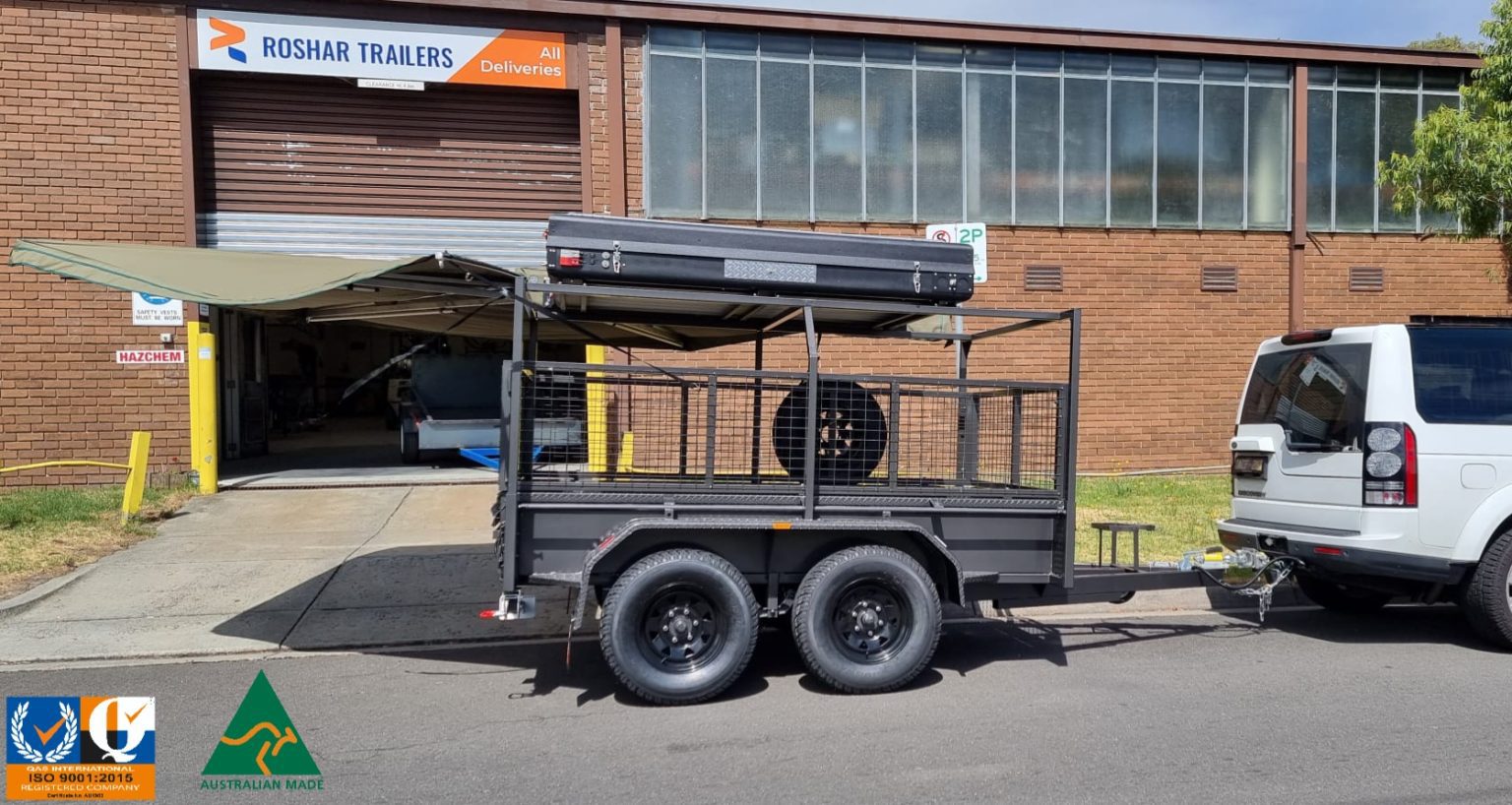
For contractors who need a tailored setup, explore custom trailers built around the actual load and workflow.
For Melbourne buyers, Roshar also provides custom trailers Melbourne services with local advice on trailer size, layout, load support and upgrade options.
When customisation is worth considering
A custom build may be appropriate when:
- Your machinery is unusually wide.
- You carry multiple attachments.
- You need a specific ramp arrangement.
- You need extra deck length.
- Standard restraint points don’t work with your machine.
- You need dedicated storage.
- Your machinery changes regularly.
- Your tow vehicle imposes specific configuration requirements.
Customisation should begin with the machine and work backwards.
Measure the machine, identify its centre of gravity and loading points, consider the attachments and then design the trailer around those requirements.
What should you check before buying an earthmoving trailer?
Before buying, confirm the machine’s operating weight, dimensions, attachments, trailer payload, ATM, towing capacity, ramp configuration, restraint points, brakes, suspension, tyres, deck design and storage requirements. These checks help prevent buying a trailer that is technically large enough but unsuitable for the actual job.
Use this checklist before requesting a quote:
1. Record the machine specifications
Write down:
- Operating weight
- Overall length
- Overall width
- Height
- Track width
- Wheelbase where relevant
- Attachment weight
- Maximum operating configuration
2. Confirm the trailer rating
Ask for:
- Tare
- ATM
- GTM
- Payload
- Axle ratings
- Coupling rating
3. Check your tow vehicle
Confirm:
- Maximum towing capacity
- Towbar rating
- Maximum ball weight where applicable
- Gross combination limits
- Brake controller requirements where applicable
4. Test the loading concept
Ask:
- How will the machine get onto the trailer?
- What is the loading angle?
- Where do the ramps sit?
- Can the operator load safely?
- Where will the bucket or attachment go?
5. Plan restraint
Identify where chains or rated restraints will attach.
The National Transport Commission recommends selecting restraint equipment suitable for the load and ensuring it is in good working order. National Transport Commission
6. Consider your worksite
If you regularly operate on muddy or uneven sites, discuss:
- Floor type
- Ramp design
- Ground clearance
- Suspension
- Tyres
- Corrosion protection
7. Plan for future equipment
If your business is likely to move from a small mini loader to a larger machine, discuss the future requirement before ordering.
Buying a trailer that only works for today’s smallest machine can create another capital expense sooner than expected.
How do you choose between plant and machinery trailers?
Plant and machinery trailers are closely related categories, and the better choice depends on the machine, loading method, trailer rating and worksite. Contractors should compare the actual configuration rather than choosing based solely on the product name.
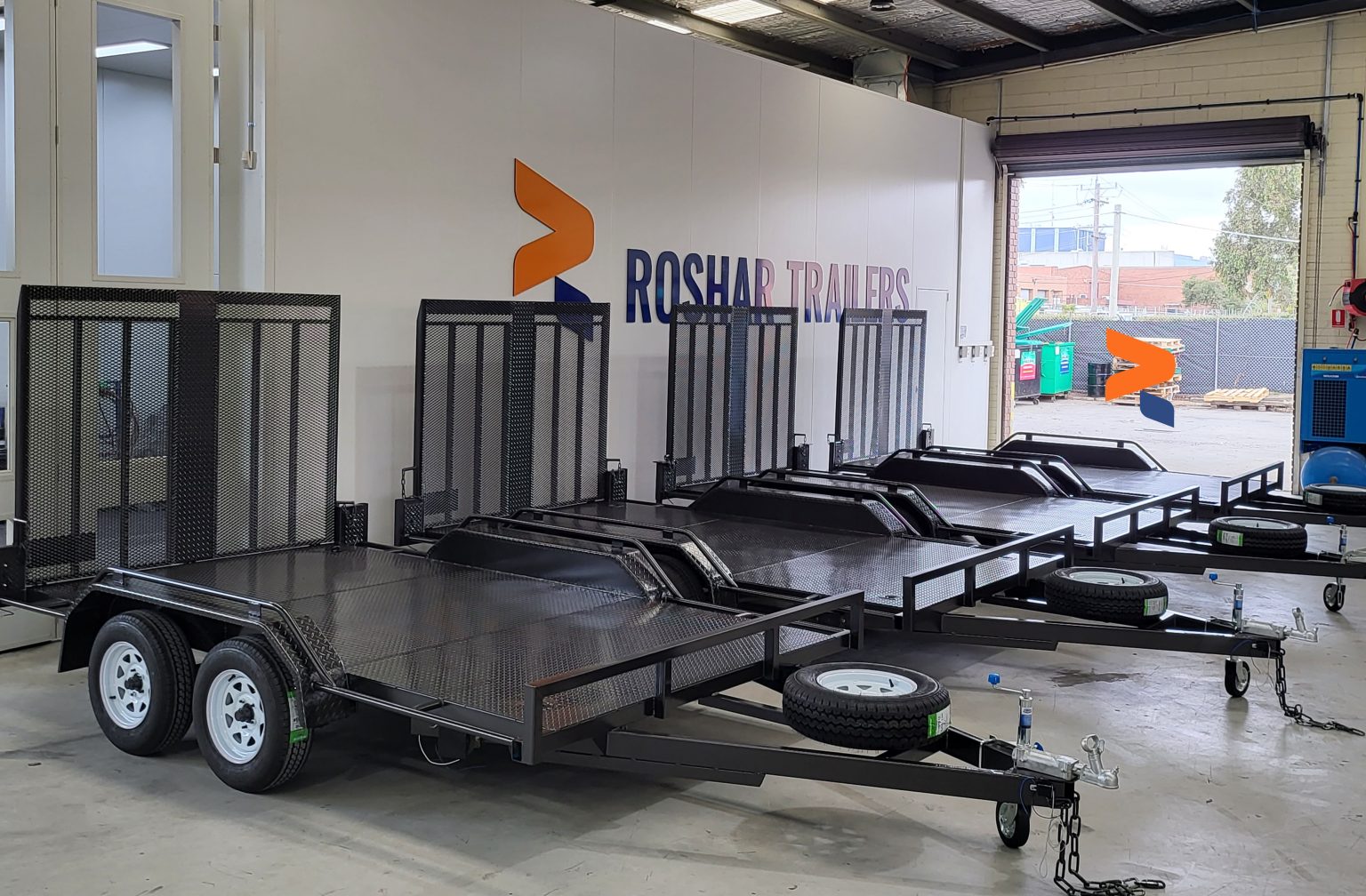
Roshar’s range includes both plant trailers and machinery trailers, with different configurations for equipment transport.
| Requirement | Plant trailer | Machinery trailer |
| Compact excavator | Excellent fit | Excellent fit |
| Skid steer | Depending on rating | Depending on rating |
| Landscaping machinery | Excellent | Excellent |
| Multiple machine types | Choose based on capacity | Choose based on capacity |
| Custom loading arrangement | Available | Available |
| Heavy equipment transport | Rating-dependent | Rating-dependent |
| Attachment storage | Can be specified | Can be specified |
The important decision is the specification, not the label.
What trailer parts need the most attention on machinery trailers?
The trailer parts most relevant to machinery transport include ramps, axles, suspension, brakes, bearings, tyres, coupling components, tie-down points, lights and structural components. Their suitability depends on the trailer’s approved configuration and the loads it is designed to carry.
For contractors, these parts experience repeated loading and road use.
A machinery trailer used every day may need more frequent inspection than one used occasionally.
Roshar’s trailer range and shop provide access to trailer configurations and components, while its maintenance guidance recommends checking tyres, bearings, brakes, suspension, coupling and structural areas as part of trailer care.
When a component needs replacement, do not select it purely because it looks similar. Match the component to the trailer specification and intended application.
Conclusion
The right earthmoving trailer features are the ones that make your machinery easier to load, secure, tow and unload without compromising the trailer’s rated capacity. Payload, ramps, restraint points, running gear, deck design and practical storage should all be considered together.
For Melbourne and Victorian contractors, Roshar Trailers offers plant and machinery trailer configurations for earthmoving, construction, landscaping and commercial applications, with standard and custom options available.
If you are comparing machinery transport options, start with the machine specifications and work backwards to the trailer.
Need a trailer built around your machinery? Contact Roshar Trailers to discuss the right configuration for your equipment and towing setup.
FAQ’S
Can I use the same earthmoving trailer for different machines?
Yes, but only if every machine and attachment stays within the trailer’s approved dimensions, mass ratings, loading arrangement and towing limits. A trailer suitable for a compact excavator may not automatically be suitable for a heavier skid steer, even if both physically fit on the deck.
Do I need a custom trailer if my machine has attachments?
No, not necessarily. A standard trailer may work when the machine and attachments fit within its deck, payload and restraint arrangement. Customisation becomes more useful when attachments require dedicated holders, extra deck length, unusual ramp positioning or storage that a standard configuration cannot provide.
Can I carry a machine and its bucket on the same trailer?
Yes, provided the combined machine, bucket and other equipment remain within the trailer’s rated capacity and the loading arrangement allows the attachment to be secured safely. Check the actual weights rather than assuming the trailer has enough spare payload because the machine itself fits.
Is a heavier trailer always better for earthmoving work?
No, a heavier trailer is not automatically better. The trailer must match the machinery, towing vehicle, legal ratings and intended use. Extra tare weight can reduce available payload, so choosing the highest-rated trailer without checking the complete towing combination can work against the contractor.
Should I choose ramps or a tilt trailer for machinery?
It depends on the equipment, loading frequency, trailer configuration and worksite conditions. Ramps can provide a straightforward loading solution, while a tilt arrangement can reduce manual ramp handling and create a lower loading transition. Compare the complete system rather than choosing by feature alone.
How often should an earthmoving trailer be inspected?
Yes, frequent-use machinery trailers deserve regular inspection, particularly when they operate on rough worksites or carry heavy equipment. Check the trailer before trips and schedule more detailed servicing according to manufacturer guidance, usage and component condition. Pay particular attention to tyres, bearings, brakes, suspension, ramps, coupling and restraint points.