
37 Malcolm RD, Braeside, VIC
10 Trailer Features for Construction Businesses
6 November 2026 | roshartrailers
Table of Contents
By Writer :- Ron
Roshar Trailers Team, Trailer Manufacturing and Sales Specialists
Published: 06/11/2026
A construction trailer setup should match the equipment, materials and daily workflow of the business. For most contractors, the priority features are a suitable load rating, strong tie-down points, practical storage, ramps, durable flooring, secure access, lighting and a towing configuration matched to the vehicle.
Construction businesses rarely carry the same load every day. One job may require power tools and building materials, while another may involve machinery, pallets, long materials or site clean-up.
That is why the best trailer is not simply the biggest trailer available. It is the one configured around how the business actually works.
Roshar Trailers builds and supplies trailers for construction, trade, landscaping and machinery applications from its Melbourne locations in Braeside, Bayswater North and Dandenong. Its current range includes tradesman, flat top, plant, machinery, tipper, tandem and custom trailer options.
What trailer setup is best for a construction business?
The best trailer setup for a construction business is one matched to its heaviest regular load, towing vehicle and daily workflow. Tradesman trailers suit tools, flat tops suit open materials, while plant trailers suit machinery and equipment transport.
A construction company carrying hand tools, fixings and smaller equipment has different needs from a contractor transporting a mini loader or compact excavator.
For example:
| Construction requirement | Suitable trailer direction |
| Daily trade tools | Tradesman trailer |
| Heavy mixed loads | Tandem trailer |
| Pallets and long materials | Flat top trailer |
| Compact machinery | Plant trailer |
| Soil, gravel or site waste | Tipper trailer |
| Specialised equipment | Custom trailer |
Roshar’s current range includes these trailer categories, allowing businesses to select a configuration around the job rather than trying to make one basic trailer perform every task.
The right construction trailer setup features should therefore be considered as a complete system: load capacity, structure, access, restraint, storage, security and road-use equipment all need to work together.
1. Does the trailer have enough payload and load capacity?
A construction trailer needs enough payload for the heaviest realistic working load, including tools, machinery, materials, ramps, accessories and other equipment carried during the job. Choosing by empty trailer size alone can lead to insufficient usable capacity.
Start with the heaviest normal workday rather than the average day.
For example, a builder might carry:
- Power tools
- Timber
- Fixings
- Ladders
- Compressors
- Generators
- Safety equipment
- Materials
A machinery contractor may need to account for an entire machine plus attachments, fuel and restraint equipment.
Roshar’s plant trailer range offers configurations from 1,400 kg to 4,500 kg GVM depending on the model and build, with different sizes, floors, brakes and ramp options.
Practical rule: write down the weight of everything you expect to carry on your busiest regular job, then compare that requirement against the trailer’s actual tare, ATM, GTM and payload figures.
The final ratings should always be confirmed on the written quotation and compliance information for the selected build.
2. Is the chassis and running gear suited to construction work?
The chassis, axle, suspension and drawbar should be selected for the trailer’s intended load and frequency of use. Construction work creates repeated loading, unloading and towing stresses, so running gear should suit the application rather than simply the trailer dimensions.
A trailer that spends most of its life carrying light garden waste has a different duty cycle from one loaded with construction materials every morning.
When comparing options, consider:
- Chassis section and construction
- Drawbar strength
- Axle rating
- Suspension type
- Wheel and tyre rating
- Coupling rating
- Brake configuration
Roshar’s current tradesman specifications, for example, include a strength-tested drawbar, hydraulic braking, seven-leaf slipper suspension and 185R14LT tyres on a specific 8×5 configuration. The exact specification varies by completed build, so buyers should confirm the final configuration rather than assuming every model has identical components.
In practice, we would start with the load and duty cycle, then work backwards to the chassis and running gear. That approach prevents the common mistake of selecting a trailer based purely on length and appearance.
3. Does it have enough tie-down points?
A construction trailer should have enough correctly positioned tie-down points for the equipment and materials it will carry. Tie-down locations should work with the actual load rather than forcing straps around unsuitable structural components.
According to the National Transport Commission, loads must be properly restrained, must not exceed applicable mass limits and must not affect vehicle stability. The NTC recognises both tie-down and direct-restraint methods for light-vehicle loads.
Transport Victoria also advises that loads should be positioned securely and evenly across the trailer, with suitable restraint equipment selected for the load. Heavy loads may require stronger headboards or racks, while rated restraint equipment should be used where appropriate.
Useful construction trailer tie-down features can include:
- Flush floor tie points
- U-shaped tie-down points
- Side tie rails
- Heavy-duty attachment points
- Machinery restraint positions
Roshar’s 8×5 tradesman configuration lists flush-floor tie points and U-shaped tie-down points among its available options.
4. Are the loading ramps practical for your equipment?
Loading ramps should match the machinery, wheel or track configuration and available loading space. A good ramp setup makes equipment easier to load while keeping the trailer practical to store, tow and operate on different construction sites.
Think about what actually needs to get onto the trailer.
A contractor may load:
- Mini loaders
- Compact excavators
- Mowers
- Generators
- Plate compactors
- Site equipment
Ramp considerations include:
| Ramp consideration | Why it matters |
| Ramp length | Influences loading angle |
| Ramp width | Must suit the equipment |
| Ramp capacity | Must support the loaded machine |
| Storage | Prevents ramps becoming loose site equipment |
| Loading angle | Affects clearance and equipment access |
| Ramp surface | Helps provide suitable traction |
Roshar’s plant trailers offer ramp configurations for wheeled and tracked equipment, including fold-down and slide-under systems, depending on the build.
For construction businesses, the best ramp is the one that matches the machine you actually use rather than simply choosing the heaviest-looking option.
5. Does the trailer provide useful tool and equipment storage?
Construction trailer storage should put frequently used tools within easy reach while keeping heavier equipment positioned sensibly. Lockable toolboxes, shelving, drawers, racks and dedicated compartments can turn unused trailer space into a more organised mobile workspace.
A well-organised storage system can reduce the amount of time spent moving tools around at the start and end of each job.
Useful options include:
- Toolboxes
- Shelving
- Drawers
- Small-parts storage
- Ladder racks
- Compressor boxes
- Jerry-can holders
- Equipment brackets
Basic Trailers’ research on tradesman trailer organisation highlights dedicated storage, tie-down points, internal racks and lockable access as important parts of an effective work setup.
The storage layout should also reflect the trade. An electrician may need many small compartments. A carpenter may need larger tool storage and long-item racks. A landscaper may need space for battery equipment and machinery accessories.
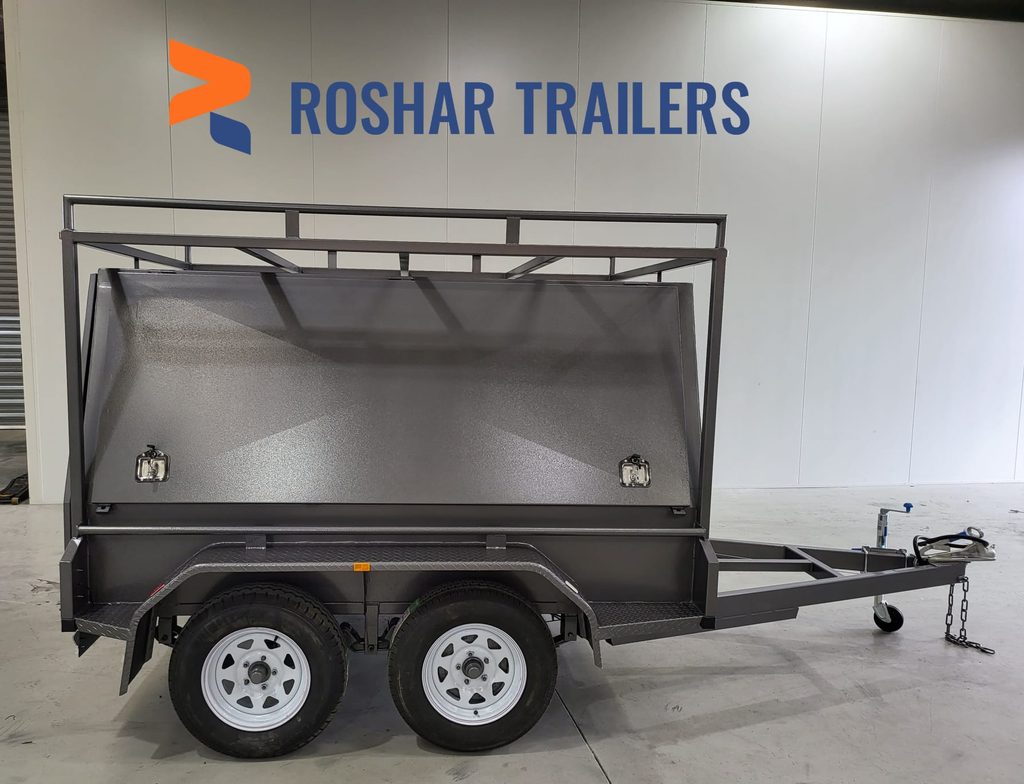
If the trailer will mainly carry tools, consider tradesman trailers rather than trying to convert a basic open trailer into a mobile workshop.
6. Is the flooring suitable for construction loads?
The trailer floor should suit the weight, shape and loading method of the equipment and materials. Construction users should consider impact resistance, surface grip, drainage, cleaning requirements and whether machinery will repeatedly drive across the floor.
A floor that works well for boxes of tools may not be suitable for tracked equipment or heavy machinery.
Common options can include:
- Checker plate
- Smooth metal flooring
- Perforated flooring
- Grid mesh flooring
Roshar’s plant trailer range offers checker plate, perforated and grid mesh floor options, allowing the floor to be selected around equipment and loading requirements.
For a construction business, ask how the floor will behave during the full working cycle:
Load → tow → unload → clean → reload.
That simple test often reveals whether a particular floor configuration makes sense for the job.
7. Can the sides, cages or load containment match the job?
Side panels, cages, rails and load stops should match the shape and movement risk of the materials being transported. Construction businesses carrying loose or bulky materials need containment that supports safe loading without making access unnecessarily difficult.
For example, a builder carrying long materials may need side rails or load stops. A landscaping contractor may benefit from a cage configuration. A machinery operator may prefer a low open deck with ramps.
Transport Victoria recommends keeping loads stable and evenly distributed and notes that heavy-load headboards and racks need to be strong enough for the job.
The right configuration therefore depends on the load.
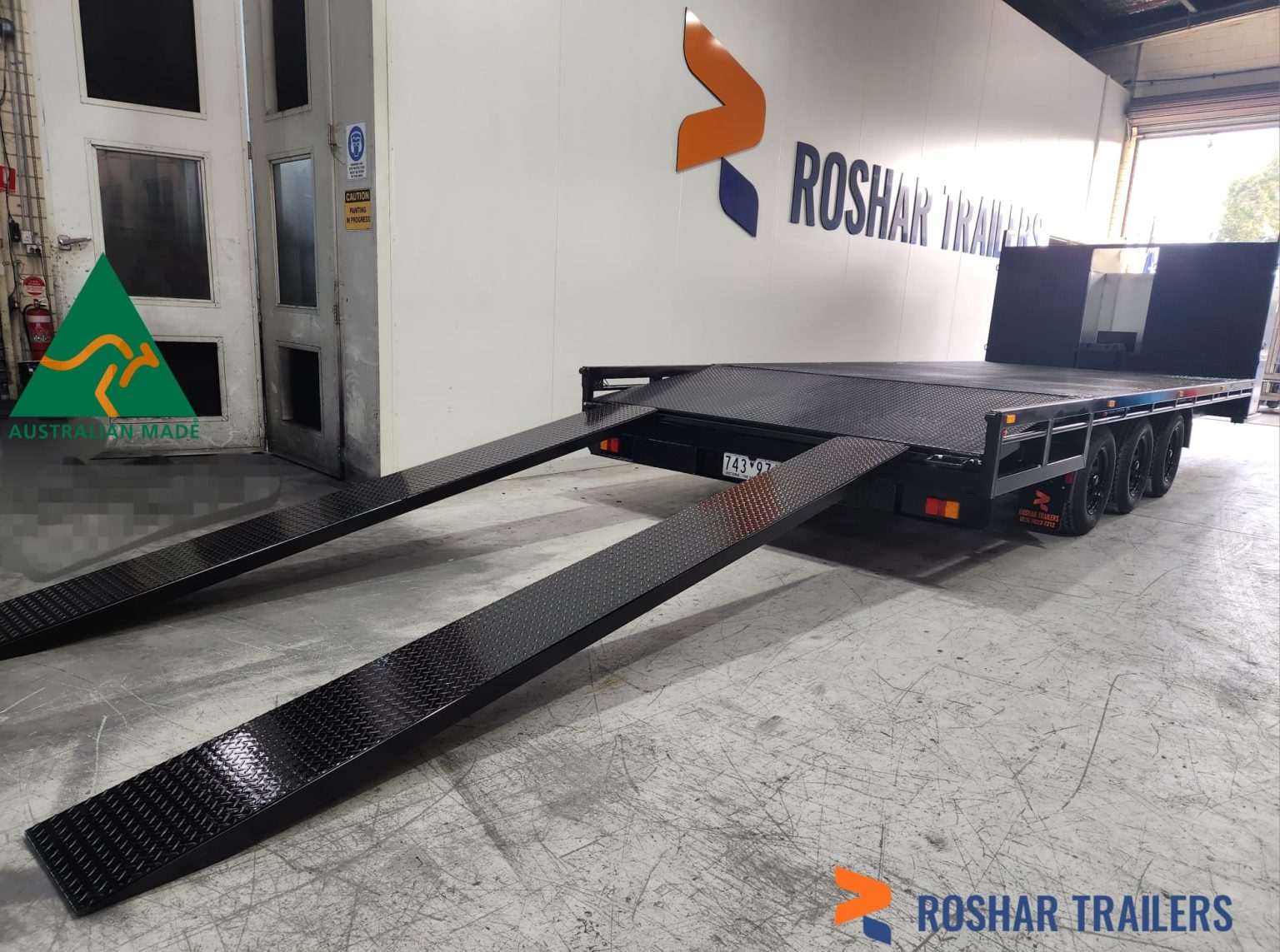
A flat top trailer can provide open loading flexibility for machinery, pallets and awkward materials. A cage configuration may make more sense when carrying bulky or loose items.
Don’t add a cage simply because it looks useful. Make sure it improves your actual workflow.
8. Are the brakes, coupling and lighting suitable?
A construction trailer needs road-use equipment that matches its final configuration, including suitable brakes, coupling, safety chains and lighting. These components should be specified alongside the trailer’s load ratings rather than treated as optional details at the end.
According to the Australian Government’s current VSB 1 Revision 6, trailers with an aggregate trailer mass of 4.5 tonnes or less are expected to comply with applicable Australian Design Rules, with the bulletin providing guidance for common trailer types.
For a construction business, consider:
- Brake type
- Brake capacity
- Coupling rating
- Safety chains
- LED lighting
- Reflectors
- Number plate location
- Jockey wheel
- Tyre rating
The exact setup depends on the completed trailer and its rated configuration. Roshar’s current product specifications show that braking, suspension and other components can vary between configurations.
Don’t treat compliance as something to check after the trailer has been built. It should form part of the specification from the beginning.
9. Does the setup protect valuable tools and equipment?
Construction businesses often carry expensive tools, batteries, equipment and accessories, so security should be considered before ordering the trailer. Lockable storage, protected access and sensible overnight parking can reduce exposure when equipment remains with the trailer.
Security starts with the trailer design.
Depending on the application, useful options can include:
- Lockable toolboxes
- Lockable doors
- Enclosed compartments
- Secure ramp storage
- Coupling locks
- Wheel security
- GPS tracking provisions
Roshar’s trailer security guidance recommends layered protection, including coupling locks, wheel clamps and secure storage for tools and equipment.
The most useful security setup depends on what is being protected. A construction trailer carrying high-value power tools needs a different approach from an open plant trailer carrying a machine that is secured separately.
10. Can the trailer be customised around your workflow?
Customisation becomes valuable when a standard trailer cannot efficiently carry your equipment, tools or materials. Construction businesses can use custom dimensions, storage, ramps, tie-downs, cages, flooring and other features to create a trailer around the work rather than adapting the work to the trailer.
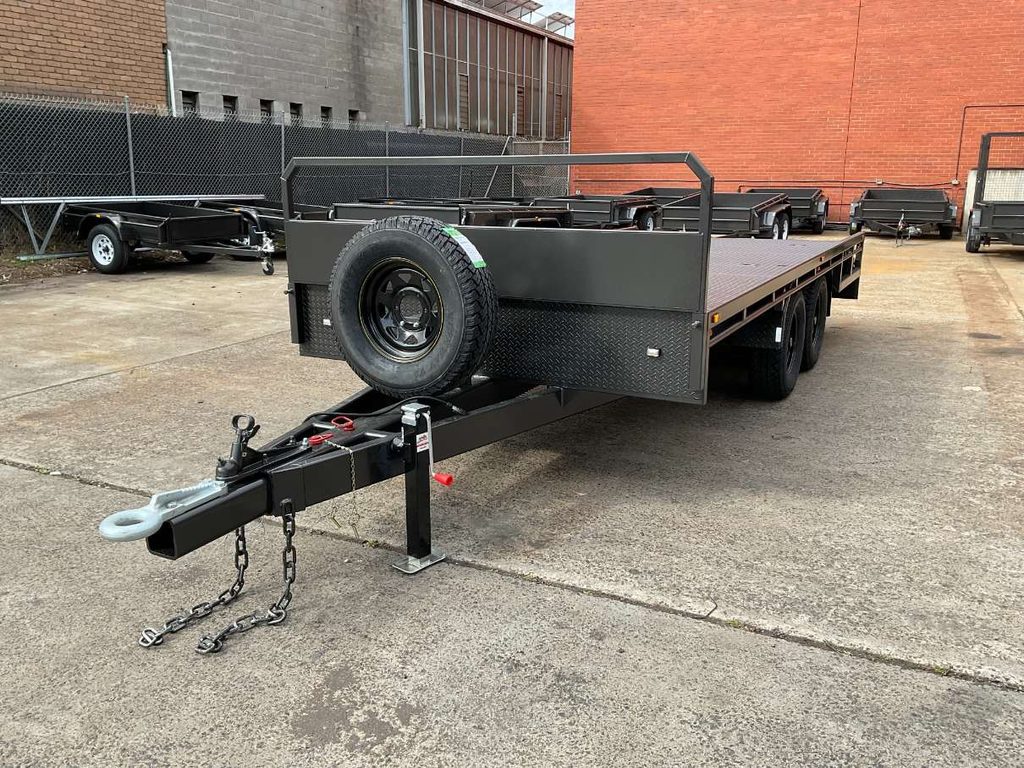
Roshar offers custom trailers for trade, business, machinery, landscaping, vehicle transport and specialised applications. Its custom range includes options for trailer size, load capacity, flooring, suspension, brakes and other practical requirements.
Customisation can make particular sense when:
- The equipment has unusual dimensions
- The trailer needs dedicated storage
- Multiple trades use the same trailer
- Machinery requires specific ramp positioning
- Materials need special restraint points
- The business has a repeatable loading process
A custom trailer should solve a real operational problem. If the same tool is always difficult to reach, the same machine always needs a particular ramp position or the same material needs a dedicated storage area, that is useful information for the trailer design.
How should a construction business choose its trailer setup?
A construction business should choose its trailer by mapping its real workflow from loading through transport to unloading. Start with the heaviest load, then select the trailer type, running gear, access, storage, restraint and security features around that use.
Use this process before requesting a quote:
- List the real workday load: include tools, machinery, materials, fuel, accessories and restraint equipment rather than estimating from memory.
- Record the heaviest regular load: this establishes the starting point for payload and trailer rating discussions.
- Match the towing vehicle: check the vehicle’s towing capacity, towbar rating and other applicable limits before selecting the trailer.
- Choose the trailer direction: use tradesman, flat top, plant, tandem, tipper or another configuration according to the job.
- Map loading and unloading: identify whether you need ramps, forklift access, rear loading, side access or machinery-specific positioning.
- Plan storage: separate frequently used tools from equipment that is only needed occasionally.
- Plan restraint: identify where straps, chains and other suitable restraint equipment will connect.
- Plan security: decide what needs to be locked, tracked or removed at the end of the day.
- Specify road-use equipment: confirm brakes, coupling, safety chains, lighting, tyres and compliance requirements.
- Review the finished specification: make sure the written quote clearly states the final configuration, ratings and included features.
For businesses comparing a trailer for sale, this checklist helps turn a general trailer search into a practical equipment decision.
Construction trailer setup examples by business type
Different construction businesses need different trailer configurations because their loads, tools and loading methods are not the same. A tradesman trailer can suit tool-heavy contractors, while a plant trailer or flat top can better suit machinery and material transport.
| Business | Recommended direction | Priority features |
| Builder | Tradesman or tandem | Tool storage, tie-downs, material space |
| Electrician | Tradesman | Shelving, drawers, cable storage, security |
| Plumber | Tradesman or custom | Pipe storage, tool compartments, access |
| Landscaper | Cage, tipper or tandem | Bulk capacity, ramps, easy unloading |
| Earthmoving contractor | Plant trailer | Ramps, payload, brakes, tie-downs |
| General contractor | Tandem or custom | Flexible load area, storage, restraint |
| Construction supplier | Flat top | Open deck, load stops, tie-downs |
| Small construction business | Tradesman or custom | Multi-purpose storage and flexibility |
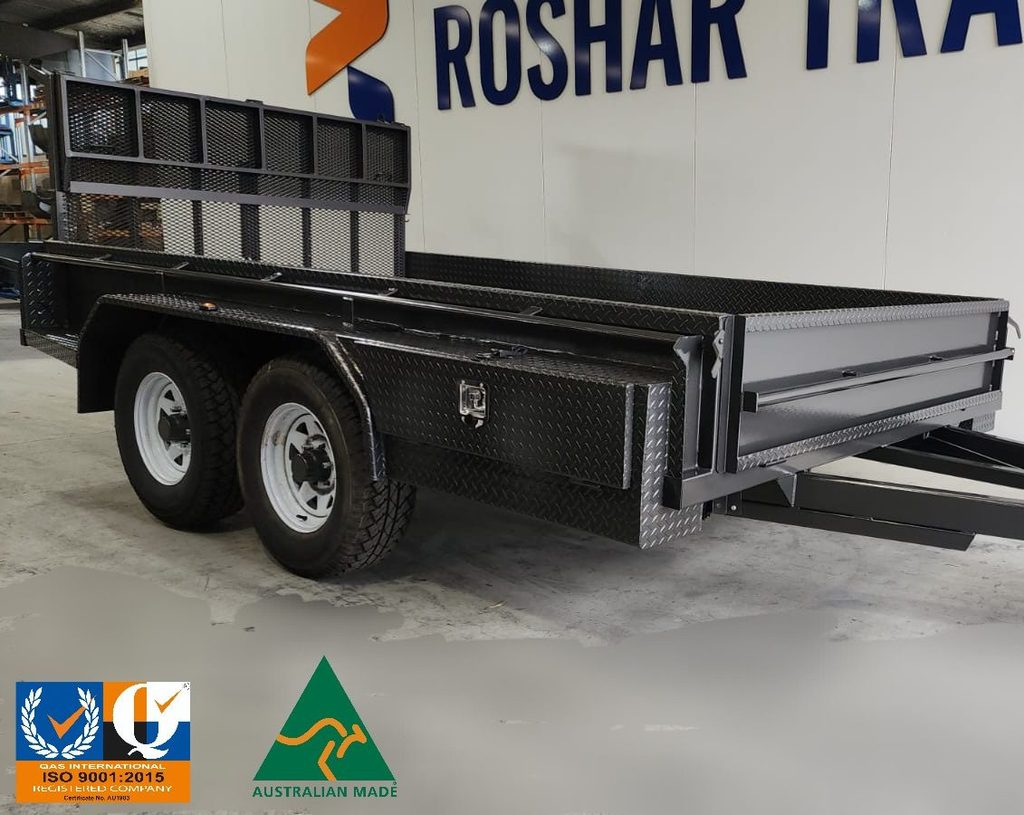
If machinery is the main load, compare plant trailers for sale Melbourne and check the equipment weight, dimensions, ramp arrangement and towing vehicle before selecting a configuration.
A practical construction trailer setup checklist
Use this checklist when comparing trailer quotes:
| Area | Question to ask |
| Load | What is the heaviest regular load? |
| Payload | Does the usable payload cover tools, equipment and materials? |
| Chassis | Is the structure suited to the intended duty cycle? |
| Axles | Does the axle configuration match the load? |
| Suspension | Is it suitable for the expected road and worksite use? |
| Brakes | Is the braking configuration appropriate for the completed trailer? |
| Ramps | Can the equipment be loaded without an impractical angle? |
| Restraint | Are tie-down points positioned for the actual loads? |
| Storage | Can frequently used tools be accessed quickly? |
| Flooring | Is the floor suited to machinery and material handling? |
| Security | Can valuable equipment be protected when parked? |
| Compliance | Will the completed build meet applicable requirements? |
| Future use | Will the setup still work if the business adds equipment? |
Conclusion
The best construction trailer setup is built around the work, not simply the trailer’s dimensions. Load capacity, chassis, ramps, restraint, storage, security and road-use equipment should all be considered together.
For Melbourne construction businesses, tradies and contractors, Roshar Trailers offers standard and custom trailer options across Braeside, Bayswater North and Dandenong. Its range includes tradesman, flat top, plant, machinery, tandem, tipper and custom builds.
If your current trailer forces you to compromise on loading, storage or equipment transport, it may be time to specify a trailer around the job instead.
Talk to Roshar Trailers about a trailer setup built for your construction work.
FAQ’S
Can one trailer be used for different construction trades?
Yes, a multi-purpose trailer can work well for a small contractor who handles varied jobs. The key is to avoid over-specialising the layout. Modular storage, removable racks, adjustable tie-down positions and practical loading access can give one trailer enough flexibility for changing work requirements.
Should a construction trailer be designed for future equipment?
Yes, but only after considering realistic business growth. Building unnecessary capacity adds weight and cost. A better approach is to identify equipment you are likely to add, then discuss whether the chassis, payload, dimensions and storage layout can accommodate that future requirement without compromising today’s work.
How often should a construction trailer layout be reviewed?
A practical review every few months can identify wasted storage, unused equipment and access problems. Also review the setup whenever your business adds machinery, changes trades, takes on another worker or starts handling different materials. A trailer layout should evolve when the workflow changes.
Do construction trailers need special load restraint equipment?
Yes, the restraint method must suit the load being carried. The National Transport Commission says loads on light vehicles must be properly restrained and must not exceed applicable mass limits or affect vehicle stability. The appropriate equipment can vary between tools, machinery, building materials and loose loads.
Does a custom trailer always cost more than a standard trailer?
No, not necessarily. Customisation can add cost when it introduces additional materials, fabrication or specialised components, but the right comparison is the completed specification. A standard trailer that requires several later modifications can be less practical than specifying the important features correctly from the beginning.
Should trailer compliance be checked before the trailer is delivered?
Yes, confirm the completed trailer’s ratings, compliance information and approval status before taking delivery. The Australian Government’s current RVS guidance states that low-ATM trailers supplied to the Australian market require the applicable approval pathway and RAV information. Confirm the requirements for the specific completed build and registration jurisdiction.