
37 Malcolm RD, Braeside, VIC
10 Useful Trailer Features for Builders
13 November 2026 | roshartrailers
Table of Contents
By Writer :- Ron
Roshar Trailers Team, Trailer Manufacturing and Sales Specialists
Published: 13/11/2026
A builder trailer setup should make tools easier to access, materials easier to carry and the workday easier to manage. The most useful features include secure storage, shelving, ladder racks, tie-down points, strong flooring, ramps, suitable brakes and practical access.
For builders and contractors, the trailer often works as a mobile extension of the worksite. It carries power tools, hand tools, fixings, ladders, building materials and equipment between jobs, so its layout needs to reflect how the trailer is actually used.
A well-planned setup is not about filling every available space. It is about putting the right equipment in the right place while keeping weight, access and load restraint under control.
What trailer features are useful for builders?
The most useful trailer features for builders are lockable storage, shelving, drawers, ladder racks, long-item racks, tie-down points, strong flooring, practical access doors, suitable loading ramps and a chassis, suspension and braking system matched to the intended load.
The right combination depends on whether you mainly carry tools, materials, machinery or a mixture of all three.
A builder doing renovation work may prioritise enclosed storage and small-part organisation. A new-home builder may need more room for materials, ladders and site equipment. A contractor moving heavier machinery may need a different trailer altogether.
10 useful features at a glance
| Feature | Main purpose | Particularly useful for |
| Lockable compartments | Tool security and organisation | Power tools, hand tools and valuable equipment |
| Internal shelving | Separate tools and consumables | Fixings, hardware and trade supplies |
| Drawers | Fast access to small items | Screws, bits, fasteners and fittings |
| Ladder racks | Store long equipment outside the floor area | Ladders, levels and long materials |
| Long-item racks | Separate pipes, timber and similar items | Construction and maintenance work |
| Tie-down points | Secure equipment and loads | Machinery, tools and materials |
| Strong flooring | Handle repeated loading | Building materials and equipment |
| Access doors | Reach equipment without unloading everything | Daily trade work |
| Loading ramps | Simplify equipment loading | Compactors, small machinery and wheeled equipment |
| Suitable running gear | Support safe towing and load handling | Daily commercial use |
These features are not equally important for every builder. The best setup prioritises the equipment that is used most frequently and the loads that create the greatest demands.
How should you plan a builder trailer setup?
A builder trailer setup should be planned from the work backwards: list your tools and materials, group them by frequency of use, decide how they will be loaded, then position storage and heavy equipment around safe access and weight distribution.
Start by observing a normal workday rather than designing the trailer from a catalogue photo.
Ask:
- What comes out at almost every job?
- What only gets used occasionally?
- Which items are heavy?
- Which materials are long or awkward?
- Which tools need weather protection?
- Which equipment needs to remain locked?
- What needs to be loaded or unloaded first?
Use a simple three-level storage system
Daily-use zone: Keep drills, impact drivers, tape measures, levels, hand tools and commonly used fixings close to the easiest access point.
Job-specific zone: Store specialist tools, materials and equipment that are used for particular projects.
Backup zone: Keep spare stock, replacement parts and less frequently used equipment further away from the main access areas.
This creates an access hierarchy. The tools you use ten times a day should not be buried behind equipment you use once a month.
A practical builder scenario
Imagine a builder carrying a circular saw, impact driver, drill, levels, fasteners, hand tools, ladders and sheet materials.
If the trailer has no storage zones, the floor quickly becomes a pile of equipment. The builder then has to move several items just to reach a drill.
A better layout places power tools in accessible storage, fixings in labelled drawers, ladders on an external rack and sheet materials in a designated loading area.
That is the difference between having storage and having a useful workflow.
Which storage features are most useful for builders?
The most useful builder trailer storage features are lockable compartments, internal shelving, drawers, toolboxes and dedicated zones for small parts. They should keep high-use equipment accessible while preventing tools and materials from becoming mixed together.
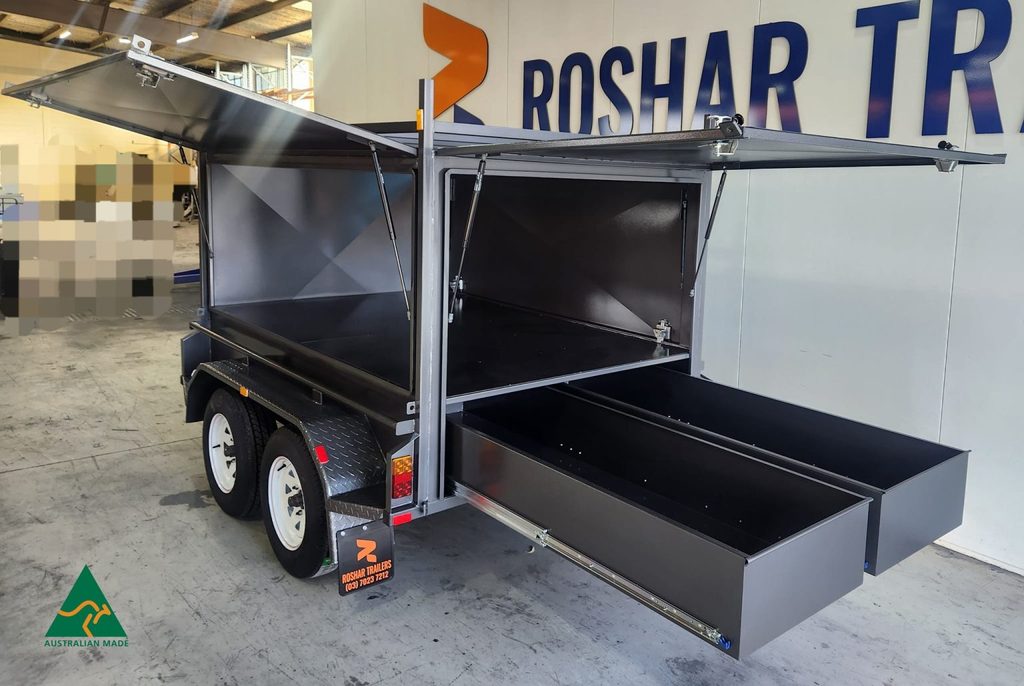
Roshar’s current tradesman trailer range includes options such as internal shelving, toolboxes, lockable storage, compressor boxes, ladder racks and tie-down points, allowing the trailer to be configured around different trade workflows.
1. Lockable compartments
Lockable compartments are useful for expensive power tools, testing equipment and other equipment that should not be left exposed.
For a builder, this could include:
- Drills
- Impact drivers
- Saws
- Batteries
- Measuring equipment
- Specialist tools
The key is access. A secure compartment that requires you to unload half the trailer before opening it is secure but inefficient.
2. Internal shelving
Shelving works well for items that need to remain visible and separated.
Builders can use different shelves for:
- Fasteners
- Adhesives
- Hand tools
- Safety equipment
- Consumables
- Replacement parts
Shelving is especially useful when multiple workers use the same trailer because everyone can see where equipment belongs.
3. Drawers for small parts
Drawers are useful for small items that disappear quickly in open boxes.
Consider dedicated drawers for:
- Screws
- Nails
- Wall plugs
- Drill bits
- Blades
- Brackets
- Washers
- Fixings
Labelled drawers make restocking easier and reduce time spent searching.
4. Toolboxes
External or drawbar-mounted toolboxes can provide additional storage without taking up the main floor area.
Roshar’s custom trailer range allows storage and toolbox arrangements to be considered alongside trailer dimensions, load requirements and towing needs.
How can a builder trailer make loading easier?
A builder trailer makes loading easier when access points, tailgates, ramps, storage doors and floor space are planned around the equipment being carried. The goal is to load heavy or bulky items without repeatedly moving smaller tools out of the way.
Loading access becomes particularly important when the trailer carries a mixture of tools and materials.
5. Practical rear access
Rear access should allow common equipment to be loaded without unnecessary handling.
For example, if a builder frequently carries a small mixer, compactor or other wheeled equipment, the rear opening should accommodate the equipment’s dimensions and loading method.
6. Loading ramps
Ramps can be useful when equipment needs to be rolled or driven into the trailer.
Before specifying a ramp, check:
- Equipment width
- Equipment operating weight
- Ground clearance
- Wheel or track position
- Loading angle
- Ramp storage location
The ramp should be matched to the equipment rather than added simply because it is available as an accessory.
7. Drop-down gates
Drop-down gates can make loading sheet materials and other building supplies easier.
They can also provide a useful loading edge when moving items in and out of the trailer.
What features help keep building materials secure?
Builders need more than storage; they need a trailer that allows materials and equipment to be restrained appropriately during transport. Tie-down points, rails, suitable sides and practical load placement all contribute to a safer working setup.
Transport Victoria states that loads must be properly restrained and that heavy loads require suitable headboards and racks; it also recommends positioning loads securely and distributing them evenly across the vehicle or trailer.
The National Transport Commission similarly states that light-vehicle loads must be properly restrained, must not exceed mass limits and must not dangerously overhang.
8. Tie-down points
Tie-down points should be positioned where they can actually be used with the equipment you carry.
For example, a builder carrying a plate compactor needs suitable restraint locations that allow the machine to be secured without placing straps over vulnerable components.
9. Tie rails
Tie rails provide more flexibility when securing different loads.
They can be useful when the load changes from one project to another.
A renovation job might involve:
- Timber
- Tools
- Hardware
A landscaping or external works job could involve:
- Equipment
- Materials
- Bagged products
The trailer should allow the restraint arrangement to change without compromising safe loading.
Keep heavy items low
Heavy equipment should generally be positioned with weight distribution in mind rather than placed wherever there happens to be room.
A practical builder trailer should have a defined location for heavier equipment before the storage system is finalised.
How should weight and trailer capacity influence the setup?
A builder trailer should be designed around the actual load, not just the available floor area. Tare mass, ATM, GTM, payload, tow vehicle capacity, axle ratings, braking and coupling specifications all need to be considered before adding storage or equipment.
The Department of Infrastructure’s current VSB 1 Revision 6 applies to trailers with an aggregate trailer mass of 4.5 tonnes or less and explains the applicable Australian Design Rule requirements for common low-ATM trailers.
That matters because every permanent addition contributes to the completed trailer’s mass.
A toolbox, shelving system, ladder rack, spare wheel, ramp or heavy floor is not weight-free.
A simple capacity framework
| Question | Why it matters |
| What is the trailer’s tare mass? | Shows the trailer’s mass before the working load |
| What is the ATM? | Sets the trailer’s maximum aggregate mass |
| What is the GTM? | Relevant to axle-group load and braking requirements |
| What is the actual payload? | Determines how much equipment and material can be carried |
| What does the tow vehicle allow? | Prevents choosing a trailer beyond the vehicle’s capability |
| What is the axle rating? | Limits the load supported by the axle system |
| What braking setup is fitted? | Must suit the trailer’s applicable mass and requirements |
For example, a trailer can have plenty of floor space but still be unsuitable if the builder’s tools, materials and permanent storage exceed its usable payload.
Capacity should therefore be checked before the fit-out is finalised.
When is a custom builder trailer worth considering?
A custom builder trailer is worth considering when a standard model cannot comfortably accommodate your tools, materials, storage zones, loading method or towing requirements. Customisation is most useful when it solves a recurring workflow problem rather than simply adding more accessories.
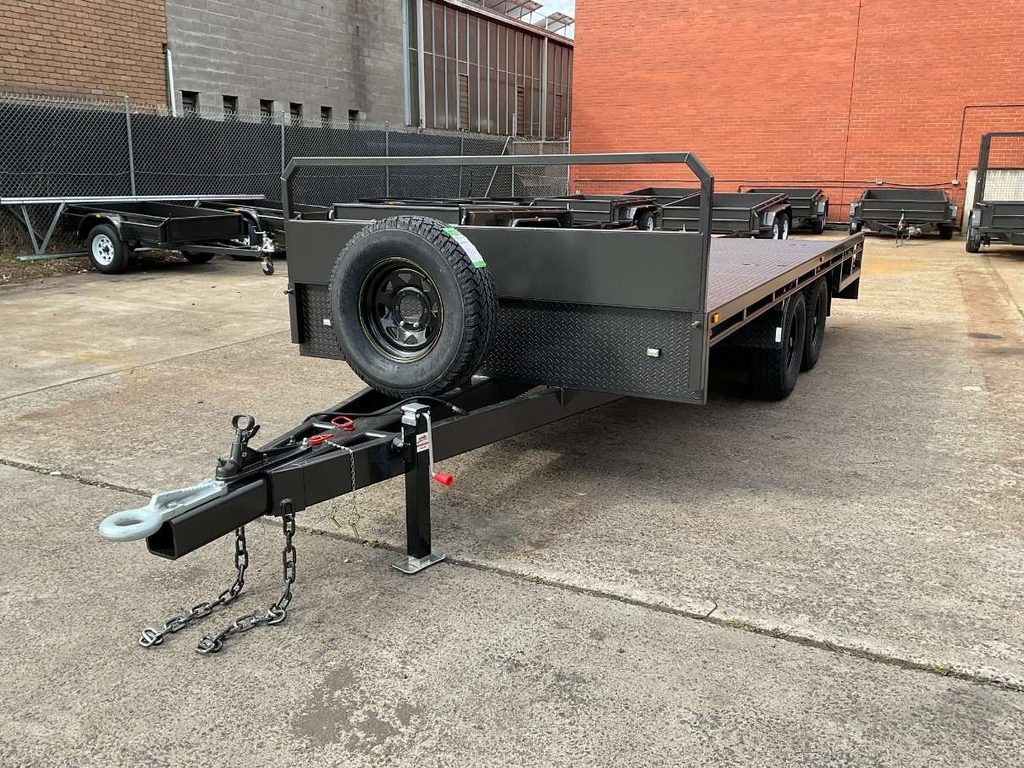
Roshar’s custom trailer service allows customers to discuss dimensions, axle setup, ramps, flooring, cages, toolboxes, tie-down points, braking and storage around the intended application.
Customisation makes sense when you need:
- Specific internal storage
- Dedicated tool compartments
- Long-item racks
- Custom ladder storage
- Compressor storage
- Special loading access
- Additional tie-down locations
- A combination of open and enclosed areas
- A specific axle or suspension arrangement
- A trailer designed around unusual equipment
Standard vs custom builder trailer
| Standard trailer | Custom trailer |
| Faster to select | Designed around the workflow |
| Fixed configuration | Specific storage and access |
| Lower design complexity | More planning required |
| Good for predictable loads | Better for specialised loads |
| Limited layout choices | Greater control over features |
The important point is not to customise everything. Choose the features that solve real problems.
How much can a builder trailer setup cost?
The cost of a builder trailer setup depends on trailer size, rated capacity, axle configuration, braking, storage, racks, flooring and other custom features. As a current Roshar reference point, an 8×5 Tradesman Trailer is listed at $6,600, while a custom builder configuration will vary with its specifications.
Treat the advertised trailer price as the starting point rather than the final cost of a work-ready setup.
A builder should compare:
- Base trailer price
- Storage additions
- Racks
- Ramps
- Braking configuration
- Flooring
- Axle setup
- Custom fabrication
- Delivery or collection
- Registration and other applicable costs
What is worth paying for?
A useful rule is to prioritise features that solve a repeated problem.
High priority: secure storage, suitable payload, reliable load restraint, practical access and appropriate running gear.
Medium priority: specialist racks, additional shelving and job-specific storage.
Lower priority: features that look useful but are rarely used.
For example, a builder who carries ladders every day is likely to get more value from a properly planned ladder rack than from an accessory that is rarely used.
When should you choose professional trailer advice?
You should speak with a trailer manufacturer or specialist when your load is heavy, your equipment is unusual, you need multiple storage systems or you are unsure whether your tow vehicle and trailer ratings work together. Professional input can prevent expensive changes after purchase.
A useful consultation should cover:
- Explain the actual workload: provide your common tools, materials, equipment weights and job types so the trailer is matched to real use.
- Discuss the towing vehicle: provide the vehicle model and relevant towing information so the proposed trailer is not selected in isolation.
- Review the storage plan: show which tools need daily access and which can remain in lower-priority storage.
- Confirm the mass ratings: check the completed trailer’s tare, ATM, GTM and payload before finalising the configuration.
- Plan load restraint: identify where machinery, materials and bulky equipment will be secured.
- Confirm the finished specification: make sure the written quote records the agreed trailer size, features, braking, suspension and included components.
For Melbourne builders, Roshar Trailers operates from Braeside, Bayswater North and Dandenong and offers tradesman and custom trailer options for trade and commercial applications.
Builder Trailer Setup: Feature Priority Framework
The following framework is a practical way to decide what deserves space and budget first.
| Priority | Feature | Ask yourself |
| 1 | Payload and ratings | Can the completed trailer legally carry my real load? |
| 2 | Tool security | What equipment needs to stay locked? |
| 3 | Daily access | What do I reach for at almost every job? |
| 4 | Load restraint | Where will heavy and awkward items be secured? |
| 5 | Long-item storage | Where will ladders, levels and long materials go? |
| 6 | Loading access | How will heavy equipment get on and off? |
| 7 | Small-part organisation | Which consumables need drawers or bins? |
| 8 | Weather protection | Which tools or materials need covered storage? |
| 9 | Future capacity | Will the business add tools or equipment? |
| 10 | Custom features | Which modifications solve a recurring problem? |
This framework is the article’s main decision tool: capacity first, workflow second, accessories third.
Builder Trailer Storage Ideas: A Practical Daily Layout
Good builder trailer storage ideas are based on access frequency rather than simply filling every compartment. Keep daily tools close to the main access point, specialist equipment in dedicated storage, long items on racks and heavy equipment low and secure.
A practical layout could look like this:
| Trailer area | Suggested contents | Access |
| Rear | Daily hand and power tools | Very high |
| Side compartments | Fixings, consumables and small parts | High |
| Front/drawbar | Compressor or selected heavy equipment | Medium |
| Roof/upper rack | Ladders and long items | Medium |
| Main floor | Materials and larger equipment | Based on job |
| Dedicated restraint zone | Machinery and heavy equipment | High when loading |
The exact arrangement should change according to the builder’s trade and equipment.
A carpenter may need more long-item storage. A renovation contractor may need more enclosed tool space. A builder working with heavier equipment may need more open floor space and stronger restraint points.
What if your business also does landscaping or property maintenance?
Builders who also handle landscaping, grounds maintenance or property work may need a different trailer configuration from a construction-only setup. In those cases, a separate equipment-focused trailer can sometimes make more sense than trying to fit every tool into one builder trailer.
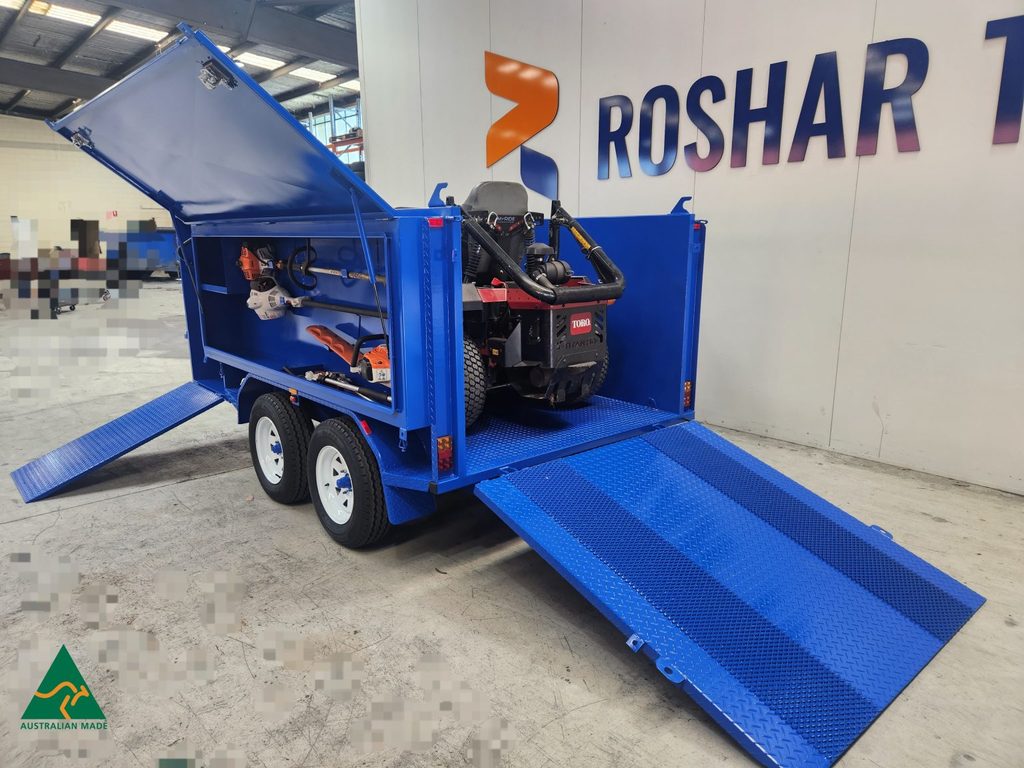
For example, Roshar’s lawn mowing trailers can be configured around mowers, trimmers, blowers, tools, ramps, storage, cages and equipment racks depending on the completed build.
That is useful for businesses with multiple service lines because the trailer can be designed around the equipment rather than forcing unrelated equipment into one storage layout.
Conclusion
A practical builder trailer setup should make daily work easier, not simply give you more space. Start with payload and towing requirements, then build the layout around tool access, secure storage, load restraint, long-item storage and the equipment you actually carry.
For builders in Melbourne, Roshar Trailers offers tradesman and custom trailer options that can be planned around different trade workflows and commercial requirements.
If your current trailer makes you unload half the gear to reach one tool, it may be time to rethink the setup.
FAQ’S
Can a builder trailer be used for both tools and building materials?
Yes, provided the trailer’s completed payload, dimensions and load-restraint arrangement suit both uses. A mixed-use builder trailer can combine lockable tool storage with open floor space for materials. The important part is keeping heavy items within the applicable ratings and ensuring every load is restrained appropriately.
Do builders need a tandem axle trailer?
No, not every builder needs a tandem axle trailer. A lighter trade workload may suit a single-axle configuration, while heavier equipment, larger loads or frequent commercial use may justify tandem construction. The decision should be based on the completed trailer rating, payload, towing vehicle and actual work requirements.
How often should a builder reorganise trailer storage?
A monthly review is a useful starting point, with a quick reset after each workday. Look for tools that are consistently difficult to reach, storage zones that stay overcrowded and equipment that is carried but rarely used. Those patterns show where the layout needs adjustment.
Can I add storage to a builder trailer later?
Yes, but only where the trailer’s design, available space and completed mass allow it. Adding heavy toolboxes, racks or shelving changes the trailer’s weight and may affect available payload. Check the proposed addition with the manufacturer before fitting it rather than assuming unused space means unlimited capacity.
Should a builder keep a spare wheel on the trailer?
Yes, a correctly specified spare wheel can be useful for a trailer used regularly between worksites. It should have a suitable mounting location that does not obstruct access or create an impractical weight-distribution issue. Confirm the wheel and tyre specification matches the trailer before relying on it as a spare.
Can a builder trailer be used for highway travel?
Yes, provided the trailer, tow vehicle, load and equipment meet the applicable requirements. Before highway travel, confirm the trailer’s ratings, coupling, braking, tyres, lighting and load restraint, then distribute the load appropriately. Check the relevant state or territory rules for your route and trailer configuration.