
37 Malcolm RD, Braeside, VIC
Box Trailer vs Cage Trailer vs Tandem Trailer: Which One Should You Buy?
14 August 2026 | roshartrailers
By Roshar Trailers Team, Trailer Manufacturing
Published: 14 August 2026
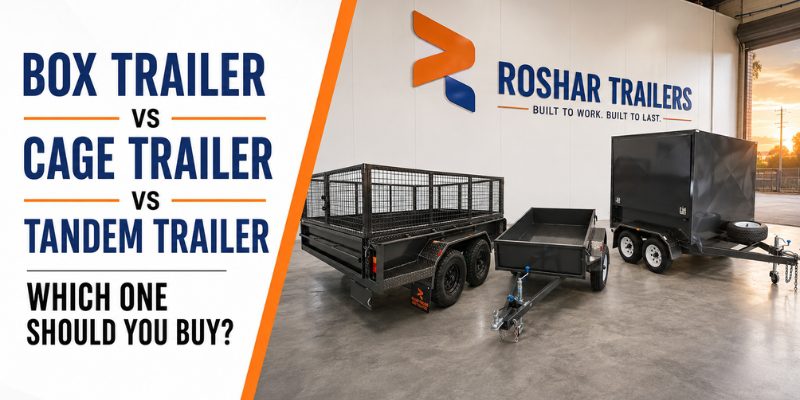
Box trailer vs cage trailer vs tandem trailer comes down to load type, weight, height, use frequency and towing stability. Choose a box trailer for general hauling, a cage trailer for bulky loose loads and a tandem trailer for heavier regular work.
Buying the wrong trailer usually does not feel wrong on day one. It feels wrong when you need two trips instead of one, when green waste spills over the sides, when a single axle setup feels overloaded, or when your tools, materials or machinery no longer fit the trailer safely.
For tradies, landscapers, builders, farmers, property owners and small businesses, the right trailer is not only about size. It is about how the trailer loads, how the weight sits, how often it gets used, whether the load needs height or containment, and whether the tow vehicle can handle the setup.
How does box trailer vs cage trailer vs tandem trailer compare?
Box trailer vs cage trailer vs tandem trailer is mainly a choice between open loading, load containment and heavier-duty support. A box trailer suits general use, a cage trailer adds height and containment, and a tandem trailer improves capacity and stability.
The easiest way to compare these trailers is to think about your most common load. If you carry furniture, tools, small materials or garden waste occasionally, a simple box trailer may be enough. If the load is bulky or loose, cage sides become valuable. If the load is heavy, long, frequent or work-related, tandem axle support becomes more important.
This is where many buyers get confused. A tandem trailer is not always a separate “body style” like a box trailer or cage trailer. It refers to an axle setup. You can have a tandem box trailer, a tandem cage trailer, a tandem flat top trailer or a tandem tipper trailer.
Roshar’s own range reflects this. Its trailer page lists box trailers, cage trailers, tandem trailers, hydraulic tipper trailers, plant trailers, tradesman trailers, car carrier trailers and custom trailer options, showing that trailer body style and axle configuration are often matched together for the job. View Roshar’s trailer range.
Box vs cage vs tandem trailer comparison table
| Trailer type | Best for | Main advantage | Main limitation |
| Box trailer | General hauling, furniture, tools, garden waste, small materials | Simple, versatile and easy to load from above | Loose or tall loads need good restraint, tarp or cage option |
| Cage trailer | Green waste, bulky loads, bags, boxes, light equipment, furniture | Extra height and containment for awkward loads | Can catch more wind and may not suit very heavy loads without the right axle setup |
| Tandem trailer | Heavier work loads, frequent towing, machinery, construction materials | More support, better load spread and stronger work-use options | Costs more, has more tyres/components and needs more careful towing |
| Tandem cage trailer | Landscaping, property maintenance, bulky trade loads | Combines containment with stronger axle support | May be more trailer than occasional users need |
| Tandem box trailer | Heavier general hauling and trade work | Open loading with higher-capacity configuration | Still needs correct load restraint and tow vehicle matching |
When should you choose a box trailer?
Choose a box trailer when you need a practical all-rounder for general hauling, garden waste, furniture, small tools, building supplies or household jobs. It works best when the load is not too tall, loose or heavy for the trailer rating.
A box trailer is usually the simplest entry point because the design is open, flexible and easy to understand. You can load furniture from above, carry garden waste, move tools, take rubbish to the tip, transport small building materials or use it for weekend property work.
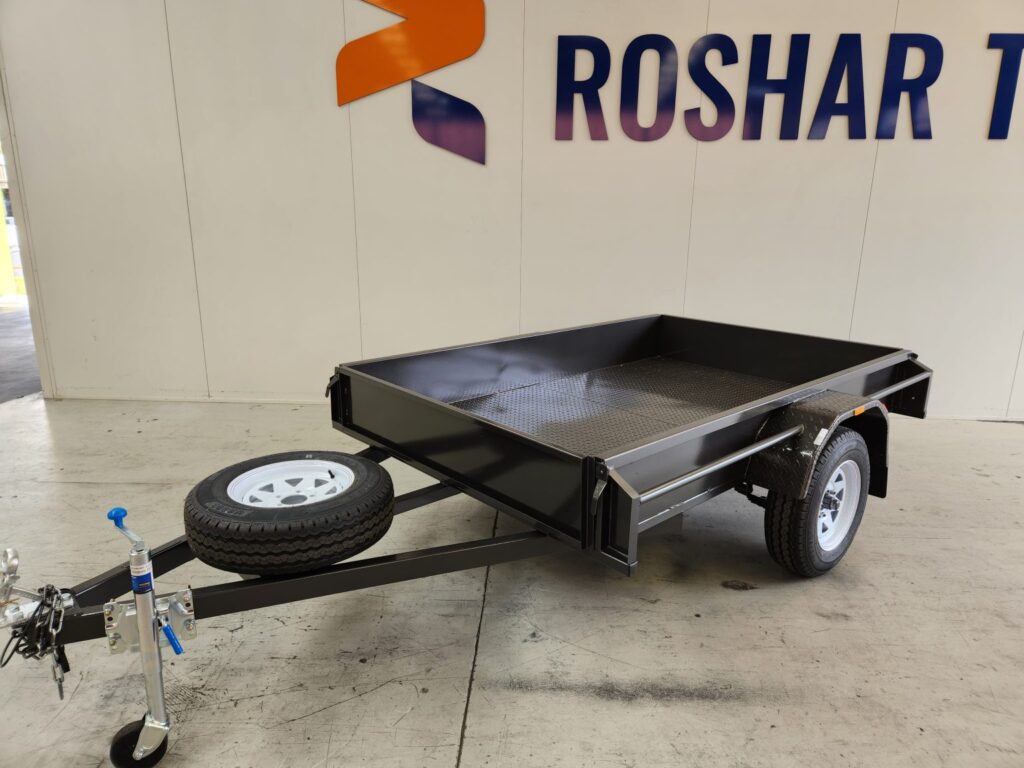
Roshar’s box trailer page says its box trailers suit household transport, garden waste and landscaping, tools and trade equipment, furniture and moving, construction materials, farm and rural work, business deliveries and general hauling. It also lists common sizes from 6×4 through 8×5 and tandem box trailer options. Browse Roshar box trailers.
The main limitation is containment. If you regularly carry loose branches, green waste, boxes stacked high, lightweight bags or tall furniture, a standard box trailer may need extra tie-downs, a tarp, higher sides or a cage.
A box trailer is a strong choice when:
- you need a simple everyday trailer
- you carry mixed household or light trade loads
- you want open-top loading
- you do not need permanent high sides
- you want something easier to store and tow
- your loads are usually below the trailer’s payload rating
When should you choose a cage trailer?
Choose a cage trailer when the load needs extra height, better containment or easier stacking. It suits green waste, branches, bulky household items, furniture, bags, tools and light equipment, especially where a normal box trailer feels too low.
Cage trailers are popular with landscapers, property maintenance teams and homeowners because many real loads are bulky rather than extremely heavy. A pile of branches, garden clippings, cardboard, cushions or camping gear may not weigh much, but it needs more height and containment than a plain box trailer provides.
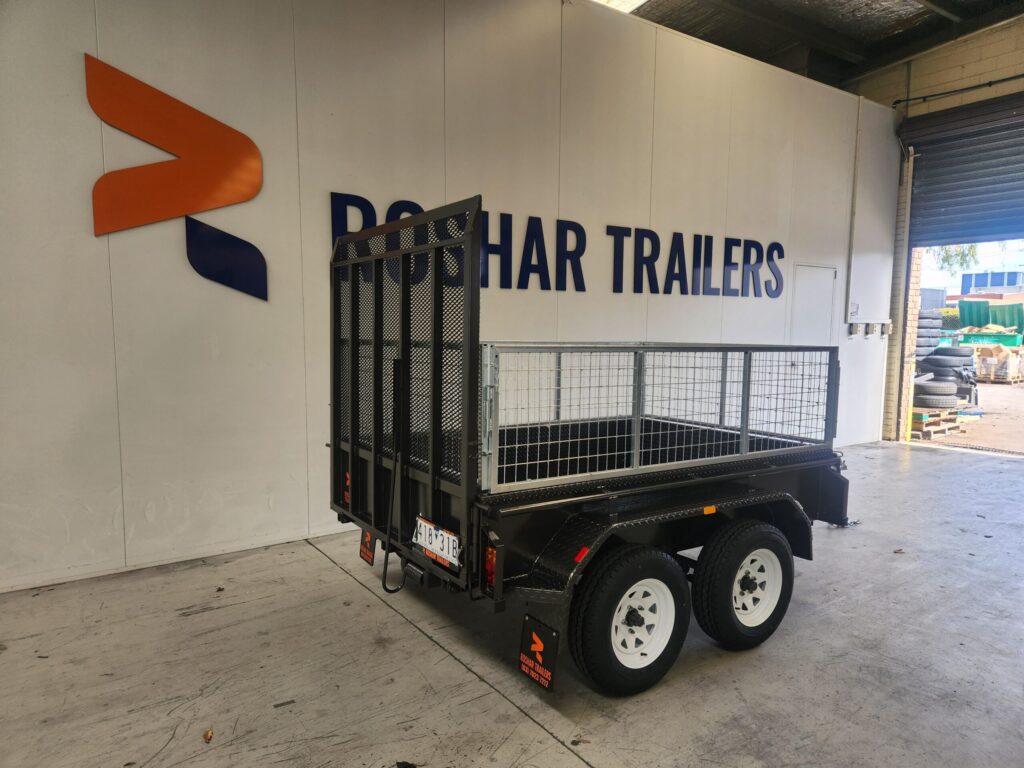
Modern Trailers describes box cage trailers as having enclosed sides with a cage-like structure and notes that tandem axle cage trailers increase load-carrying capacity compared with single axle options. Its article also lists hydraulic tipper, enclosed, off-road and customised cage trailer variants. Modern Trailers cage trailer comparison.
Roshar’s cage trailer page lists available sizes such as 6×4, 7×4, 7×5, 8×5 or custom, with load capacity from 750 kg to 4500 kg GVM depending on configuration. It also notes optional ramps, tie-down points, toolboxes and custom cage heights. Browse Roshar cage trailers.
A cage trailer is a strong choice when:
- you carry green waste or bulky garden material
- you need extra height above standard trailer sides
- you want better load containment
- you carry lightweight but awkward items
- you want removable or custom cage options
- you need a practical trailer for landscaping or property maintenance
When should you choose a tandem trailer?
Choose a tandem trailer when loads are heavier, towing is frequent, the trailer is larger or you need stronger work-use capability. Tandem axles spread weight across four wheels, making them useful for business loads, building materials and heavier equipment.
A tandem trailer is about axle configuration. Instead of one axle and two wheels, it uses two axles positioned close together. This can improve load support and towing stability when the trailer is matched correctly to the tow vehicle, brakes, tyres and loaded weight.
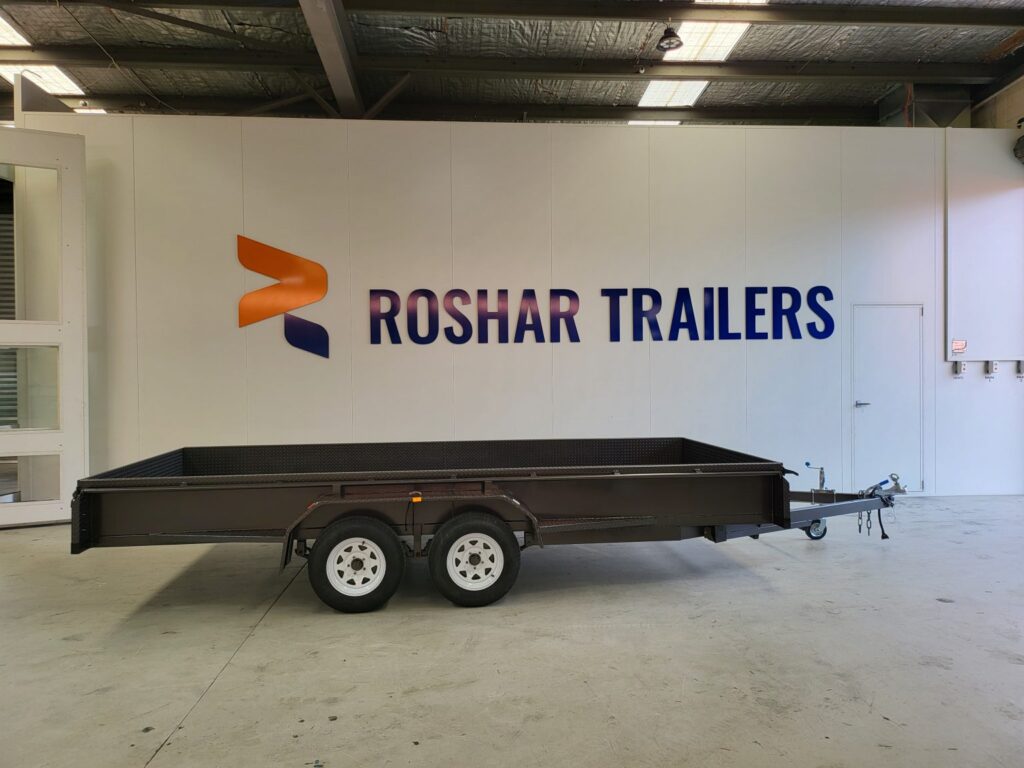
Roshar explains that a tandem axle trailer uses two axles positioned close together to support the trailer and load across four wheels. It says tandem trailers are commonly chosen for larger sizes, regular towing and applications needing a more capable setup than many lighter single axle trailers. Browse Roshar tandem trailers.
A tandem setup can be useful for tradies, contractors, farmers, landscapers and construction businesses that regularly tow heavy or mixed loads. The trade-off is cost, turning space, tyre count, brake setup and maintenance. You are buying more trailers, so the work should justify it.
A tandem trailer is a strong choice when:
- you tow heavy loads regularly
- you carry construction materials or machinery
- you need stronger load support
- you want a larger tray size
- you travel longer distances with work gear
- a single axle trailer feels close to its practical limit
Which trailer is best for tradies, landscapers and homeowners?
The best trailer depends on the buyer’s everyday load. Homeowners often suit box trailers, landscapers often need cage trailers or tandem cage trailers, and tradies or contractors may need tandem, tradesman, plant, tipper or custom trailer setups.
For a homeowner, the trailer may be used for tip runs, furniture, garden waste and occasional moving. A box trailer or small cage trailer can be practical because the load changes from job to job and the trailer does not need to work every day.
For a landscaper, the problem is usually volume. Grass, branches, mulch bags and garden waste can pile high, so cage height and easy unloading matter. A tandem cage or hydraulic tipper may be more useful when the work becomes regular.
For a tradie, the issue is often access and security. A basic open box trailer may carry materials, but it will not protect expensive tools. A tandem trailer, tradesman trailer or custom trailer may be better if the setup needs shelves, lids, side access, racks, storage and daily site use.
Buyer type matching table
| Buyer type | Better trailer direction | Why |
| Homeowner / DIY buyer | Box trailer or small cage trailer | Good for tip runs, furniture, garden waste and occasional hauling |
| Landscaper | Cage trailer, tandem cage trailer or tipper | Better for green waste, bulky loads and repeated unloading |
| Tradie / contractor | Tandem trailer, tradesman trailer or custom trailer | Better for tools, materials, storage and worksite use |
| Builder / construction business | Tandem trailer, flat top or plant trailer | Stronger support for materials, equipment and frequent towing |
| Farmer / rural property owner | Tandem, flat top, cage or custom trailer | Better for mixed loads, uneven access and practical durability |
| Vehicle owner / workshop | Car carrier or flat top trailer | Better for transporting cars, bikes or machinery safely |
| Small business | Box, cage, tandem or enclosed trailer | Depends on whether the priority is delivery, storage, capacity or security |
What trailer checks matter before buying?
Before buying, check tare, ATM, GTM, payload, tow vehicle limit, axle setup, brakes, tyres, coupling, safety chains, lights, tie-down points, floor strength, cage height, ramp needs and warranty support. These details matter more than tray size alone.
A good trailer should suit the load legally and practically. The size may look right, but the payload may be wrong. The cage may look useful, but the tow vehicle may be close to its limit. The tandem setup may look strong, but the brakes, tyres and coupling still need to match.
According to Transport for NSW, the loaded mass of a trailer should not exceed the rated capacity of the towbar and coupling, the vehicle’s towing capacity, the trailer’s carrying capacity or the tyres’ maximum rated carrying capacity. Transport for NSW towing guidance.
According to the Department of Infrastructure, VSB 1 Revision 6 helps trailer manufacturers understand Australian Design Rule requirements for trailers with an aggregate trailer mass of 4.5 tonnes or less. Department of Infrastructure VSB 1.
Pre-purchase process
- Action: List your three heaviest regular loads: this prevents buying around an easy job instead of the real job.
- Action: Check your tow vehicle limit: the trailer must suit the vehicle, not just your storage needs.
- Action: Ask for tare, ATM, GTM and payload: payload tells you what the trailer can actually carry after its own weight is counted.
- Action: Choose body style before accessories: box, cage and tandem decisions should come before toolboxes, racks or spare wheels.
- Action: Confirm brake and tyre specifications: heavier trailers need running gear that suits the loaded weight.
- Action: Inspect tie-down points and floor strength: load restraint is only useful if the trailer has practical, strong places to secure the load.
- Action: Ask about local support and warranty: a work trailer should have backup if lights, brakes, latches or fit-up issues need attention.
How should you compare trailer quotes?
Compare trailer quotes by specification, not only price. Ask whether each quote includes the same tray size, cage height, axle setup, brakes, tyres, floor, ramps, tie-down points, spare wheel, jockey wheel, coating, registration readiness and warranty.
Two trailer quotes can look close until you read the details. One may include a cage, spare wheel, LED lights, ramps, upgraded tyres, brake setup and stronger drawbar. Another may show a lower price because those items are optional or built lighter.
Transport Victoria says loads should be stable and evenly distributed, and that suitable restraints such as rated webbing straps or chains should be chosen for the load. It also notes that chains are best suited for heavy loads. Transport Victoria securing loads.
The National Transport Commission says light vehicle loads must not exceed mass limits and must not cover lights, indicators, reflectors or the number plate. It also provides load restraint guidance for light vehicles. NTC Load Restraint Guide.
Quote comparison table
| Quote item | Why it matters |
| Tray size | Determines space, but not true carrying ability |
| Cage height | Helps with bulky loads but may affect wind exposure and storage |
| Axle setup | Single axle may suit light use; tandem suits heavier or regular use |
| Brake setup | Important for heavier GTM and towing control |
| Tyres and wheels | Load rating and condition affect safety and replacement cost |
| Floor and chassis | Determines strength under real loads |
| Ramps | Essential for machinery, mowers and wheeled equipment |
| Tie-down points | Needed for safe load restraint |
| Coating | Helps with corrosion resistance in outdoor and worksite use |
| Warranty and support | Important for business users who cannot afford downtime |
When should you upgrade from single axle to tandem?
Upgrade from single axle to tandem when the trailer is used regularly, the load is heavy, the tray size is larger or the trailer often feels close to its limit. Tandem trailers make sense when capacity and durability matter more than simplicity.
Single axle trailers are easier to move around by hand, usually cost less and can be enough for light home or occasional business use. They are a good choice when the trailer stays well within payload limits and does not need to carry heavy tools, machinery or bulk material regularly.
Tandem trailers make more sense when the load becomes heavier or more frequent. For example, a small landscaper may start with a cage trailer for light green waste but later upgrade to a tandem cage or tipper when the business grows. A contractor may start with a box trailer, then move to a tandem trailer when carrying heavier materials or equipment.
Roshar’s box trailer page notes that tandem axle box trailer configurations can support higher load requirements, with selected models available up to 4500 kg GVM. That makes tandem configurations suitable for heavier tools, equipment, building materials, garden waste, machinery and general cargo across Melbourne and Victoria. View Roshar box trailers.
Upgrade signal table
| If this is happening | Better next step |
| You need two trips for the same job | Consider a larger box or cage trailer |
| Loose loads sit above the sides | Consider a cage trailer |
| The trailer is regularly near its payload limit | Consider a tandem trailer |
| You carry wet green waste, soil or bulky material | Consider a tandem cage or hydraulic tipper |
| You carry machinery or wheeled equipment | Consider ramps, plant trailer or flat top setup |
| You need tool security | Consider tradesman or enclosed trailer options |
| You tow every week for business | Consider tandem, custom or purpose-built work trailer |
Conclusion
The answer to box trailer vs cage trailer vs tandem trailer depends on what you carry, how often you tow and how much load support you need. Choose a box trailer for simple all-round use, a cage trailer for bulky loads and a tandem trailer for heavier regular work.
Roshar Trailers offers box trailers, cage trailers, tandem trailers and a broader trailer for sale range for Australian buyers. If your load changes by job, start with the real use case, then match the size, axle setup, brakes and features around it.
FAQ’S
Can a cage be added to a box trailer later?
Yes, sometimes, but it depends on the trailer design, side structure and available mounting points. Ask the manufacturer before modifying the trailer. A poorly fitted cage can create rattles, weak points, wind drag or load-restraint issues if it was not designed for that trailer.
Is a tandem cage trailer better than a single axle cage trailer?
Yes, if the loads are heavier, larger or used for regular work. A single axle cage trailer can suit light green waste and household use. A tandem cage trailer is better when the extra containment needs stronger axle support, better load spread and more work-use capacity.
Which trailer is easiest to store at home?
A smaller single axle box trailer is usually easiest to store because it is lighter, simpler and may be easier to move by hand. Cage trailers need more vertical space, and tandem trailers can be harder to manoeuvre in tight driveways, sheds or narrow side access.
Can I use a cage trailer for furniture moving?
Yes, cage trailers can work well for furniture because the added height helps contain taller items. You still need blankets, straps and careful packing to stop rubbing, movement or weather exposure. If the furniture must stay dry, an enclosed trailer may be better.
Do tandem trailers need more maintenance?
Yes, generally, because there are more tyres, bearings, suspension parts and sometimes more braking components. The benefit is stronger load support for heavier or regular use. For business buyers, the extra maintenance can be worthwhile if it reduces overload risk and downtime.
Which trailer is better for green waste?
A cage trailer is usually better for green waste because branches, clippings and bulky garden material need height and containment more than a plain box trailer provides. If the loads are heavy or frequent, a tandem cage trailer or hydraulic tipper may be the better long-term option.
Should I buy bigger than I currently need?
No, not automatically. A bigger trailer costs more, takes more space and may need a stronger tow vehicle. Buy around your realistic regular load, then allow some margin for growth. If your work is expanding quickly, a tandem or custom build may make sense.