37 Malcolm RD, Braeside, VIC
Best Trailers for Farmers and Rural Property Owners
27 July 2026 | roshartrailers
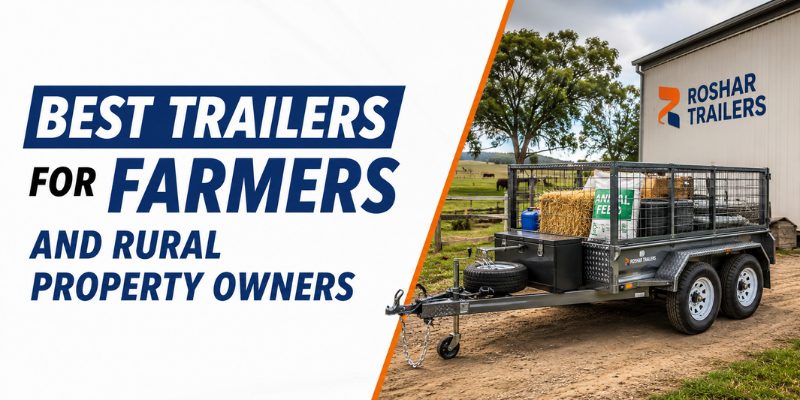
The best trailers for farmers are the ones matched to the real farm job: fencing, machinery transport, hay, water tanks, livestock gear, feed, tools or property maintenance. Most rural buyers compare tandem, flat top, plant, machinery, tipper and cage trailers first.
On rural properties, one trailer often does more than one job. It may carry fencing posts in the morning, a water tank after lunch and a mower or small loader the next week. That is why buying only by tray size can lead to the wrong setup.
When rural buyers ask Roshar about the best trailers for farmers, the useful starting point is simple: what do you carry, how often, where do you tow, and how will the load be secured? This farm trailer guide explains how to match trailer type to real Australian rural work.
Which are the best trailers for farmers in Australia?
The best trailers for farmers usually include tandem trailers, flat top trailers, plant trailers, machinery trailers, tippers and cage trailers. The right choice depends on whether you move bulk material, equipment, fencing, feed, tanks, livestock gear or mixed property-maintenance loads.
A small rural property may need one versatile trailer for general jobs. A working farm may need different trailers for hay, fencing, machinery, tools, feed and bulk loads. A contractor servicing rural properties may need a trailer that handles both highway travel and rougher site access.
Roshar’s trailer range includes box, cage, car carrier, custom, flat top, hydraulic tipper, machinery, plant, tandem, tradesman and tri-axle trailer options. Roshar also advises buyers to consider load type, use frequency, single axle or tandem axle setup, towing capacity, ramps, cages, brakes and custom features before choosing a trailer.
Farm trailer comparison table
| Trailer type | Best rural use | Main advantage | Watch before buying |
| Tandem trailer | Heavier mixed farm loads, tools, fencing, waste and equipment | Better support across four wheels for regular work | Needs correct towing capacity, braking and turning space |
| Flat top trailer | Hay, pallets, tanks, fencing steel, pumps and odd-shaped loads | Open access from sides, rear and top | Load must be restrained properly because there are no high fixed sides |
| Plant trailer | Mini loaders, compact excavators, mowers and small machines | Built around drive-on equipment and ramps | Equipment weight, ramp angle and tie-down points must match |
| Machinery trailer | Heavier machinery, attachments and rural equipment | Stronger build for tough transport tasks | Must suit the machine dimensions and tow vehicle |
| Hydraulic tipper trailer | Soil, gravel, mulch, manure, feed clean-up and property maintenance | Fast unloading with less manual shovelling | Payload, tipping angle and floor strength matter |
| Cage trailer | Green waste, light fencing supplies, farm clean-up and loose bulky loads | Contains tall or awkward loads better than a low-sided trailer | Wind drag and load height need attention |
How do you match a farm trailer to rural jobs?
Match the trailer to the job by listing the heaviest regular load, the largest awkward load, the roughest access point and the most common unloading method. A trailer that suits all four is usually better than the cheapest size match.
Most rural buyers carry mixed loads. A fencing run may include posts, rolls of wire, strainers, tools and a water container. A paddock maintenance job may include a mower, spray unit, chainsaw, fuel, spare parts and loose waste. These loads need different layouts and restraint options.
The mistake is buying for the easiest job. If the trailer is used on gravel, sloped driveways, muddy access, paddocks or regional roads, the axle setup, tyres, suspension, brakes, ramp system and drawbar strength matter more than they would for a short suburban tip run.
Rural job matching framework
| Rural job | Better trailer direction | Why |
| Fencing repairs | Flat top, tandem or trailer with racks | Long posts, rolls and tools need length, tie-downs and side access |
| Moving compact machinery | Plant trailer or machinery trailer | Drive-on equipment needs ramps, strong floor and proper restraint |
| Carrying hay, pumps or tanks | Flat top trailer | Open deck helps with awkward, bulky or palletised loads |
| Cleaning paddocks or yards | Cage trailer or tipper trailer | Loose material needs containment or fast unloading |
| Property maintenance | Tandem trailer or custom trailer | Mixed loads often need capacity, tie-downs, cage or toolbox options |
| Landscaping on rural blocks | Hydraulic tipper, plant or tandem trailer | Soil, gravel and machinery need practical loading and unloading |
| Carrying tools between properties | Tradesman or custom trailer | Lockable storage and layout matter for daily work |
When should farmers choose tandem trailers?
Farmers should choose tandem trailers when they regularly move heavier loads, mixed tools, fencing materials, bulky supplies or rural-maintenance gear. A tandem setup gives more load support than many single axle trailers, but only when ratings and braking suit the job.
A tandem trailer uses two axles close together to support the trailer and load across four wheels. Roshar explains that this setup is commonly chosen for larger trailer sizes, regular towing and applications needing more capability than many lighter single axle trailers.
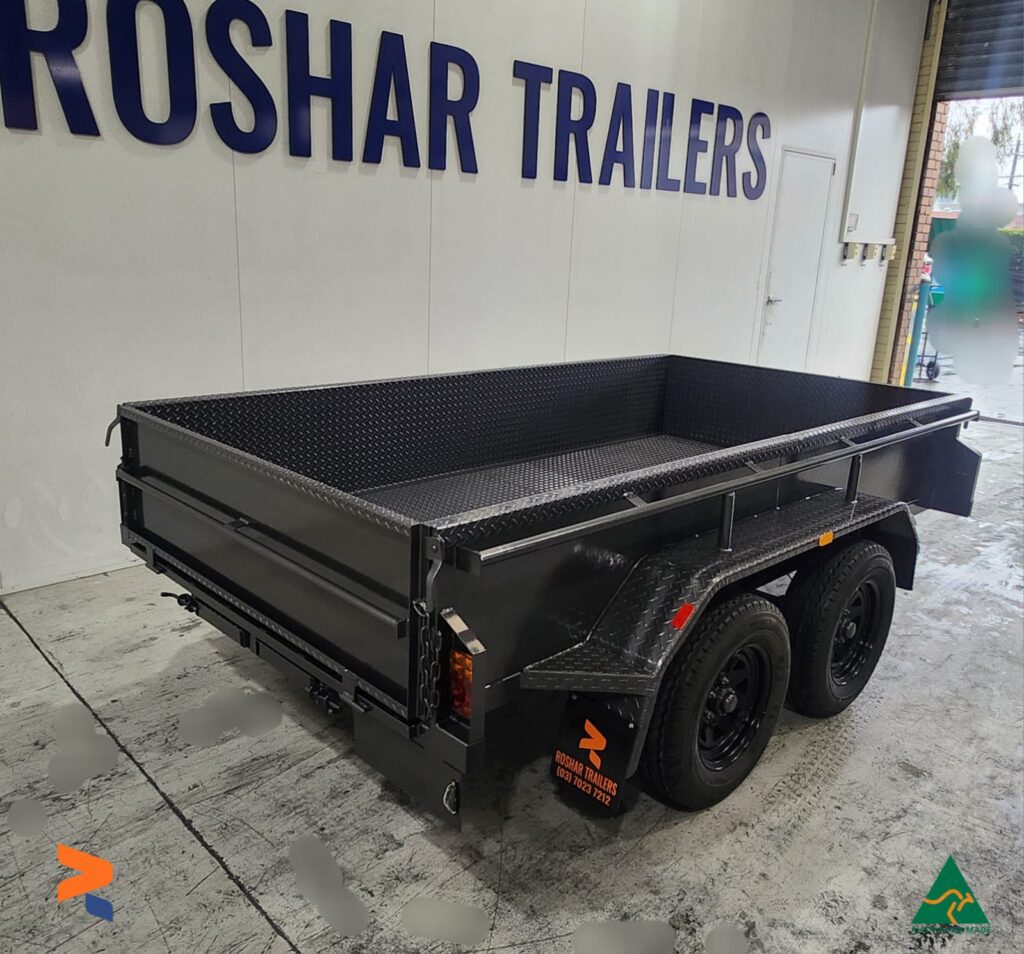
For rural buyers, tandem trailers can make sense when the load changes often. A farmer may carry feed bags one day, fencing materials the next and equipment parts later in the week. The extra carrying platform and configuration options can be useful when the trailer is part of regular property work.
Tandem trailers are not automatically the answer for every farm. They cost more, have more tyres and running gear, and need enough space to turn and park. If your loads are genuinely light and occasional, a smaller trailer may be easier to handle.
Tandem trailer buying checks
- Confirm loaded weight before choosing: the trailer must suit the real payload, not the empty trailer size.
- Check towing vehicle capacity: the ute, towbar, coupling and trailer rating all need to work together.
- Compare brake requirements: heavier rural loads need braking that suits GTM and road conditions.
- Look at floor and side options: fencing, tools, feed and waste all need different containment.
- Inspect tie-down access: rural loads often shift shape, so flexible restraint points matter.
When are flat top trailers better for rural properties?
Flat top trailers are better when farmers need open loading access for machinery, pallets, hay, tanks, pumps, fencing supplies, building materials or awkward loads. They suit rural work where side, rear or forklift loading is more important than fixed high sides.
Roshar describes flat top trailers as open-deck trailers used for machinery, pallets, building materials, equipment and oversized loads, with loading access from the sides, rear and top. Roshar also notes that flat top trailers can be built in different sizes, GVM options, floor types and configurations.
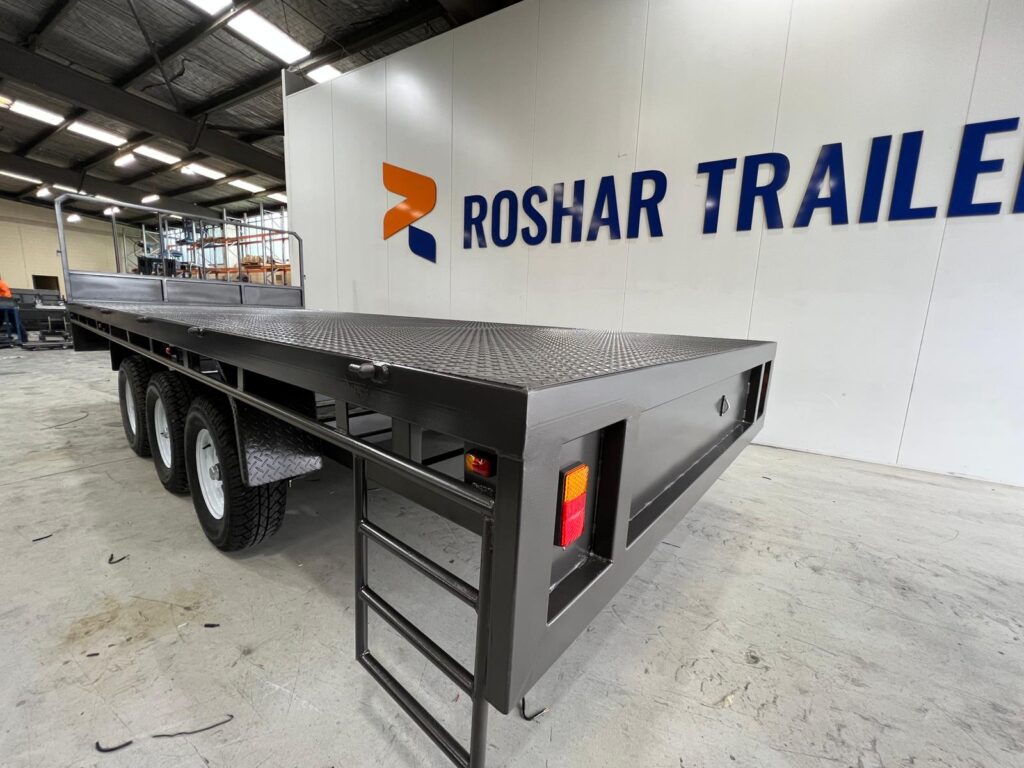
For rural buyers, flat top trailers are especially useful when the load does not fit neatly inside a box trailer. Long fencing strainers, pumps, tanks, hay, pallets and steel can be easier to load when nothing blocks side access.
The trade-off is load containment. A flat top trailer gives flexibility, but it also puts more responsibility on tie-down points, headboards, racks, chocks, straps, chains and load placement. If you carry loose waste or small items, a cage or tipper may be safer and faster.
Best farm uses for flat top trailers
- carrying fencing posts, timber, pipes and steel
- moving pumps, generators, tanks and irrigation equipment
- transporting pallets of supplies or feed
- carrying machinery attachments and implements
- loading with a forklift, loader or from the side
- moving irregular loads that do not fit a box trailer
When do farmers need plant or machinery trailers?
Farmers need plant or machinery trailers when the load has wheels, tracks, high point loads or specific ramp requirements. Compact tractors, mini loaders, excavators, rollers, slashers and attachments need more than a general-purpose trailer with basic tie-downs.
Roshar’s plant trailer page says plant trailers are designed for mini loaders, compact excavators, Dingo machines, Kanga loaders, landscaping equipment and construction machinery across Melbourne and Victoria. It also notes that these trailers suit contractors, landscapers, builders, earthmoving operators and trade professionals needing reliable equipment transport.
For rural properties, plant trailers are useful when you need to move compact machinery between paddocks, blocks, jobsites or service locations. The key checks are equipment weight, equipment width, ramp angle, deck strength, brake setup and tie-down layout.
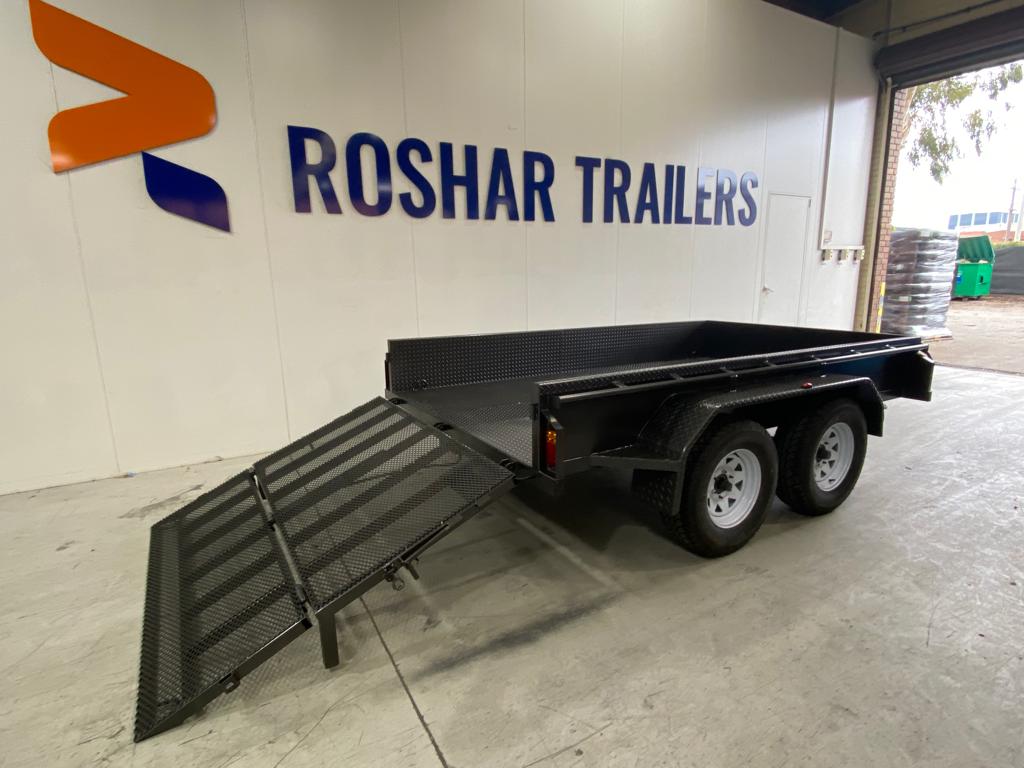
Roshar’s machinery trailer page says its machinery trailers are used across earthmoving, excavation, construction, landscaping, agriculture, machinery rental, trades and civil work. For heavier or more specialised equipment, machinery trailers should be compared around the machine, not just the tray.
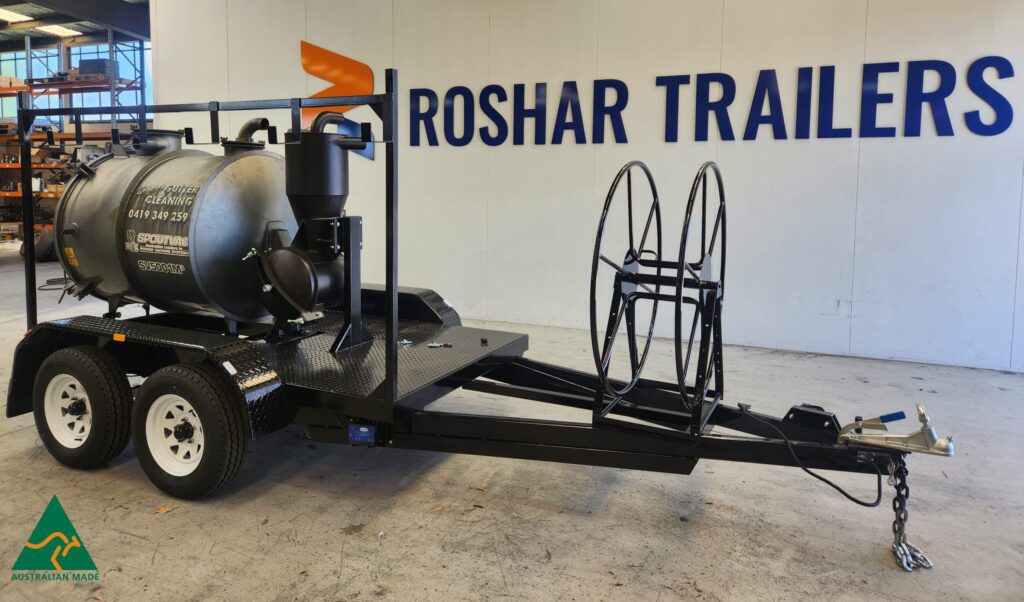
Plant and machinery trailer checklist
| Check | Why it matters |
| Machine operating weight | The trailer must handle the machine plus fuel, buckets, attachments and gear |
| Machine width and track type | Deck width, guards and ramp spacing must suit the equipment |
| Ramp angle | Too steep can make loading unsafe, especially with tracked equipment |
| Tie-down points | Machinery needs restraint points in the right positions, not just any hook |
| Brake setup | Heavier loads need braking that suits the loaded trailer |
| Ground clearance | Farm tracks, gates, driveways and paddock access can affect trailer choice |
| Floor type | Checker plate, mesh or reinforced floors suit different equipment types |
What farm trailer features matter before buying?
The most important farm trailer features are payload, tare, ATM, GTM, axle setup, brakes, tyres, suspension, drawbar, coupling, ramps, tie-down points, floor material, side height, cage, toolbox storage and corrosion resistance for rural conditions.
A farm trailer works harder than many casual-use trailers. It may sit outside, travel on gravel, carry wet or dirty loads, cross uneven access points and handle irregular items. Small details like latch strength, wiring protection and spare wheel placement become important over time.
According to the Department of Infrastructure, trailers with an aggregate trailer mass of 4.5 tonnes or less are expected to comply with applicable Australian Design Rules. That matters because farm buyers should treat compliance, braking, lighting, tyres and mechanical connection details as buying factors, not afterthoughts.
Source: Vehicle Standards Bulletin 1 trailers with ATM of 4.5 tonnes or less
Farm trailer feature table
| Feature | What to ask | Practical reason |
| ATM and payload | What can it legally carry after tare is counted? | Avoids buying a trailer that is too small for real loads |
| GTM | What load sits on the trailer wheels when coupled? | Helps match axles, tyres and braking |
| Brakes | What brake system suits the load? | Rural roads, hills and heavy loads need control |
| Tyres | What load rating and tread pattern are fitted? | Gravel, heat and weight punish weak tyres |
| Ramps | Are they rated and positioned for your machine? | Safer loading for mowers, loaders and equipment |
| Tie-down points | Are they placed for your usual load? | Prevents unsafe strapping shortcuts |
| Floor | Checker plate, mesh, timber or custom floor? | Different loads need different grip, drainage and strength |
| Cage or racks | Fixed, removable or custom? | Helps with loose waste, fencing and bulky materials |
| Finish | Paint, galvanised or other coating? | Outdoor storage and wet loads affect corrosion risk |
How should farmers load and secure rural trailer loads?
Farmers should load heavy items low, centred and slightly forward, then restrain the load so it cannot slide, bounce, lift, spill or affect steering. Rural loads are often mixed, so restraint must suit each item, not just the top layer.
According to the National Transport Commission’s Load Restraint Guide for Light Vehicles, you must restrain a load so it stays on the vehicle during normal driving conditions, including heavy braking, cornering, acceleration and minor collisions.
Source: National Transport Commission Load Restraint Guide for Light Vehicles
The NTC guide also supports the broader rule that loads must be properly restrained, must not overhang dangerously, must not exceed mass limits, and must not cover lights, indicators, reflectors or number plates.
According to Transport Victoria, loads should be positioned so they are stable and evenly distributed across the vehicle or trailer, similar items should be bundled together, and heavy items should be placed underneath lighter items.
Source: Transport Victoria Securing loads on vehicles and trailers
That matters on farms because loads are rarely neat. A single trip may include star pickets, wire, a water drum, a chainsaw, tools and loose rubbish. Each item moves differently. One strap over the top may not stop smaller objects sliding, bouncing or rubbing through.
Rural load restraint process
- Separate the load by shape and weight: heavy items, long items, sharp items and loose items need different restraint.
- Place heavy gear low and forward: this helps trailer stability and reduces bounce.
- Bundle long materials tightly: fencing posts, pipes and timber should act like one stable unit.
- Use rated straps or chains where needed: machinery and heavy equipment need stronger restraint than light waste.
- Fill gaps between items: empty gaps allow load movement during braking or cornering.
- Protect straps from sharp edges: wire, steel and farm equipment can cut restraint gear.
- Check after the first short drive: rural roads and corrugations can loosen a load quickly.
- Cover loose material: mulch, feed, rubbish and soil should not blow out on public roads.
When should a farmer choose a custom trailer build?
Choose a custom trailer when standard sizes do not suit your load, access, storage, ramp angle, tie-down layout or farm workflow. Customisation is most valuable when the trailer will be used weekly and downtime would affect work.
A standard trailer can work well when the job is simple and repeatable. A custom build becomes more useful when the trailer needs to carry mixed rural loads, fit specific machinery, support long materials, include tool storage or manage repeated loading and unloading.
This is where rural buyers should think beyond tray size. A farmer may need removable racks for hay, extra tie-downs for pumps, a toolbox for fencing gear, longer ramps for a mower, a reinforced floor for point loads, or a tandem setup for repeated heavy carrying.
Custom farm trailer decision table
| You need | Standard trailer may work when | Custom trailer is better when |
| Fencing and posts | Loads are short and occasional | You need racks, long-load support and tool storage |
| Machinery loading | Equipment is light and ramp angle is simple | Machine weight, width or ramp position is specific |
| Water tanks and pumps | Loads are small and easy to tie down | You need load stops, brackets or repeatable placement |
| Rural maintenance | Jobs are simple and local | One trailer must handle many mixed property jobs |
| Business use | Trailer is occasional backup | Trailer earns income or supports daily work |
| Rough access | Roads are sealed and flat | Farm tracks, slopes or gravel are common |
Conclusion
The best trailers for farmers are not chosen by size alone. They are chosen by the load, the towing vehicle, the road, the paddock access, the unloading method and the way the trailer will be used every week.
For Victorian farmers and rural property owners, Roshar Trailers can help compare tandem, plant, flat top, machinery, tipper, cage and custom trailer options for real farm use. Start with your heaviest regular load, then choose the build around the work.
Faq’s
Can one trailer handle both farm and road use?
Yes, but only if it is correctly rated, roadworthy and built for both environments. Paddock use can demand clearance and durability, while public-road use needs legal lighting, tyres, brakes, registration suitability and secure loads. Check state rules before assuming farm use automatically covers road use.
Do farm trailers need brakes?
Yes, if the loaded trailer weight reaches the braking threshold set by the relevant road rules and trailer specifications. Even when brakes are not legally required for a lighter trailer, rural buyers should consider braking control if they regularly tow on hills, gravel, wet roads or with heavy loads.
Should farmers buy a new or used trailer?
Used can work if the trailer is straight, roadworthy, correctly rated and suited to the load. Check the compliance plate, chassis, welds, rust, tyres, brakes, floor, coupling and lights carefully. A cheap used trailer needing major repairs may cost more than a better new build.
What size trailer is best for a small rural property?
The best size depends on your regular load, not the property size. A small acreage may only need a box or cage trailer, while another may need a tandem, tipper or plant trailer for machinery. List your heaviest and most awkward loads before comparing sizes.
Can a flat top trailer carry hay or fencing materials?
Yes, flat top trailers can suit hay, fencing materials, pipes, timber, pumps and tanks because they allow open access from multiple sides. The key is restraint. Use proper tie-downs, racks, load stops or headboards so long or bulky items cannot slide, lift or roll.
What should farmers ask before ordering a custom trailer?
Ask about payload, ATM, GTM, brakes, tyres, ramp rating, floor type, tie-down layout, corrosion protection, warranty, spare parts and delivery timeframe. Also describe your towing vehicle, property access, regular loads and unloading method so the trailer is designed around real farm use.